As promised, brace yourself for some history! I’m sure most Armenians would never admit it, but Georgia and Armenia have had somewhat similar historical experiences and are similar culturally. Both countries declared Christianity the state religion in the early 4th century, though any Armenian will quickly tell you that Armenia was first in 301 AD. Georgia followed not long after in 337 AD. Predictably, the populations today are majority Christian, though it would be interesting to know how religiously active people in Georgia are. In Armenia, practically everyone will say that they’re Christian and practically no one regularly attends church. I imagine a lot of that has to do with the 70 secular years of the Soviet Union which would mean that you’d expect Georgia to be in a similar situation. I don’t know if that’s true or not, though.

As usual, I’m getting ahead of myself… I could go into detail about the years between the beginning of the world and modern times, but that could take all day. Let me focus on the highlights.

The oldest wine jars in the world were found in Georgia. This is apparently a commonly ignored fact by the people who insist that Armenians invented wine because the world’s oldest winery was found in Armenia. The wine jars are around 2,000 years older, but I’m sure that any good Armenian would quickly recover and maintain their claims by telling you that either 1. wherever those jars were found used to be Armenia, 2. whoever made the wine was definitely Armenian and the Georgians just bought some because it was so good, or 3. the Georgians were jealous, so they fabricated history and the jars are a lie.
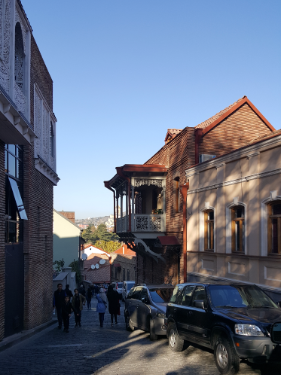
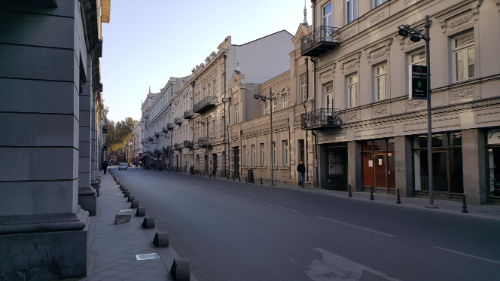
Random Tbilisi street with more of those classic balconies (similar to ones you’ll see in Armenia)
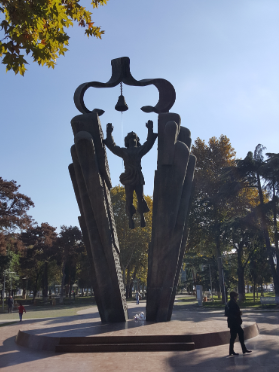
This is the “Mother Language Monument”. During Soviet times, Russian was imposed as the official language in all Soviet republics. Georgians protested, and as a result, they were allowed to continue with Georgian as their official language. The story in Armenia is pretty much exactly the same with the Armenian language.

Throughout history, both countries spent a considerable amount of time getting conquered and reconquered by different empires and dynasties. They each had their golden ages when they were on top, and those were both short-lived. For a while, the Byzantine Empire and then Ottoman Turkey controlled both western Georgia and Western Armenia. Eastern Armenia and eastern Georgia were under the rule of the Persians and later the Russian Empire. The Russian Empire managed to win back many of the Ottoman-controlled regions of Georgia, reuniting the country. Western Armenia, on the other hand, remained under Ottoman rule. (Side note: this long period of being ruled by different empires is much of the reason for the linguistic and cultural differences between Western Armenians – most of the Diaspora – and Eastern Armenians – most of the people in modern-day Armenia.)

In 1918 at the end of World War I, both Armenia and Georgia set up their first republics and swiftly got into a border conflict with one another. It seems like every single one of these stories has the same plot line. Two countries. One believes that the land should be allocated based on historical claims or majority populations. The other believes that the land should be allocated based on a random line drawn by some random, powerful country. You can probably guess that each chooses its stance based on which is most beneficial to them. They fought for about a month until the British got involved, and the border landed where it is now with part of the disputed territory in each country.

Both countries had short-lived independence as they got sucked into the Soviet Union in 1921. They were combined with Azerbaijan to form the “Transcaucasian Socialist Federative Soviet Republic” until it was re-split into those three parts in 1936. After 70 years as part of the Soviet Union, Armenia and Georgia became independent again in 1991 and formed their second republics.

Now, Georgia is an important trade partner for Armenia because the Armenia-Georgia border is the largest open border that Armenia has left (since the west and east borders with Turkey and Azerbaijan are closed due to the ongoing conflict with Azerbaijan in Karabakh). However, Armenia is allied with Russia and is on bad terms with Turkey and Azerbaijan. Georgia is having its own territory issues because two of its regions have declared independence, supported by Russia, and Georgia refuses to recognize them. So, Georgia and Russia are on bad terms, and Georgia is allied with Turkey and Azerbaijan.

Does your head hurt? My head hurts. You don’t even know how much I left out, but just say thank you. The Armenian/Georgian relationship is fragile at best, but the Armenian government at least isn’t going to do anything to mess it up. It hasn’t recognized either of Georgia’s “independent” regions, but that’s not surprising because it also hasn’t recognized Karabakh/Artsakh as independent even though the Armenian military is physically involved in that conflict. I think Armenia’s international stance is “we really can’t afford to get on anyone else’s bad side so let’s be as diplomatic as we can about everything and not make anyone mad”.
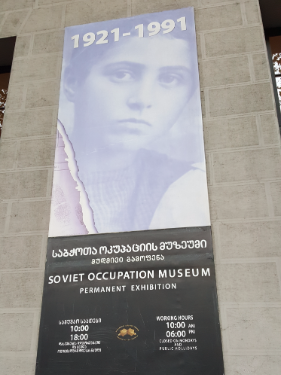
I thought this poster was interesting because of how the museum is clearly portraying the Soviet years. Even without seeing the exhibit, you can tell that it’s all going to be very negative. In Armenia, on the other hand, it doesn’t seem like most people look back on the Soviet years with such negative feelings.
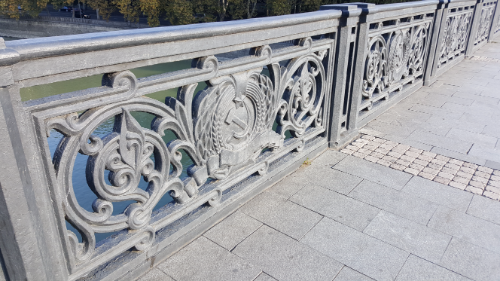
On one of the bridges in Tbilisi.. See the hammer and sickle in the middle? I guess there’s some limit to the Georgian determination to erase the memory of Soviet years… or maybe they just haven’t gotten to this bridge yet.

Okay, so there you go! Some mind-numbing historical background. I guess my point was to show that the two countries have kind of been living parallel histories, and it’s interesting to see how they’ve reacted in similar ways to some things and in very different ways to others.

I’ll get into fun sightseeing stuff in the next post. No more long history, I promise! (Short history though… there will likely be some short history.)
Adventures on adventures! One of my friends asked a few weeks ago if I wanted to go to Georgia for a weekend, and of course I said yes! That’s Georgia the country, to be clear. It only takes about 5 hours (theoretically) to get to the capital, Tbilisi, by car from Yerevan, and most people go there when they need to renew their passport stamps because it’s the easiest open border to get to.

Someone knew a driver and got in touch with him to organize rides to Tbilisi on Friday after work and back to Yerevan Sunday night. He asked if we could also take a woman to a village along the way, we agreed, and he subtracted her fare from our total. The drive started out okay. I mean, traffic was terrible getting out of Yerevan, but what do you expect when you leave at rush hour?

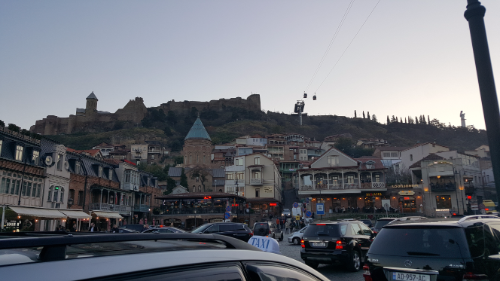
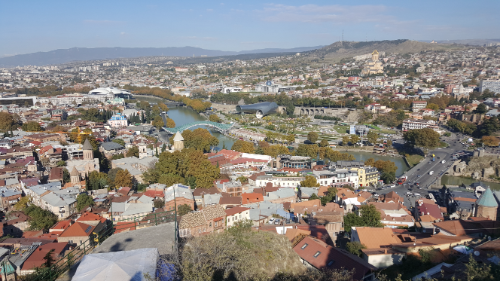
Here are some random Tbilisi views for your enjoyment. This is from one of the hills that overlooks the city.

This also was my first experience getting a gas refill in a car that runs on natural gas. I guess I never had to think about it before because I rarely even go to gas stations here. In hindsight, I realize that I’ve been in taxis with huge gas tanks in the trunk, and while I didn’t think twice about it at the time, those were probably natural gas-powered cars as well.

Armenia is apparently one of the biggest users in the world of natural gas-powered vehicles. I think it’s mostly just because it’s cheaper than gasoline, but it’s also kind of a pain. When you stop to fill the car, everyone has to get out and wait in a “safe zone” in case the car blows up. No big deal. As they say, as long as everything is installed correctly, it’s not dangerous… which is exactly my concern. I had a conversation with someone about this who said, “Oh they’re very safe. I’ve only seen a car blow up once.” Oh, well then! You’re right. No big deal. Know how many times I’ve seen a car blow up? Zero, and it would be nice to keep it that way.

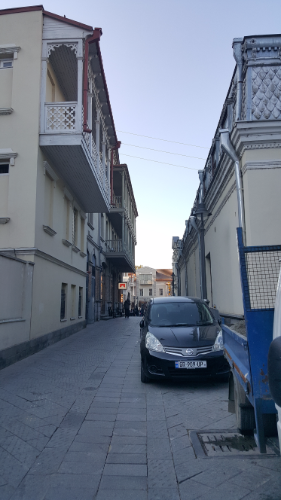
A Tbilisi street

Anyway, the stops to get gas took a bit longer than anticipated, and then, just as we dropped the extra woman off, we got a flat tire. Wonderful. As the woman is hopping out of the car (knowing full well that we have a flat), she gives a jolly, “Bari djanapar!” (have a good journey) and shuts the door behind her. My jaw dropped, and I literally gave a laugh of disbelief and a “she’s joking, right???” Who does that? “Oh, that’s too bad that you all have a flat, but here I am at my destination! How wonderful! Have a great journey!” Thanks a lot, lady.

I don’t know if the picture properly communicates the feeling, but this place looked like something out of a movie with elves in it. Something about the styles of the buildings and the colors and the way they’re all arranged on the hill… I don’t know. It was like something out of a fantasy movie.

The joke was on her though because in classic Armenia fashion, despite the fact that it was the middle of the night, we were invited to wait inside her friend’s house until the tire was changed. I guess it was someone’s birthday because cake was involved, plus the usual offers of coffee, tea, water, or anything else you could possibly want.

Finally, we set off again on the final stretch before the border. There’s nothing more fun than an 11PM border crossing! First, we got to the Armenian border. We all had to pile out of the car and walk through passport control while the driver went across with the car. Then, we piled back in, drove through what I assume is some sort of no-man’s land, and piled back out again at the Georgia border. We walked through passport control with our bags and met the driver again on the other side. Now I have passport stamps galore! From there, it was maybe an hour before we got to Tbilisi.

You know how long the whole thing took us? SEVEN HOURS. Instead of five. SEVEN. We got in after midnight, and I immediately passed out. I figured the sooner I slept, the earlier I could wake up and start exploring!

I think this is going to turn into a little Georgia weekend mini-series… I’m cutting part one off here because I don’t want to make your head explode. We’ll take it in small pieces instead, so stay tuned for a mini-Georgian/Armenian parallel history lesson.

These balconies used to be popular in Armenia as well, but they’re kind of a dying breed (mostly because of the destruction of historic Yerevan and the lack of maintenance).