Things we all know about Lara:
Lara loves rocks.
Lara loves caves and other enclosed spaces.
Lara loves climbing things.
Lara loves pretty views.

These are four very basic Lara facts. These four facts also make Lara sound like she might be four years old, but that’s not the point. The point is that, while travelling southern Armenia, Lara finally found the place where she belongs. That place is, quite unfortunately, a deserted cave village, but we don’t need to dwell on the little, insignificant details like “deserted”. That just means there’s more room for me!

Where is this magical, mystical place? Khndzoresk, aka the future site of Larkzoresk. The village is only a 40-minute drive or so from Goris where I was staying for a few nights with my new friend Mary, and she connected me with a guide, Ara, who grew up in new Khndzoresk. I know, I’m getting ahead of myself again. Typical.
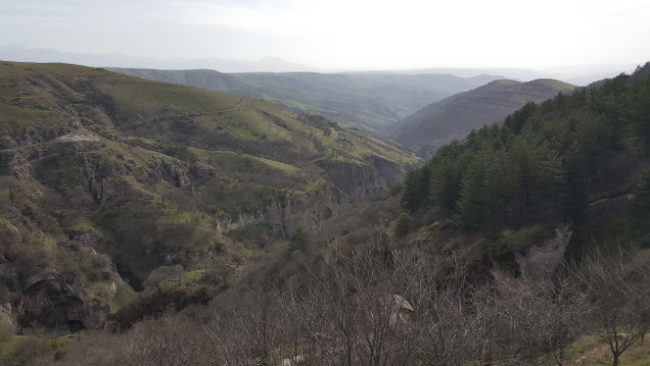
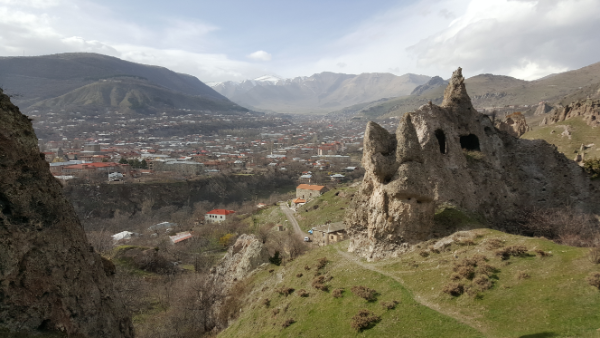
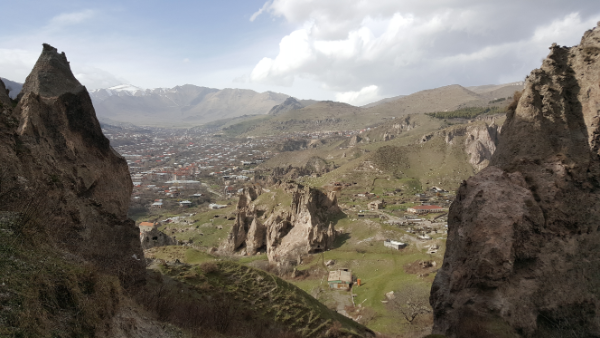
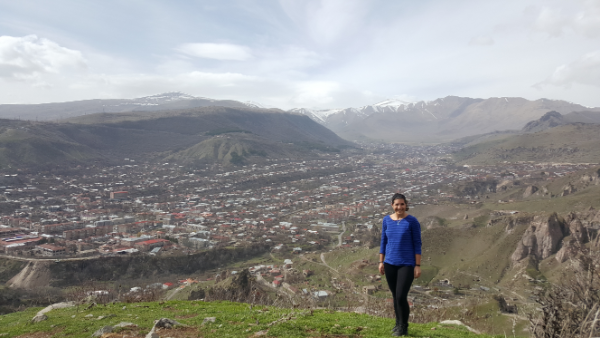
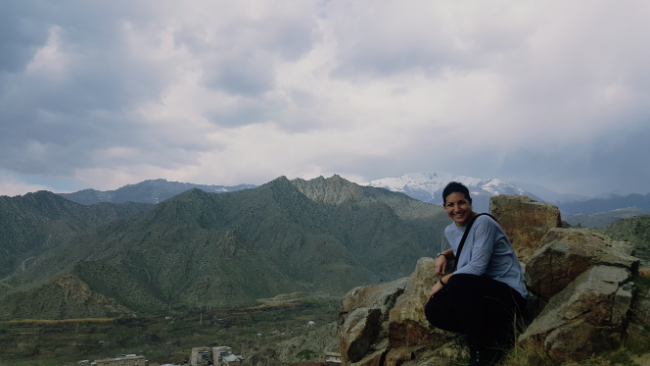
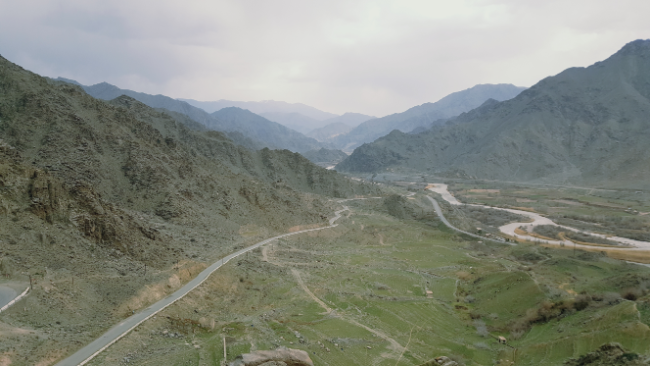
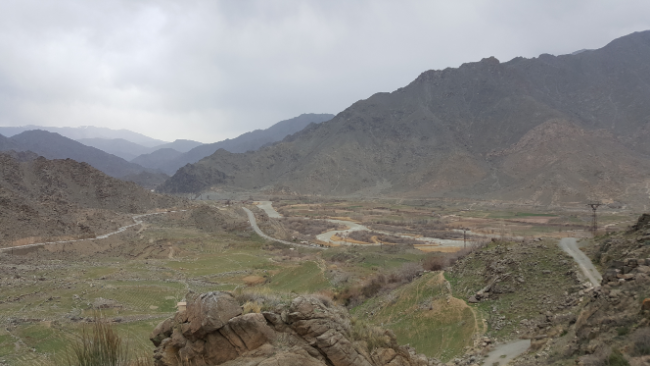
Looking down the gorge. The land in the distance is Artsakh/formerly Azerbaijan-controlled land

Khndzoreskis a village in the eastern part of Armenia, right on the border of what is now Artsakh. One name-origin theory is that “Khndzoresk” comes from the words “Khor Dzor”, meaning “deep gorge” in Armenian. At the beginning of the war with Azerbaijan, the village was so close to the fighting that some of the shepherds who lived there were kidnapped and killed. Anyway, the village has been occupied since ancient times, and until the end of the 1800s, Khndzoresk was the most populated village in eastern Armenia! At its height, there were around 24,000 people living there (though who knows how accurate that number is… that’s what I was told, but it seems like something that probably everyone has a different answer for). The thing that makes it so interesting is that it was a cave city… until the 1950s!
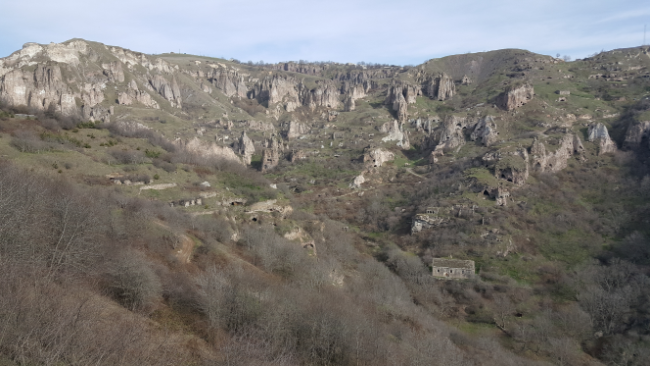
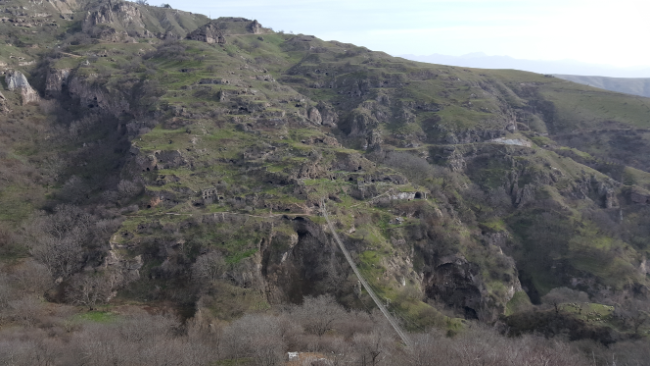
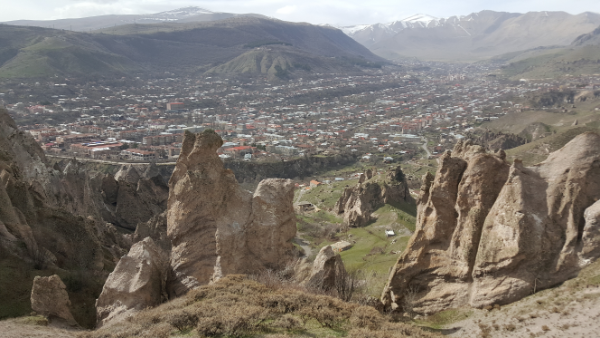
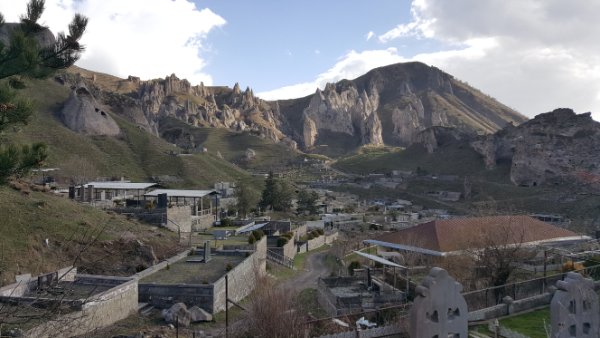
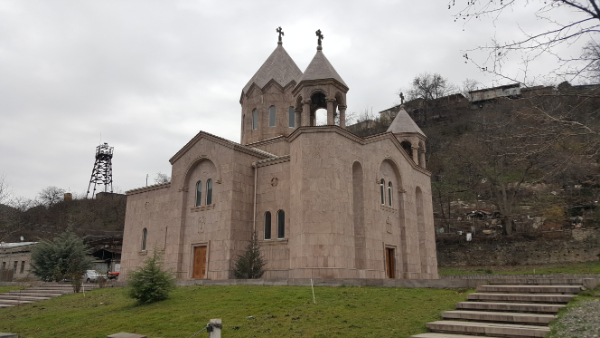
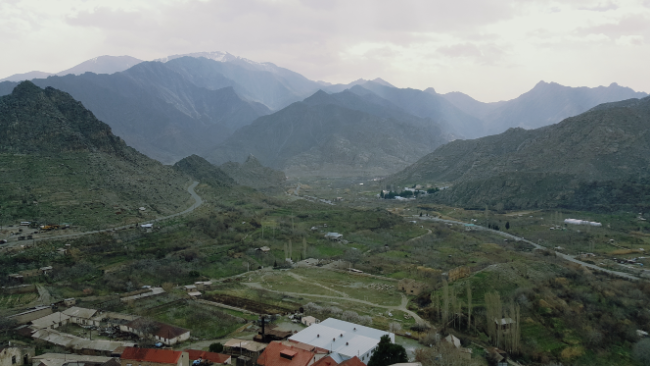
View of the city. It has those same weird rock formations as Goris! You can also see one of the churches, Surp Hripsime, in the bottomish right.
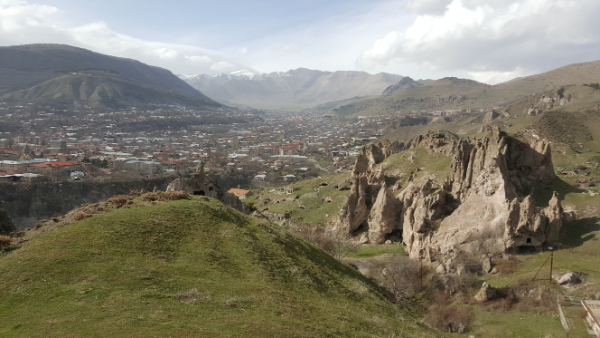
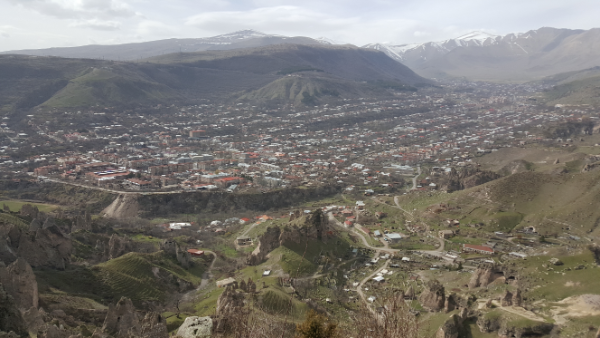
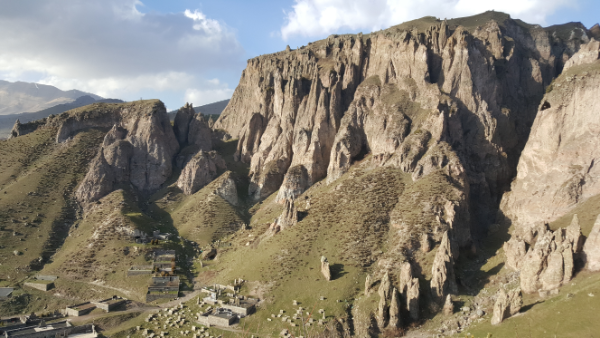
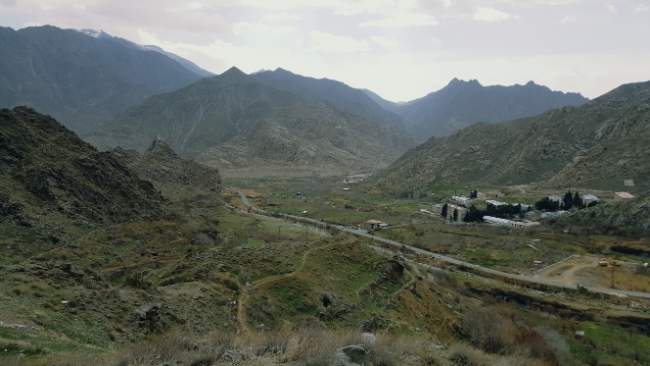
The village… mostly just looks like a cliff from this far away haha
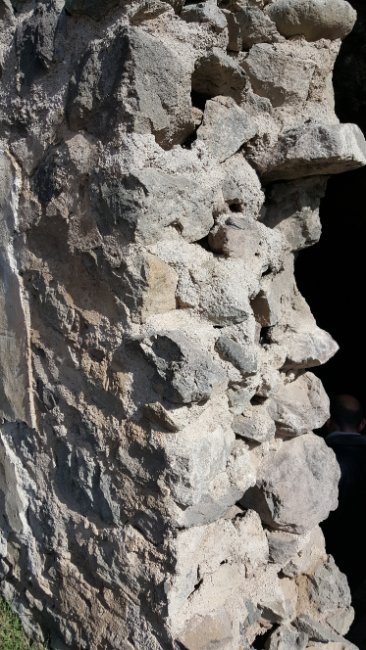
Fake concrete

It’s made up of both natural and man-made caves situated in the cliffs along a gorge. Many of the houses had a cave in the back and then a structure built in front of it, and the roof of one house created the floor for the next. Ara explained that there were three different kinds of caves: houses, stables, and safe houses. The houses had the highest ceilings and often consisted of multiple rooms. They had holes in the ground for cooking and for storing grain. Chimneys were carved out to allow smoke to escape. If someone had a two-story structure as the front part of their house, it meant they were rich because it was expensive to build like that. The house structures were built out of stones, and they didn’t use concrete. Instead, some used just clay/mud, and others used a mix of clay, eggs, and water.
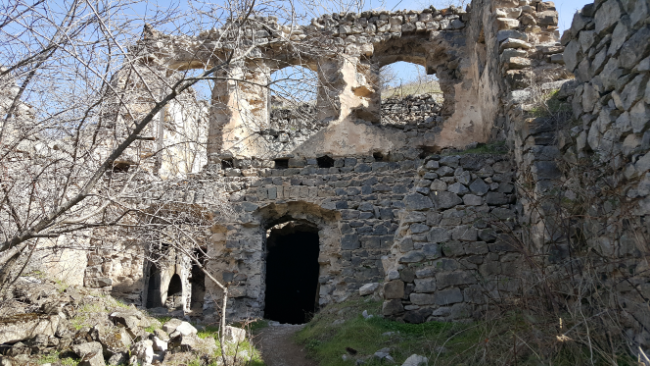
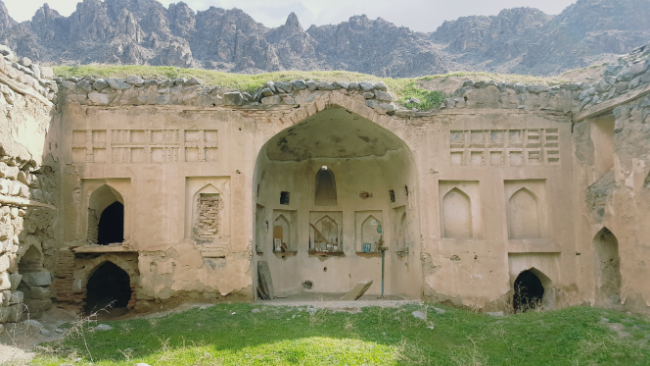
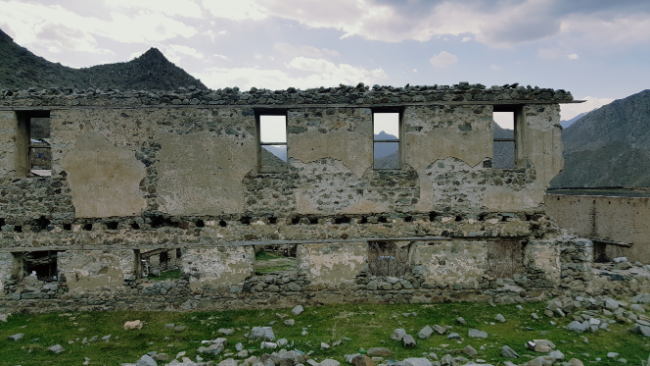
Remains of a two-story rich person house
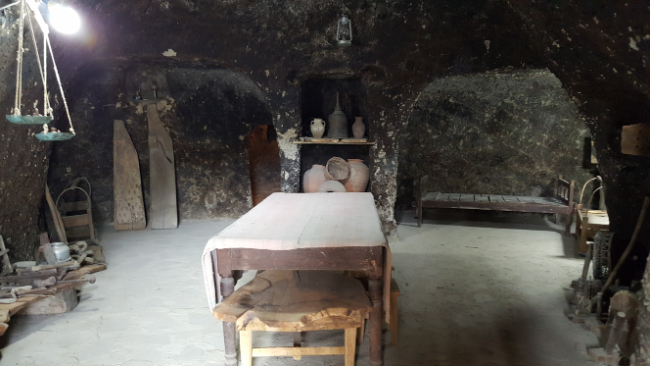
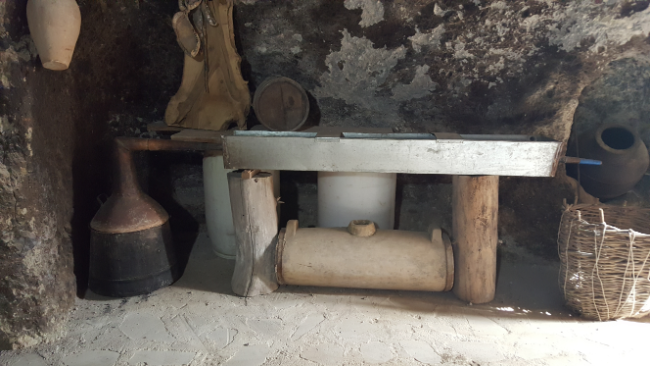
They have a little museum with a sample cave home that’s filled with things they found in the actual village. You can make alcohol with this thing. Pretty sure Ara said that he has the same thing at home now.
Cave living room. In the back left and right, there are two more little rooms that served as bedrooms.
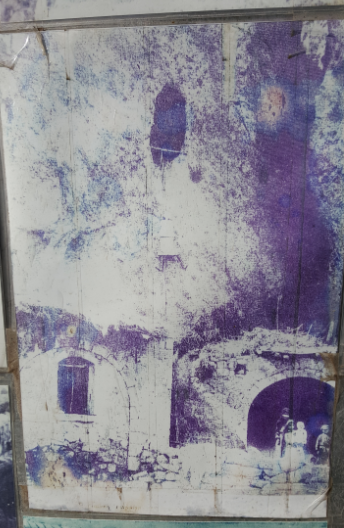
A picture of a woman climbing up into one of the safe caves

The stables had lower ceilings and didn’t have any additional construction in front. The safe caves were located high up in the cliffs. They could only be accessed by ropes which were supported by pieces of wood set across the cave entrances. In times of danger, the women and children would climb up and pull the ropes in to prevent invaders from reaching them. (Questions about this… did the women and children train for this?? It’s not like it’s easy to climb a rope into a cave! And I assume that a lot of the kids had to get carried up which means that the women must have been incredibly fit. Though I assume that everyone in the village was fit because you had to climb to get practically anywhere. Okay, I’ll stop. I just think the whole thing is kind of marvelous.)
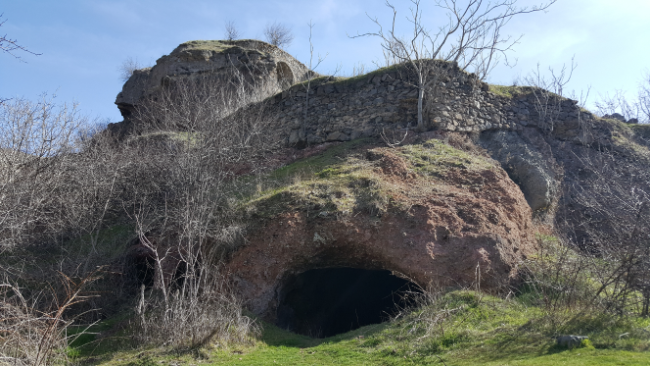
Stable caves

There are four churches in town. The oldest is in a cave and dates back to 305AD! That’s impressive because Armenia adopted Christianity only four years earlier in 301AD. There were also schools, shops, businesses, springs for fresh water… it was a town, so there was everything a town needs. Ara’s father was born in old Khndzoresk, but in the 1950s, the Soviet leadership decided that the town should be moved to the flat land above. I asked why, and he said that it was closer to the existing infrastructure and people’s gardens (they were already on the flat ground). Most people moved out in the 1950s and 1960s, but the last family didn’t leave until 1974!
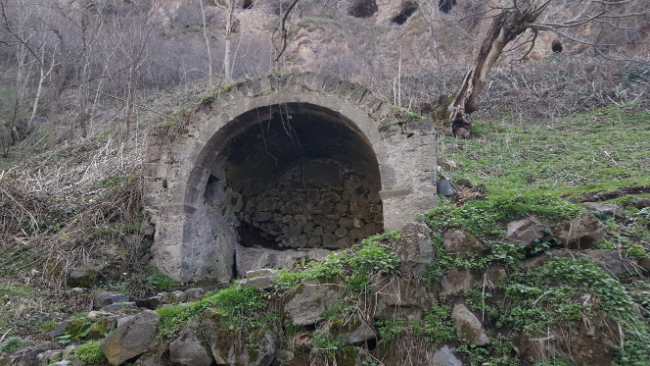
One of the many springs in town. I think this is the one that has a weird legend behind it. Back during one of the times when the village was under attack, the women fought alongside the men. One woman, Sona, was a widow with nine kids. She was killed in battle, and her father built this spring to honor her.
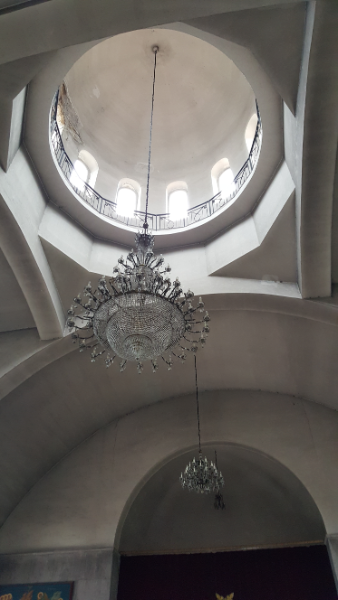
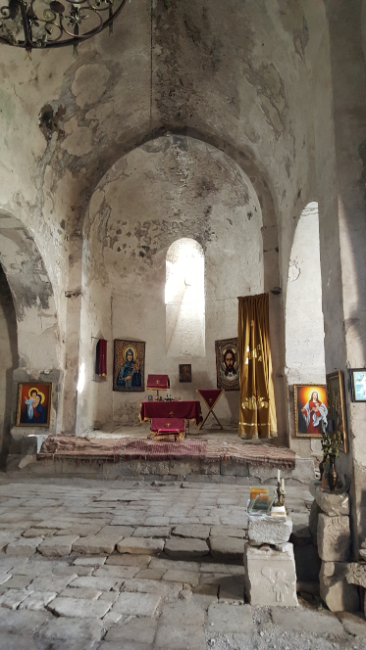
Inside Surp Hripsime

After the exodus, the cave town fell into disrepair. Ara said that he used to play in the caves with his friends growing up. He can still point out where his grandparents’ cave was, though it’s now overgrown by plants and inaccessible. The town also is kind of in ruins because when people moved, they took the stones from their cave houses to use in their new ones. Now, it’s a government protected area, so people can’t take materials or anything. They’re slowly cleaning up and restoring different parts of the town, such as one of the newer churches, Surp Hripsime, that was built in 1665. For a long time, it acted as a stable, so as you can imagine, it was filthy. Now, it’s been cleaned, and there are plans to fix parts of it. It was also cool because there are just random pictures and other documents inside the church. I asked Ara where all of the pictures came from, and he said that when the old town started attracting attention, villagers began bringing pictures and other things that they had laying around that they thought might be of interest.

There have been various improvements made to the old town over time. Ara explained that there’s a kind of unspoken rule that if you move out of the town and make a lot of money, you come back and build something. He said that some of those changes are good, but each one makes the town less authentic. I completely understand what he means… you want people to be able to access and see this awesome place, but you don’t want those changes to take away from its history and personality.

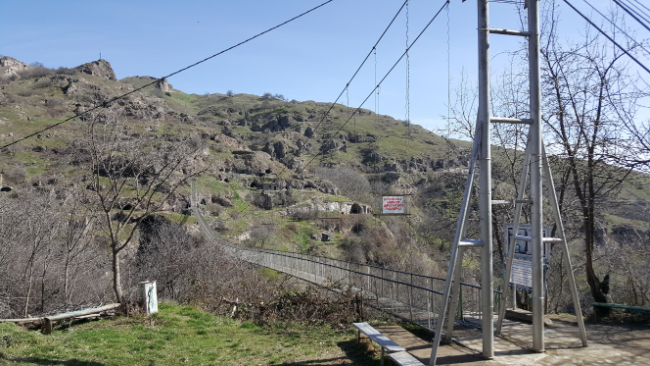
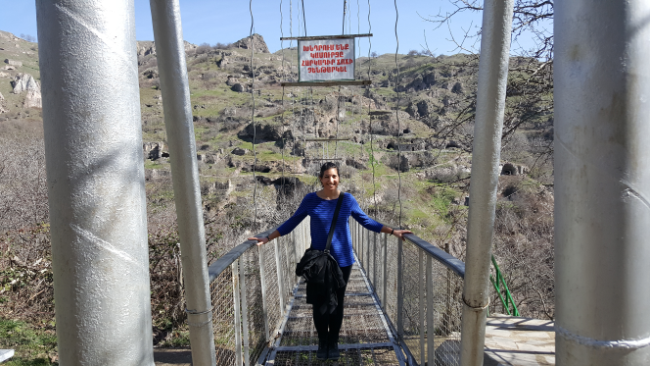
So far, the improvements have included a lookout point, stairs down into the gorge, paved paths leading to some of the sights, and a suspension bridge across the gorge. Supposedly there are plans to build a cable car down from the new town, but that seems like overkill to me. He told a story about the bridge, which looks somewhat terrifying, and said that it was built by hand by three guys: the one who was financing it, plus two others from the village. They didn’t have an engineer or anyone with bridge knowledge helping them, and when it was completed, someone complained to the government saying that it might not be safe. In response, the government sent out some engineers to evaluate the bridge, and they determined that it was strong enough to hold 500 people at once. As usual, who knows how true any of these stories are, but that’s all part of the fun.
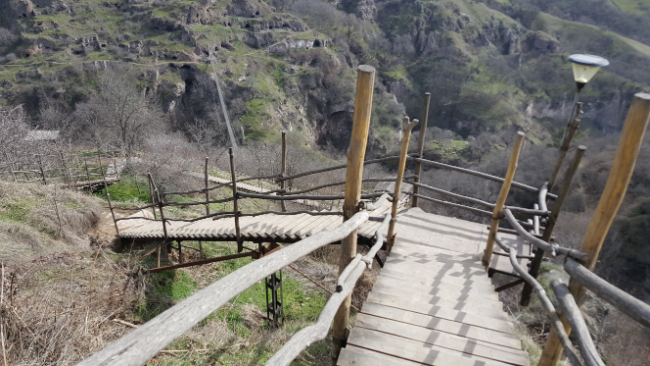
Stairs into the gorge
Me on the questionably-500-person-capacity bridge
Bridge view
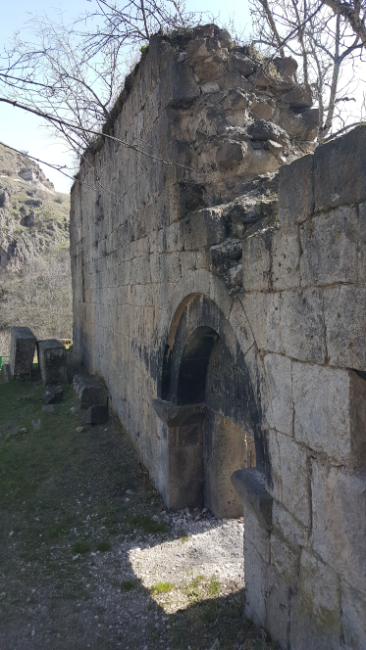
Church ruins near the cemetery

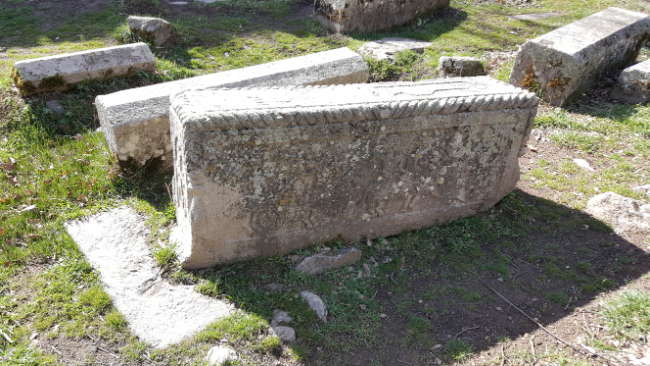
On the opposite side of the gorge from the main part of town, there’s a little area with ruins of a church and school and a cemetery. The cemetery contains the grave of an Armenian war hero, Mkhitar Sparapet, who fought with another hero, David Bek, leading the Armenian liberation efforts against Safavid Iran and the Ottoman Empire in the 18th century. Sparapet had a cave fortress at the top of the gorge. He was eventually murdered by some villagers who wanted him to move his fortifications away from the village because they were worried about what would happen if the enemies found him hiding there. They delivered his head to the Ottoman leader who apparently found their actions despicable and had them killed. Now, Iran still has his head (I have SO MANY questions about this… where have they kept it all these years? Why? In what conditions? I just don’t understand!), but they’ve agreed to give it back (ALSO so many questions about this… I asked what they’re going to do with it, but Ara didn’t know. What are they going to do with it? Bury it with the body? How will this handover occur? In person? By mail? Who will it be delivered to? Does anyone besides me think that this is the weirdest thing? Was that part of some big diplomatic discussion between Armenia and Iran? This whole thing is weird, right??).
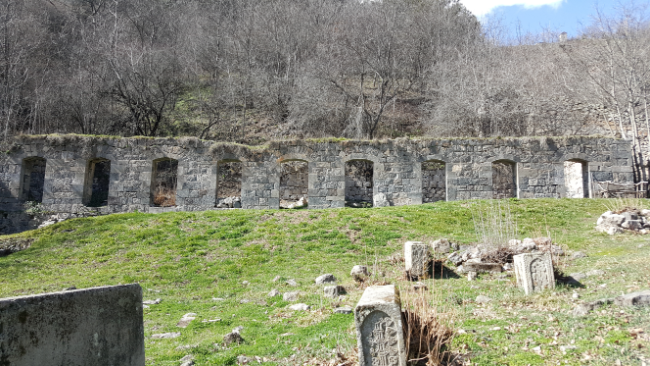
Ruins of the school near the graveyard
Mkhitar’s grave. Ara also showed me where his mistress is buried nearby. Apparently he was quite the stand-up guy (sarcasm).

In the past, if you said the words “cave town” to me, I would have thought it sounded like the kind of thing I’d be interested in. Now that I’ve been to a cave town, that thought has been MORE than confirmed. If anyone out there is trying to start a cave town and needs resident volunteers, count me in!!! I already know exactly how I’d set up my cave.
My southern adventure continued with a relocation from Kapan to Goris. The hotel staff in Kapan spoke no English, so I had to rely on my Armenian skills to figure out how to get there via public transportation. Here’s basically how my conversation with the hotel guy went:

Me: Tomorrow I want to go to Goris. Is there a marshrutka?
Guy: Yes, at 9 and noon.
Me: Do I have to call? (to reserve a seat)
Guy: Yes.
Me: Can YOU call?
Guy: Yes.

I crossed my fingers that I had actually said what I wanted to say, and sure enough, the hotel guy knocked on my door at 8:50, right as I was getting ready to walk out. He walked me out to the street, the marshrutka came, and I was off! Nice.

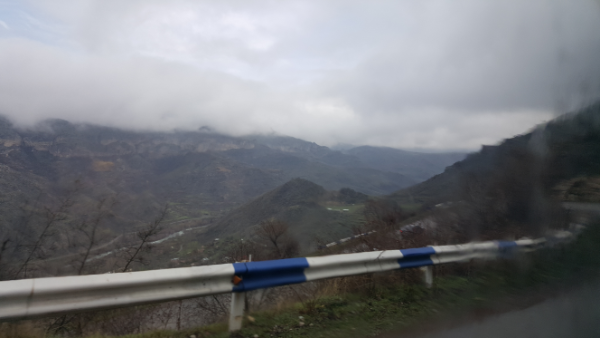
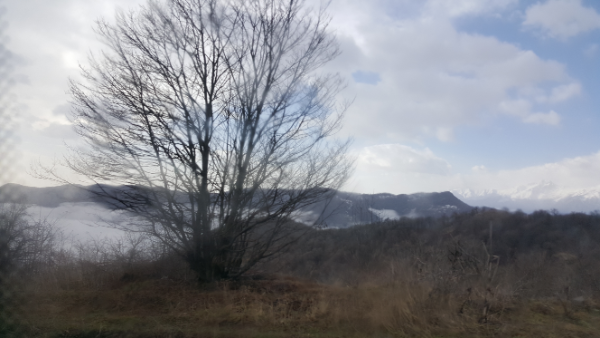
Along the drive from Kapan to Goris. Excuse the fact that they’re blurry… the window was dirty and kept fogging up, so use your imagination.

In Goris, I was staying with one of Kelsey and Olivia’s friends, Mary, who I had never met but has an extra room and was willing to take me in. Cool! She was going to call me when she finished with work for the day, but by chance, we bumped into each other on the street! Goris is a decently big town, so I think that’s impressive. She was walking up the street towards me, I looked at her and thought, “Hmm… she doesn’t fit here,” and I gave her an inquiring look. She apparently thought the same about me and said, “Are you Lara?” So that’s how we met.

Goris is a city (town?) of about 20,000 people. I wasn’t expecting that when I got there. I guess I always think that places are going to be tiny little villages with nothing going on because everyone always acts like there’s nothing happening in the country outside of Yerevan. I was pleasantly surprised! It’s nestled in the mountains, right near the eastern border with Artsakh, so the scenery is stunning. The area has been occupied since at least the 700s BC, and for much of that time, people lived in caves in the weirdly shaped mountains around the town. The caves were inhabited until the 18th century!

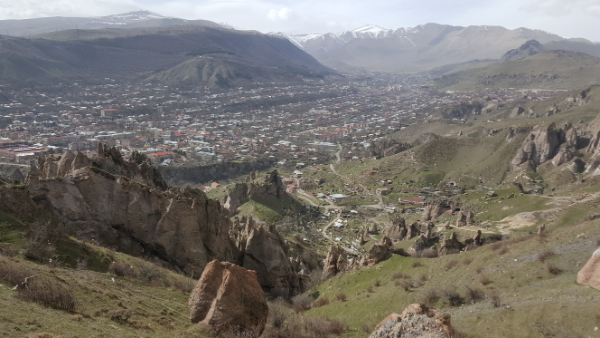
I think one of my favorite things about the south is that in every place I visited, the topography was sooo different. The cities aren’t even that far apart, but they look nothing like each other. In Goris, if you walk around the “Old Goris” area, it’s like you stepped onto another planet. I can’t even begin to describe the rock formations, so check out the pictures to see what I mean.

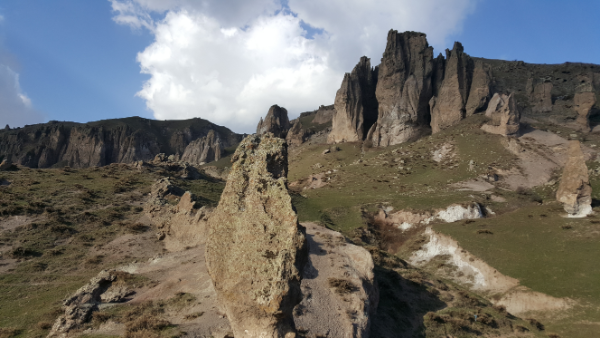
These mountains. Are so weird. But I love them.
Pretty Goris, pretty mountains.

Self timer + rock = pretend photographer

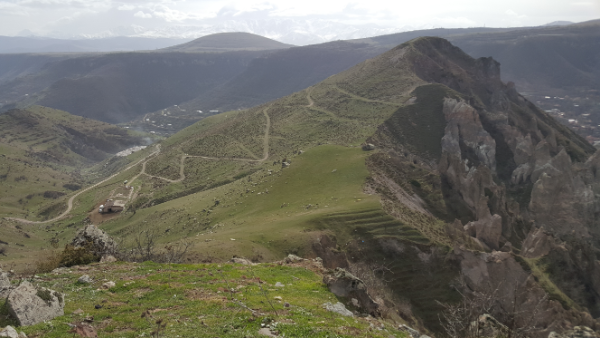
Mary and I walked around Old Goris a bit during the evening after I got into town, and I went on a more intense trek the following day. I tried to follow an actual hike through the mountains, but it was poorly marked and very confusing. Instead, I ended up wandering around on random cow paths that went into some of the strangest places. Oh, well. That was more interesting anyway… at least, I assume it was but couldn’t tell you for sure because I still don’t know where I was supposed to walk.

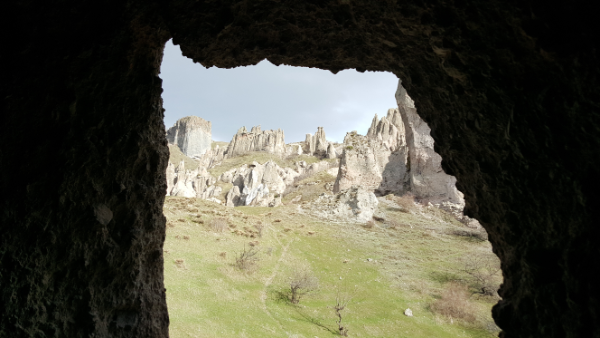
Cave dwelling

As far as I can tell, the actual path doesn’t go past any of the coolest things. My favorite part of the walk was checking out some of the cave homes. So many of them had doors that you needed to rock climb into, and you could see where the previous inhabitants had chipped hand and foot holes into the rock to help them climb up. Can you imagine having to rock climb into your house?? My reaction to that question is, “IS THAT NOT THE COOLEST THING YOU’VE EVER HEARD?” but I imagine that some of you are probably more on the, “Ummm that sounds horrible,” page. I love enclosed spaces which means that caves are just about my favorite thing, and I’ve now officially decided that my dream home is a cave home (with a very comfy couch inside, of course).

This is one of the caves I climbed into and immediately fell in love with.
Chimney above the window.
Door to the left, window to the right.
Cave window views.

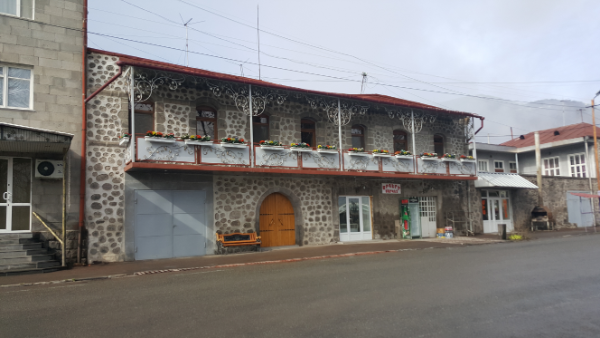
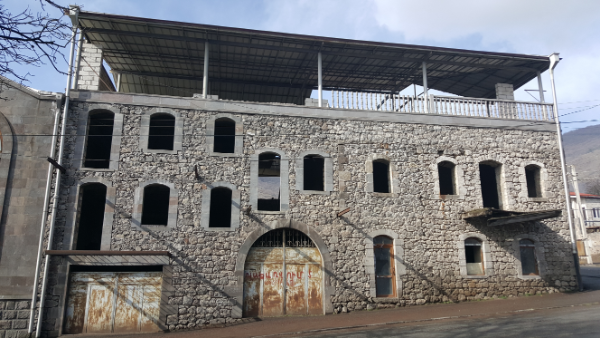
After I finished getting lost in the weird mountains and creeping around abandoned cave houses, I headed into town to check out a few of the sights. I have to say that the buildings in Goris are some of my favorite in the whole country. I love stonework, and the town is overflowing with pretty stone buildings. Even the abandoned buildings look beautiful!

Picturesque
Here’s a series of my favorite random buildings from around town. I’m in love.

I visited two churches in town, St. Hripsime and St. Gregory the Illuminator. St. Hripsime was originally built in the 4th century, and St. Gregory was built in the early 1900s. St. Hripsime is small and pretty and was rebuilt a few times, first in the 1500s and then in the early 2000s. the inside feels like you’re inside a cave… appropriate. St. Gregory the Illuminator Church is slightly more Armenian-church-typical. The inside is plain, and the outside design is nothing extraordinary, but the stone color is a pretty grey that I enjoyed. They also had a very nice gate entering into the grounds, and metalwork is another craft that I’m a big fan of.

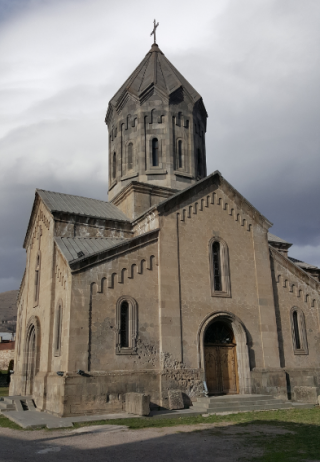
St. Gregory the Illuminator Church. Check out the gate in front.
On the side of the church (between the door and the window to the left), you can see artillery shell damage from the war with Azerbaijan

Between the natural beauty of the surroundings and the man-made beauty of the town, it’s definitely on my list of favorite places in Armenia. Mountain views, easily accessible adventure, caves, stone buildings… what more do you need?

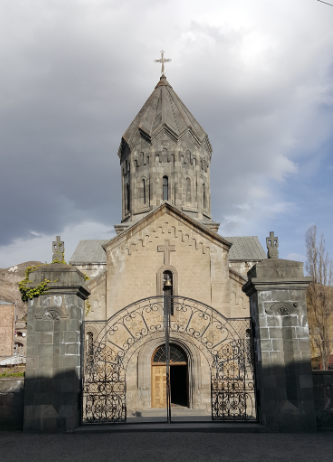
St. Hripsime
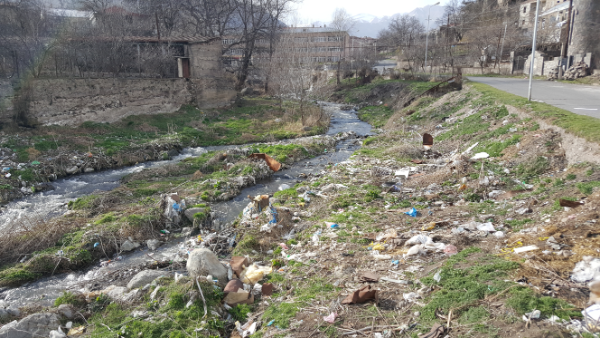
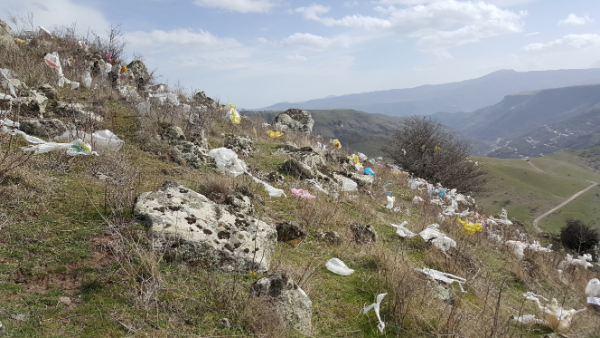
One thing that consistently makes me sad is the amount of trash that’s just laying around the country. This could be such a pretty river, but instead it’s polluted with garbage.
Field of trash encountered during my hike.
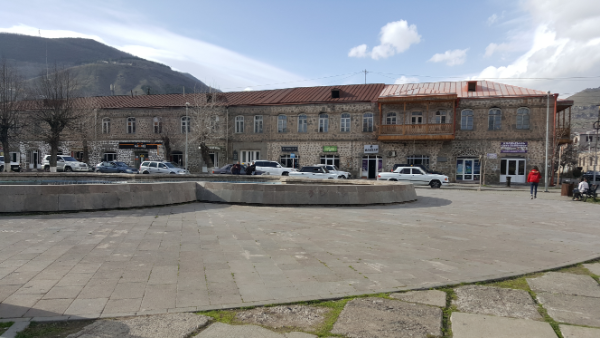
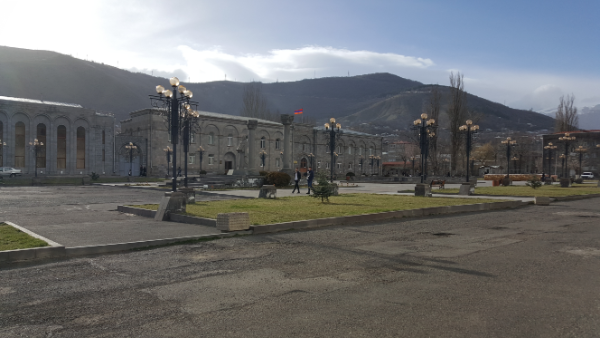
The central square
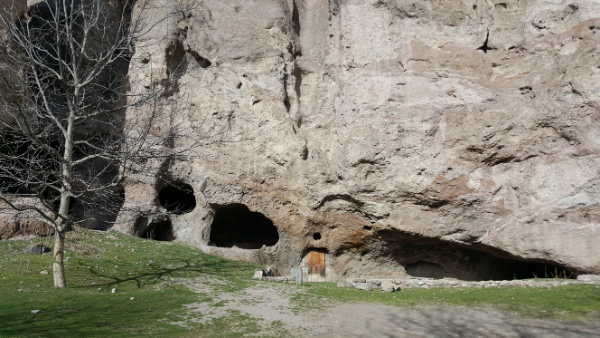
Spot the little cave door!

My trek from Meghri to Kapan started VERY early in the morning, especially by Armenia standards. The marshrutka left at 7:30AM, but it actually wasn’t too hard to get up on time… thanks to all of the walking the day before, I had a fabulous, comatose night’s sleep.

Kelsey was going all the way to Yerevan, about eight hours, and I was hopping off in Kapan after about two. It was nice to have some company for the ride! I’m so used to going places by myself now that it always throws me off when I have a friend.

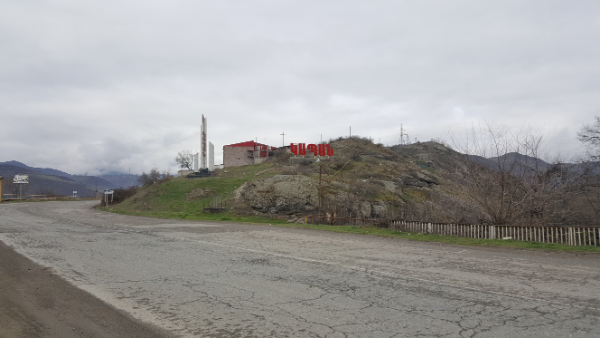
Kapan city sign

The marshrutka dropped me off right in front of my hotel for the night. I didn’t do much pre-planning for this trip (I’m trying to learn how to “go with the flow” and be okay with that), so I looked for somewhere to stay only one night in advance. According to the internet, there weren’t many cheap choices left. In hindsight, I feel like I should have just gotten dropped off in the city center and wandered around asking hotels if they had vacancies. Anyway, I didn’t do that, so I stayed at an inexpensive and NOT centrally located hotel. Everything except for the location was great! But that resulted in me having another ridiculous walking day.

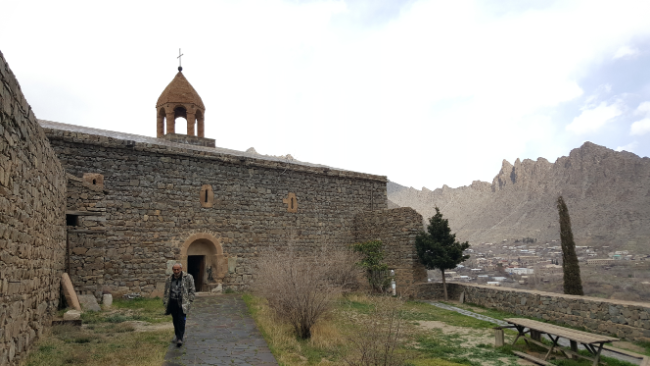
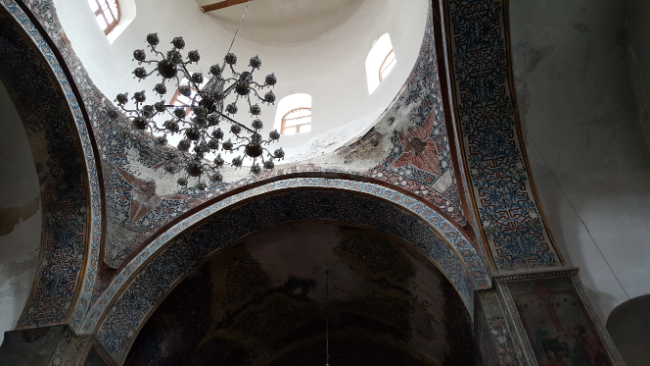
Inside Surp Mesrop Mashtots

I had two sightseeing goals for the day, Halidzor Fortress and Vahanavank. According to google maps, it was a 15 km walk to Vahanavank, and Halidzor is in the same general area. I looked at that and thought, “Oh hey, that’s not bad! Only 3 hours!” Any rational person would have looked at that and said, “I’m going to ask the hotel to call me a taxi.” Oh, well. I figured that I would walk there and then find an alternate method of transportation back.

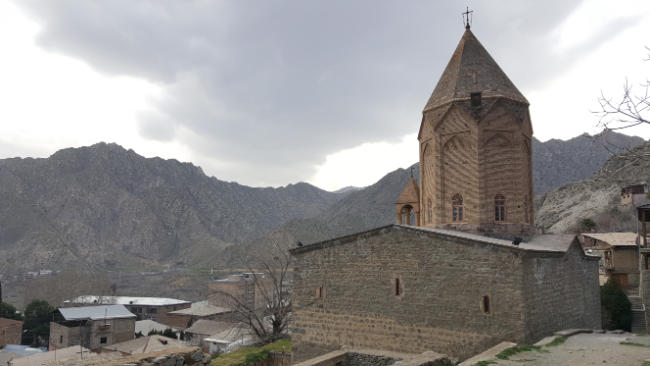
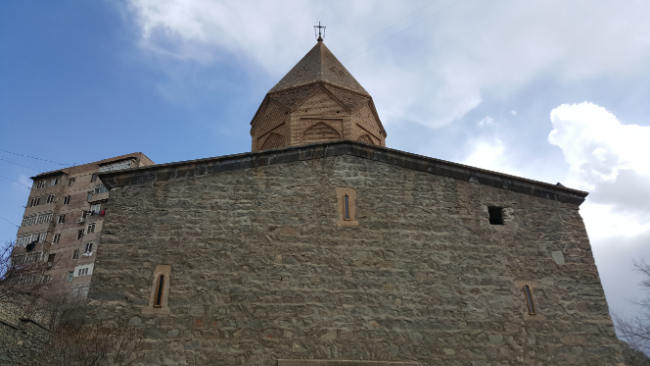
I walked about 40 minutes just to get to Kapan. The thing is, though, that you can’t just think of it as a long walk. You have to think about the fact that you’re seeing things you wouldn’t have seen otherwise because you don’t enjoy the scenery as much when you’re in a car. See? That’s my way of rationalizing my decision and telling you that it was the right one to make (though strong recommend that you just get a taxi if you’re ever in this situation). On my way through Kapan, I went to see the church, Surp Mesrop Mashtots. If you feel like you’ve heard this all before, it’s because every city/town/village in Armenia seemingly picks from the same list of five church names and ten street names, and things can get confusing very quickly.

Surp Mesrop Mashtots
The municipal building

From there, I roamed a little more, stopped in a store to buy some snacks (where they stared at me like I was a Martian and forgot to put my human suit on – classic Armenia moment right there), and continued on my way. I walked more… a lot more… and eventually realized that I could have taken a bus nearly the ENTIRE way that I walked. Well. I got some good exercise, and I REALLY saw the scenery. After maybe 11 km, I finally got to the point where I turned off the main road and started heading up to Vahanavank.

Finally off the main road
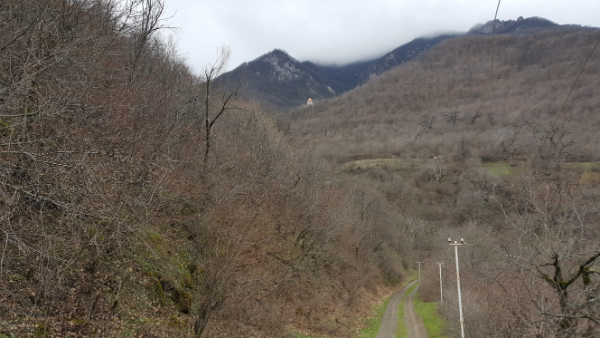
See the little peek of orange roof along the line between the brown front mountain and the darker back mountain? Vahanavank.

I was probably 20 minutes from the church when a car came up behind me. I did what I usually do and pretended that I had everything under control and totally wanted to be walking up a mountain after already walking for almost three hours… and at that moment, I got caught on a spiky plant and had to stop to untangle myself. So much for looking like I knew what I was doing. The driver pulled up next to me, rolled down his window, and asked if I was going to Vahanavank… as if there was any other reason I would be walking on a random mountain road that literally only leads to the church. I said yes, and he told me to hop in. I’m not too proud to accept a ride, especially when my legs are ready to fall off, so I got in and we were at the top in three minutes.

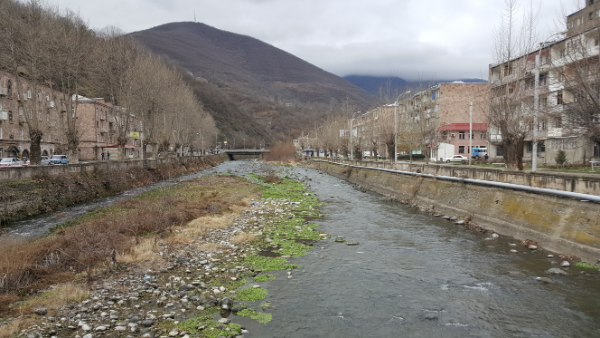
The river that runs beside the town

When we got to the church, there was actually a priest there! I was so thrown off. I think that’s literally the first time I’ve ever seen a priest in a church who wasn’t in the middle of conducting a service. The guys who picked me up seemed to be buddies with him, and I heard them telling him that they picked me up on the side of the road. I started poking around the church, and the priest invited me to drink tea with them… which he was in the process of heating water for on his little propane tank. Ha! It was a little chilly up there, and I was kind of hoping for a ride back down the mountain too, so I said okay.

The priest spoke some English, so our conversation was actually pretty good. I spoke broken Armenian, he spoke broken English, and we figured it out. He was excited that I’m an architecture person (no one knows what an architectural engineer is, so they usually just decide that I’m an architect), and after tea, we walked around the church and he pointed out different architectural features.

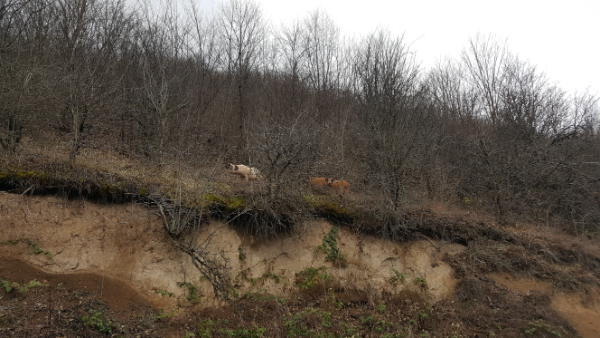
Wild pigs along the way. The priest took it upon himself to tell me about all of the creatures that live in the mountains there, including bears, snakes, deer, pigs, creepy spiders, lizards, etc.
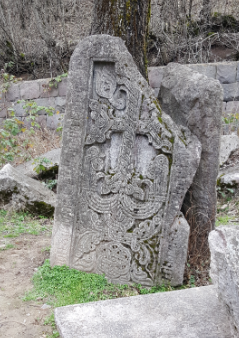
One of the priest’s favorite khatchkars. I think he said that a prayer is written around it asking for the prince to be healed.

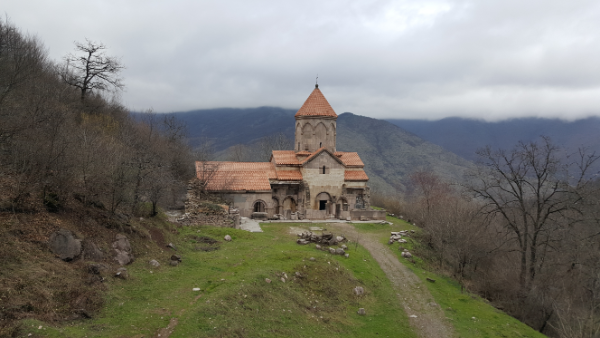
Vahanavank was founded in 911 by the prince of Kapan, Prince Vahan, who supposedly became a monk to cure himself of a demonic possession. The main church is called… wait for it… Surp Grigor Lusavorich aka Saint Gregory the Illuminator Church. It functioned as a monastery and a spiritual school for some time, and there are a bunch of graves in/around the church, including Prince Vahan and many other kings and princes of Syunik (the province where Kapan is located).

Vahanavank

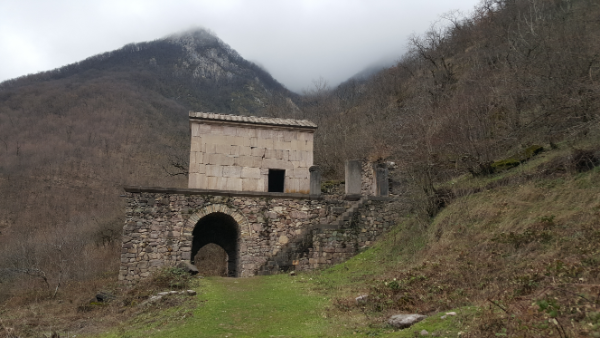
There’s another little chapel on the grounds as well, Surp Astvatsatsin, that was built by one of the Syunik queens, and it also serves as a mausoleum for her and her relatives. It seems like people just built churches when they wanted fancy places to be buried.

Surp Astvatsatsin Chapel

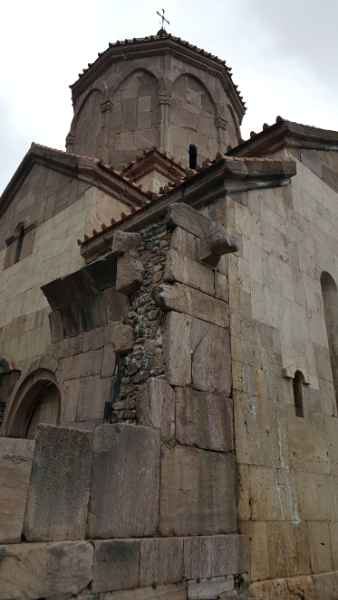
There was an earthquake that destroyed practically everything on the grounds, and they just recently did some restoration work that was never finished. The main chapel of Surp Grigor Lusavorich Church was completely restored, but the vestibule on the side is only partially completed. The priest showed us where they put in different structural features to help if there’s ever another earthquake and the difference between the original and the new stones. The original stones were quarried from a neighboring mountain, but the new ones were brought in from elsewhere.

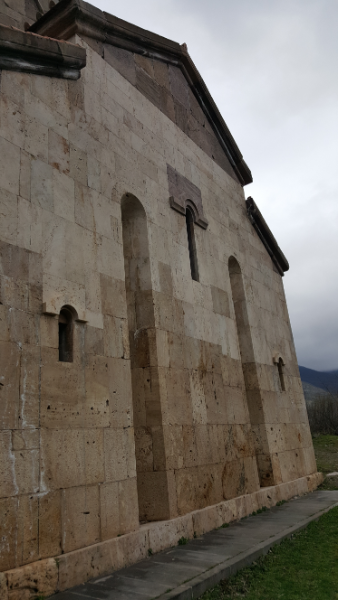
The little indents in the side of the building are to help with side-to-side movements if there’s another earthquake.
The more reddish stones on the left are original, and the more orange ones on the right are the new ones.

I stayed at Vahanavank MUCH longer than anticipated. If I had gone on my own, I probably would have stayed 15 minutes max and then kept going to Halidzor. Instead, I was there for more than an hour. When they asked where I was going next and I said Halidzor, everyone looked at me like I was a lunatic. They went on and on about how it had just rained and the path was going to be muddy and I shouldn’t go. Usually I’m not one to listen to things like that, but I was kind of cold and the sky had been overcast and dark all day, and I was a little worried about getting stuck out there in the dark. The priest gave me his phone number in case I decided to go and needed help, but I ended up deciding that I had walked enough for one day. I asked the guys who gave me a ride where they were headed, and they said, “Wherever you’re going.” I kind of assumed that would be the answer. People are too nice.

Apartment buildings along the way. Is it just me or do these look ridiculous?

They drove me all the way back to my hotel, laughing the entire time about the fact that I had walked all the way there. I’ll tell you this much – it seemed like a long way even in a car! At least I got my exercise in for the day! I was happy to have some extra chill time at the hotel to take an incredibly long, hot shower and attempt to warm up. The weather was much colder than I expected, and when I stopped walking at my breakneck pace, I think my body got pretty cold.

Anyway, it was certainly an adventure, and now I still have things to do the next time I go to Kapan! This trip is just making me even more sure of my thoughts that I need to come back to Armenia someday. Maybe Sarah and I will do another trip to conquer all of the hiking destinations!

After my long day of travel from Yerevan to Meghri, I hit the ground running the next day and did some intense Meghri sightseeing. Kelsey had work, so I was on my own. I got tips from her about what to do in town, and then I did all of it. In Meghri, the major attractions are parts of the old Meghri Fortress (four parts, though who knows, there might be more), three churches, and a nice view of Iran. I started with the two fortress parts on the ridge closest to Kelsey’s apartment, and the trek there involved some sketchy felt-like-trespassing-but-what-does-that-mean-in-Armenia-anyway moments. There are houses all along the bottom of the mountain ridge, and I had to get past the houses somehow… I walked through someone’s open gate and no one said anything, so that was that.

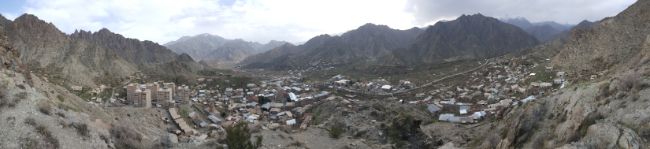
Meghri

I’ve decided that the Meghri mountains are my favorite for climbing. They’re very rocky and steep which means that climbing them involves a lot of basic rock climbing/scrambling. It makes things interesting! I think that’s way more fun than just hiking. The views from both places were awesome. Throughout the day, I took about a million pictures of the same mountains over and over again because they never got less cool.

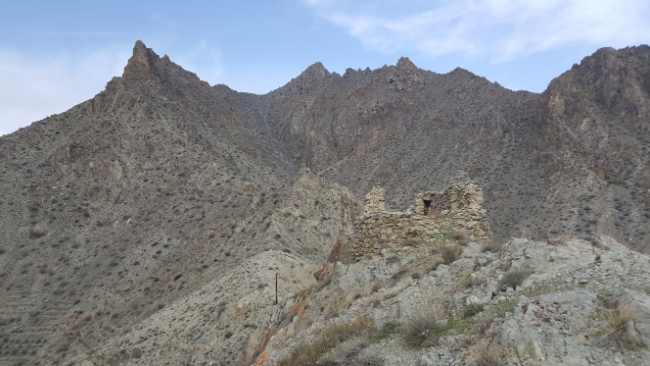
See rectangular structure #1 on top of the jaggedy cliff mountain
Rectangular structure #1
The never-ending struggle of travelling alone is remembering to take pictures that you’re actually in… and also figuring out how to physically take those pictures. Selfies aren’t my favorite, and I usually have a mini tripod, but of course I forgot it and all of the pictures on this trip are going to have to be improvised rock tripod pictures.

From there, I adventured down the other side of the ridge because I saw a road that I thought met up with the one I wanted to take to see Iran. That was kind of right… I got there eventually, so that’s all that matters. I also found a bonus church! I was walking down the street past some ruined buildings, and I saw a little peek of an arch that looked like part of a church. I decided to check it out, assuming that, as usual, no one would care that I was poking around, and sure enough, there was an altar inside! Who knows what happened to the church, but now it’s filled with grass and, based on the poop, grazing animals. I felt like I had stumbled upon a hidden treasure.

The faint mountains in the middle background are in Iran
Just enjoy the many mountain views… probably all the same mountains over and over again
Surprise church!
Another ruined building near the secret church

Finally, I found myself on the road to the view of Iran. I mean, you can see Iran from pretty much the whole town, but there’s a road that zigzags in that direction, so I walked down until I hit a little ridge that had a clear view of the Araks River and the border. Of course, I climbed the ridge because why not? I also took a bunch more pictures of the same mountains until it started drizzling and getting pretty windy, and I decided it would be wise to head down and avoid getting blown off the mountain.

Armenia on the left, Iran on the right
The murky looking squiggle is the Araks River. It runs along the Armenia/Iran border.
One of the arches inside Surp Sarkis

Luckily, the rain didn’t last too long. I say luckily because I didn’t have any rain gear (following a morning conversation with Kelsey where she checked the weather and assured me that it wouldn’t rain… oops), and that earned me a stern talking-to from an old woman who I passed on the street. Instead of taking the main roads, I chose adventure and walked down some dirt roads that seemed to be heading in the direction of the church I wanted to see next. It kind of worked… after some winding around, I popped out on a main road again, and from there, I headed to the 17th century Surp Sarkis Church (thank goodness for phone GPS). Again, I didn’t really know where I was going. I walked on the roads that looked like they were going in the right direction until I hit a dead end and asked some nearby old men how to get the rest of the way there.

My Armenian isn’t fabulous, but it’s usually good enough to understand directions. This time, not so much. He said something about taking the high path and then turning after going under the balcony and then something something something and I was completely confused. After one explanation attempt, the guy giving me the directions gave up and just went with me. I definitely would not have figured it out on my own. I don’t think I would have understood even if he had told me the directions in English. We went up this little path, walked under a balcony, around the corner, up some steps, across a rock, up some more steps, and we were there.

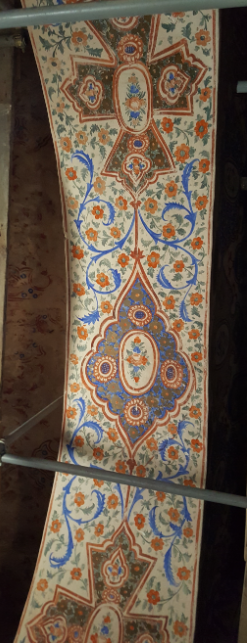
The inside of the church is filled with frescoes, and based on the scaffolding inside, I’d guess they’re getting restored. That exciting because they’re really nice already, and if the colors were a little bolder and less chipped, they’d be breathtaking.

Surp Sarkis and my new friend

When I was finished looking around, my friend and I headed back to where I picked him up. He invited me to come in for coffee, but I said “no, thank you” because I had a packed schedule to keep. My next church was in the middle of town, Surp Astvatsatsin Church (17th century). The main part of the church is stone, and the cupola is brick. Brick isn’t that popular in Armenia, so it’s a little weird to see that on a church. It was pretty though. Again, the inside was filled with frescoes in the same style as the first church.

Surp Astvatsatsin

Inside Surp Astvatsatsin
Inside Surp Hovhannes. Check out those arches!

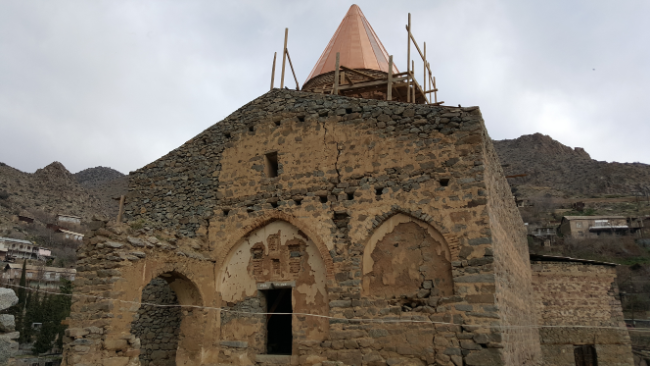
My last church stop was Surp Hovhannes. It’s in the worst condition out of the three churches and is undergoing some significant restoration work. Kelsey said some French organization is restoring it. It has a shiny, new roof on the cupola and there’s scaffolding all over the inside. The major interesting feature of the church is the arches inside. They look like Persian arches and were intentionally designed that way so that the Persians wouldn’t destroy the church if they came in and conquered the town.

Surp Hovhannes

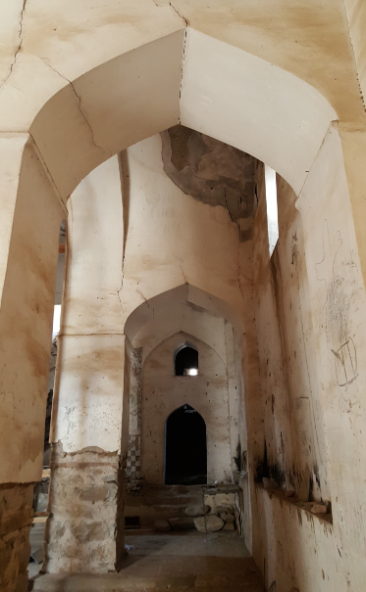
Since I still had plenty of time in the day and I wasn’t completely exhausted yet, I decided to climb to the other two fortress parts. I don’t know what way you’re supposed to get to them, but it’s definitely NOT however I went. I looked incredibly suspicious as I tried to find a way around all of the houses, and then I for sure walked straight down someone’s driveway and through their garden when I got tired of looking. Oh well. The climb to the first structure on the ridge was the most intense and highest climb of the day. I don’t completely understand what the different things, but two of the structures I went to were rectangular and two were round. I guess the round ones are watchtowers, and who knows about the other two. I tried to understand via the internet, but that was less than helpful.

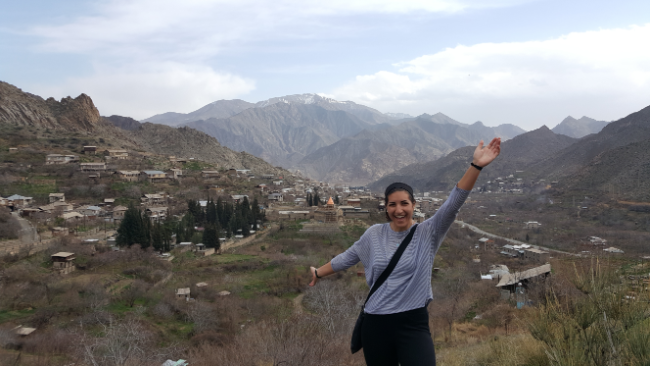
Me + Meghri
Rectangular structure #2

After climbing to the highest point, it seemed almost pointless to go to the last watchtower, but I figured it was basically on my way down… and I hoped that from there, I’d be able to see a less shady way off the mountain. Sure enough, I saw exactly the way I should have come up. It wasn’t through anyone’s yard or garden, and it would have made things a whole lot easier. Oh, well. Live and learn!

Who doesn’t like a good ‘ole panorama?

This is another one of those times when I wish I had a fitness watch or had thought to turn on a GPS tracker because it would be interesting to know how far I walked. Based on how my legs felt, it was a looong way. I was walking/climbing for probably like 5 hours, excluding stopping time and such. My conclusion about Meghri? It’s beautiful, the mountains are the best, it was absolutely worth visiting, and if you’re a lunatic who likes climbing things, you’ll probably agree.

My south trip started with a long marshrutka ride. I decided to go all the way south and then slowly work my way back because that seemed like the plan that made the most sense. My first stop was Meghri, a town almost right on the border with Iran and the last major town before the border crossing (the border town is still after that, but it’s very small). I wanted to go to see the town and because you can see the mountains of northern Iran from the Armenia side which is the closest I can get.

My friend Olivia has a friend in Meghri, Kelsey, and she graciously offered to let me stay with her while I was there! It worked out perfectly because I took the marshrutka there, stayed with her, and when I was planning to move to the next town, she was planning to go to Yerevan, so we took the same marshrutka (but I got off MUCH earlier). I’m getting very ahead of myself, sorry. Let me go back to the beginning.

I took a marshrutka from Yerevan to Meghri. It takes around 8 hours and involves a lot of windy roads. The same marshrutka passes through every town that I’m planning to visit on this trip, so it was like I got a little sneak preview of the rest of the week… when I wasn’t sleeping at least. We left at 7:30, I woke up at 5AM because I hadn’t packed (of course), and around 7, I called a taxi to take me to the bus station. I was assigned a seat next to an old woman, and soon after our intended departure time, we were off. This was one of the marshrutkas where you’re supposed to call to make a reservation, so I asked Zoe’s roommate to help me out the day before by calling to save me a seat. Part of the goal of my trip IS to work on my Armenian, but speaking over the phone is HARD! Especially when you’re asking someone to do something for you, and you’re not really sure how to ask them properly.

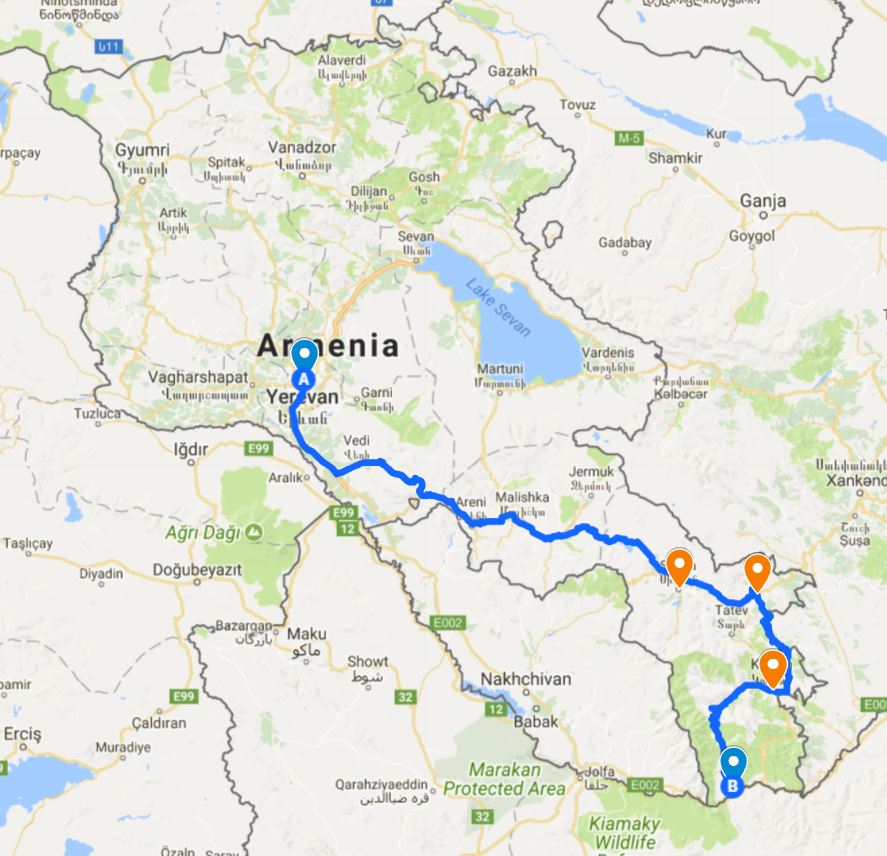
Here’s approximately the route we took to get from Yerevan to Meghri (the blue pin all the way in the south). The other destinations for my trip are the orange pins. From south to north it’s Kapan, Goris, and Sisian.

The long marshrutka rides always involve a lot of stops. You stop to let people on, you stop to let people off, and you stop so that all of the men can smoke (and so people can eat and go to the bathroom I guess, but mostly so that the men can smoke). During one of the stops, I started talking to my seatmate. She was very patient with me, letting me try to speak and speaking to me. Her name is Laura, she’s 78 years old, and she is from Meghri but lives in Yerevan with her husband. She was very excited about the fact that I also speak Spanish (though at this point my Spanish skills are at a pathetic level), and I felt like she kind of adopted me. Eventually, another woman sat on my other side, and when we got to our “lunch” stop, I was force-fed from both sides. Laura asked if I ate breakfast that morning and I said yes… and then she proceeded to put food in my hands, ignoring my insistent “no thank you”s. I was piled high with lavash bread, pork khorovadz (barbecue), cheese, peppers, lunch meat, sesame seed dessert things, and hard candy. Anytime I stopped eating, she pointed at my food and said “Ker!” which is essentially the equivalent of “Eat!”

The Meghri city sign, with the faint outline of mountains in the background

For the most part, the rest of the ride was filled with me sleeping or just closing my eyes so that I wouldn’t feel like I wanted to throw up. I’m not usually one to get carsick, but whipping around those windy mountain roads in a marshrutka is enough to freak out even my stomach. Plus, it’s a little disconcerting to see the little gravestones lining the roads from cars that almost certainly fell off the side… I’d rather not think too hard about how much I trust the marshrutka drivers. The one benefit of keeping my eyes open was that the view was beautiful. The mountains were just the right amount of snow-covered, and the sky was clear and blue… so I switched between forcing my eyes to stay open and look out the window and closing them so I wouldn’t feel nauseous.

You kind of feel a sort of kinship with the other people on the marshrutka on those long trips.  I felt like we were all on a grand adventure together. The ride is also very entertaining because people on the marshrutka will drop off bags of stuff with people who are waiting on the side of the road. One woman hailed a taxi in a town along the way and asked it to take a bag of stuff to a village nearby. The coordination that goes into those roadside handoffs is impressive. Also, the marshrutka will stop wherever you want it to, and sometimes, people get off in what seems like the middle of nowhere. After one woman got off, the driver asked her if she was sure because there was literally nothing around. Anyway, it’s all very interesting.

Kelsey said she’d meet me in the center of town, and I was worried that I wouldn’t know where that was. Hehe. Worrying not necessary. I knew when we were entering Meghri, and as soon as we pulled up somewhere that had a little plaza in the middle of a roundabout, there was no question that I was in the right place. Kelsey was there when I got off, and we spent the rest of the day hanging out, eating pizza (actually pretty good!), and roaming around town a bit. My major Meghri adventures happened the next day, but I’ll save that story for the next post

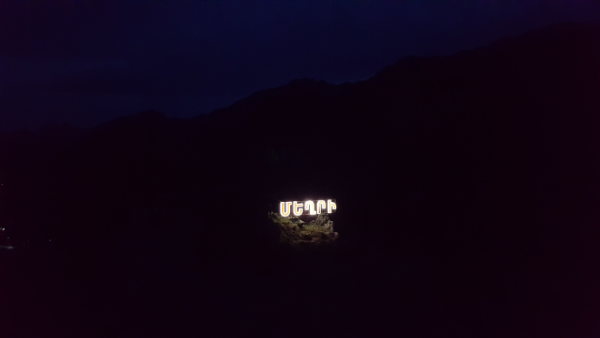
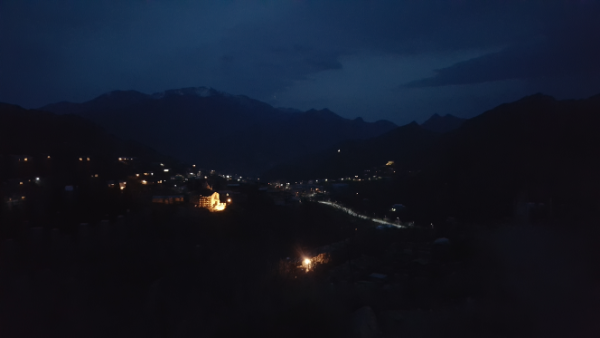
Meghri at night

I’ll be honest, I kind of felt like I was going to be here forever. Once I decided to extend for four months, I stopped worrying about what it would be like when I finally had to leave. That was something that could be left for later, something that could be easily ignored. Somehow, here we are in March, and “later” is now. Last week, all of the things that have become constants in my life here changed.
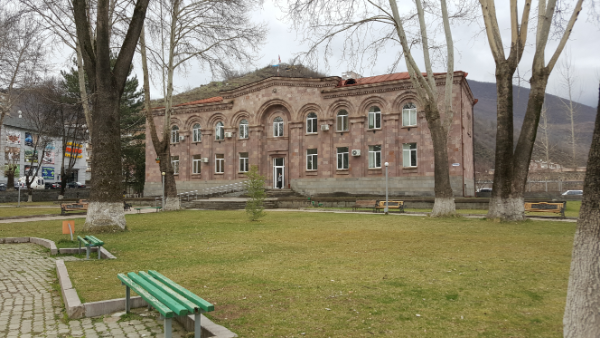
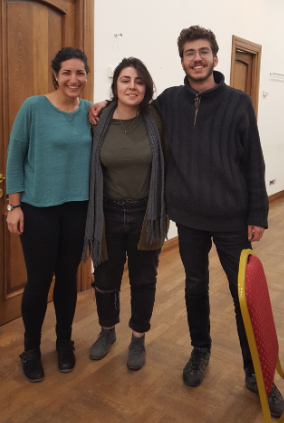
Me, Inga, and Zadig. The language class dream team.

Language class. Language class became one of the highlights of my week. I finally ended up in a class that was perfect for me. It was just me and one other guy, Zadig, plus our teacher, Inga. Zadig is hilarious and a super-fast learner. He’s been here far shorter than I have, but his vocabulary and speaking confidence are waaay beyond mine. Inga is the coolest. She’s the teacher I was assigned to when I first moved to Yerevan, and the more time I spent in her class, the more I realized how good she is at altering her teaching style to suit the people in the class. With Zadig and me, she gave us fun homework writing prompts, she made us speak ALL the time in class, and she came with different games and activities to help us grow our vocabularies and learn to speak about a wide range of topics.

Every class made me laugh, every class made me feel like I was learning, and every class made me want to stay even longer so that I wouldn’t have to leave Zadig and Inga and could keep practicing. During our last class, Inga had us debate on if all of the cars in Armenia should be required to be yellow. I, of course, got assigned the “yes” stance, and I was impressed with how many words I knew and how quickly I managed to plan out and write my arguments in Armenian. I certainly still have a long way to go (and Zadig’s Armenian is about 200 steps beyond mine already), but I’m really proud of what I managed to learn and how confident I’ve become (which is still not as confident as I probably should be, but it’s better than the mute I was before).

At the end of my last class on Thursday, I gave Inga a card I made for her and then sprinted out of there before I could start crying. I’ve become quite the emotional mess over the last couple of years. No matter how many times you go through it though, it never gets easier to leave behind something that feels perfect and that you know will never be the same again.

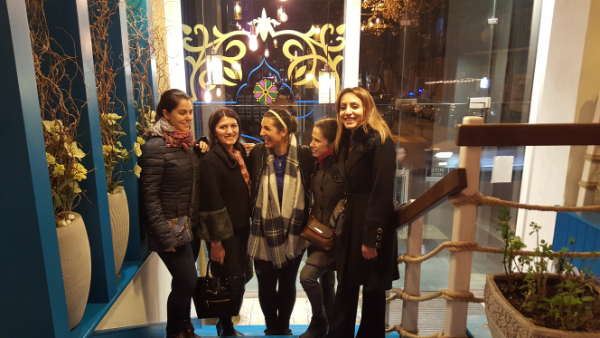
We did a “girls’ dinner” the one Friday night with all of the women from work. It was a lot of fun to spend time with everyone in a different context! From left to right it’s Laura, Yelena, me, Olivia, and Hayasa

Work. My job at Aleppo-NGO was ever-changing, but that’s one of the things I loved the most about it. I’ve always been someone who has a lot of different interests, and I’m always looking for ways to engage all of them. This job did it. Sure, there were plenty of times that were frustrating and tiring, but I felt like I was being pushed to learn new things and think outside the box. I felt like ALL of my different skill areas were being used. My last project was helping to redesign/update the website, and that involved rewriting EVERYTHING, making graphics for the different programs and projects, and coming up with ways to tweak the existing design to make it look better. I got to write, design, be creative, and use my brain. It was awesome!! Though don’t look at the website right now and think that it’s the work I did… they’re still putting everything together, and my stuff isn’t on there yet.

Besides the actual work I did there, my relationships with my coworkers really took off during my last couple months. I hung out with them outside of work, we had more fun at work, and I generally I just felt more comfortable being there and talking to them and like I was accepted as part of the team.

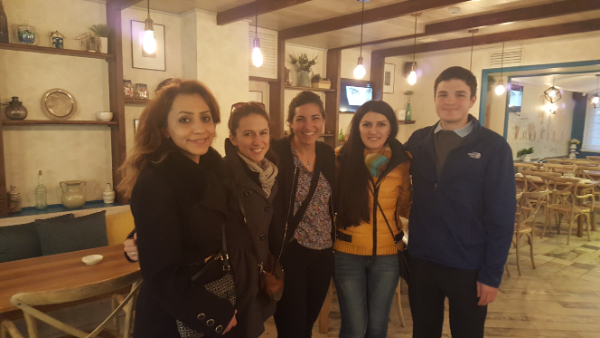
I don’t know why the quality of this picture is so terrible, but this is from a farewell dinner the people from work had for me. From left to right it’s Hayasa, Olivia, me, Yelena, and Hagop. Not pictured: Sarkis and Laura

Living situation. I moved out of my apartment at the end of February. Currently, my stuff is stored at my friend Zoe’s and I’m wandering like a nomad. I had my share of apartment struggles, including not being able to communicate with the property manager guy and him constantly judging me for “not knowing Armenian” (though really he just terrified me because I knew that he was judging me), I had a constant place where I could be alone, organize my stuff, and unwind.

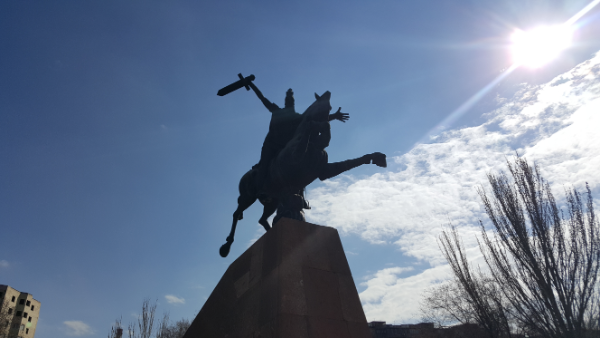
St. Vartan Mamigonian statue in Yerevan. I took this during one of my “feeling nostalgic” moments. I also realized that I had no pictures of it because I lived so close, and if you walk by something every day, why would you take a picture of it?

My last week was filled with various walks around the city, listening to sad, overly dramatic music (because what better to do when you’re on the constant verge of tears?), and reminiscing about my time in Armenia. On my last day of work, Mount Ararat was the clearest I’ve ever seen it. You could see Masis and Sis (the tall and shorter peaks), plus the rest of the mountain range. I’ve literally never seen the range before because usually, the entire base of the mountain is clouded, and you can just see this mystical peak coming up above the clouds. It was incredibly cool, and I kind of felt like God was giving me a little present for my last day. It certainly made things a little less bitter and more sweet in the whole “bittersweet” equation.

Mount Ararat on my last day of work!

For the rest of my time in Armenia, I’m doing fun thing after fun thing. It’s hard to be sad when there’s so much cool stuff ahead (though trust me, I’m still managing). This week, I’m spending some time travelling around the southern part of Armenia. I haven’t spent much time in that part of the country, and there are a few things that I’d definitely like to see before I leave… plus, why not? Next week, my cousins are coming, and we’re going to have another Armenia adventure + tour guide Lara experience. After that, I’m going on a end-date-TBD wander around Europe and places (get excited for some cool new countries and cities in the future!… also, now accepting suggestions if you have any places I should definitely visit!) before going home and having a big “WHAT IS MY LIFE?” existential questioning (I don’t want to use the word “crisis” because that makes it sound negative when it’s actually a very exciting positive).

So… things are changing, whether I’m ready or not. The future is fun and exciting, and don’t ask me what’s next because at this point, your guess is as good as mine. Stay tuned for adventures from the south.

Today on “Random Places Lara Decided to Visit”, we have one not-random-but-just-happened-to-be-on-the-way place and one google-map-located place.

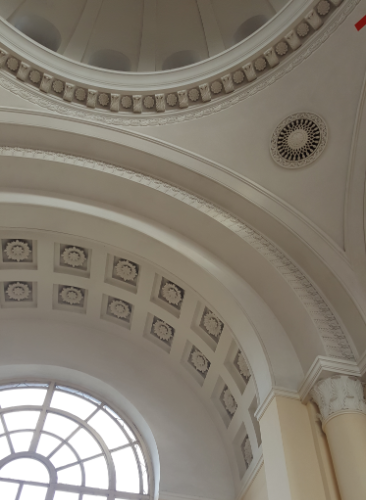
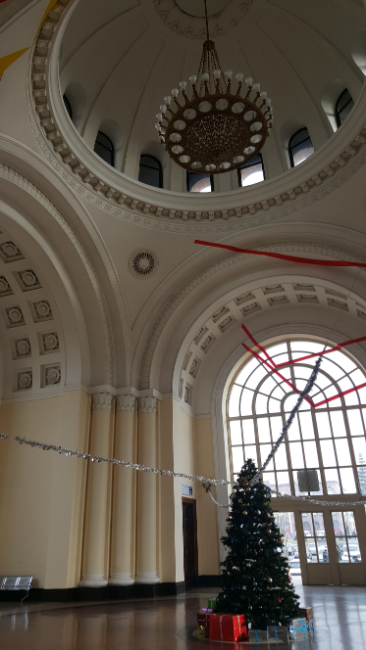
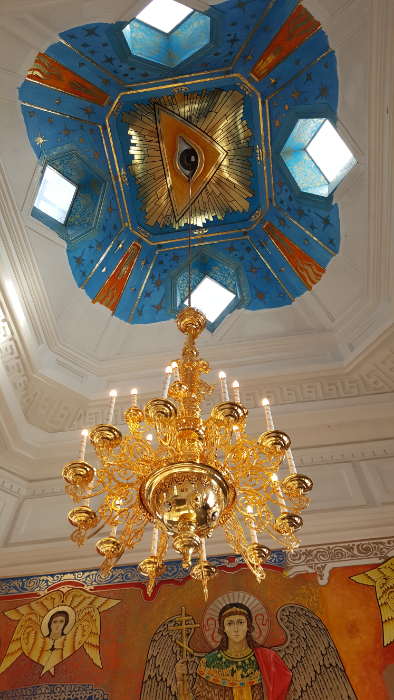
Ceiling detailing inside the train station

My plans for the day included visiting the Komitas Pantheon and Yerablur Military Cemetery… because why not just visit a bunch of cemeteries one after the next? Actually though, they’re just kind of in the same direction, and I thought I could visit both on the same day without much trouble.

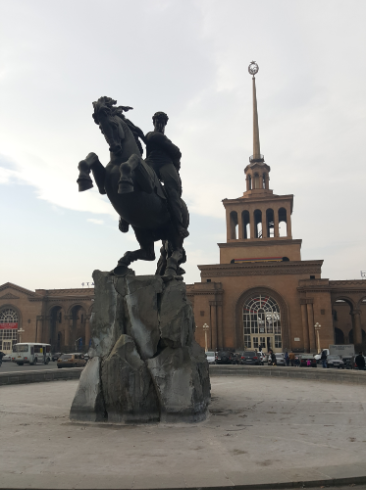
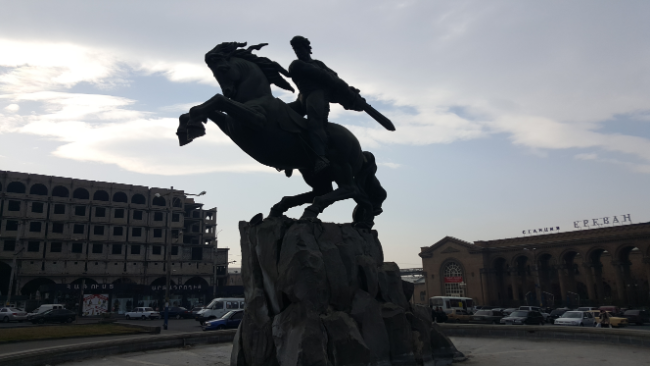
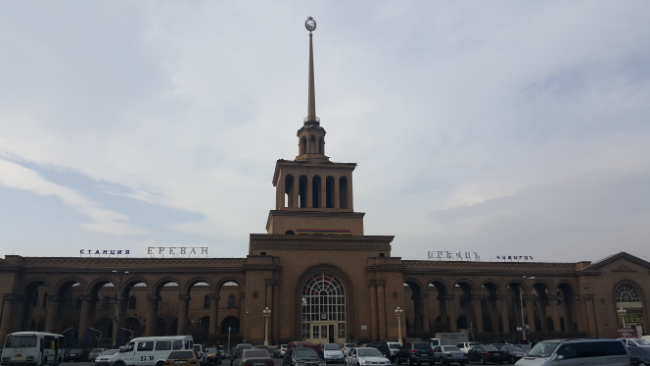
I took the metro to Sasuntsi David Station on my way to the Pantheon and figured I’d pay a visit to the train station and the famous David of Sassoun statue out front while I was in the area (this is the not-random-but-just-happened-to-be-on-the-way place). Before that, the last time I had been at the train station was when I was moving to Yerevan from Gyumri and was too busy falling asleep/trying to carry my stuff to admire the building. My general thought stream was something like, “hm this is nice. I’m tired. I should come back when it’s light. ZZZzzzZZZzzzZZZ.”

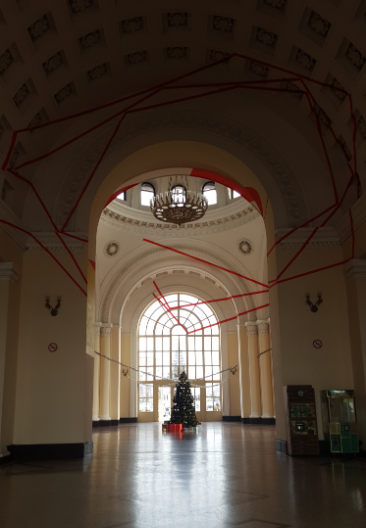
Inside the train station… the Christmas tree is gone now, the weird red lines are still there

David of Sassoun is a mythological hero of Armenia from a classic folk epic poem. The oral tales about David date back to between the 8th and 10th centuries. They were passed down from generation to generation and were finally recorded for the first time in written form in 1873 by Garegin Srvantsdiants, an Armenian bishop. It took him days to record it as it was narrated to him. In 1903, Hovhannes Tumanian, a famous Armenian poet, created a rhymed version. During the Soviet years, the story was further developed and made into a more coherent work because as a previously oral work, there were well over 100 variations of the story. The entire epic is called “Daredevils of Sassoun”, and it’s like the Armenian Illiad. It is divided into four parts that tell the stories of four generations of a family.

Sasuntsi David appears in the third part of the epic. He is a giant with super strength. He is brave, generous, selfless, peace-loving, honest, upright, and patriotic. He will do anything to protect his land and his people. The overarching theme of the epic is good vs. evil and fighting for justice.


Sasuntsi David

David was the son of a king and queen who previously had no children. They were visited by an angel who told them that they could have a child, but they would die immediately after he was born. They agreed, and so David started his life as an orphan.


He was a very strong boy, and after he grew up, he took his place as defender of the Armenian people. Throughout the epic, he fearlessly defends his people against invaders from Egypt and Persia. In one battle, to avoid shedding the blood of the enemy soldiers, he challenges their leader to a duel and emerges victorious.

The statue was sculpted by Yervand Kochar and was unveiled in 1959. Kochar was an Armenian sculptor and artist who was born in Tbilisi, Georgia, lived in Paris while his career developed, and eventually moved to Soviet Armenia. Sasuntsi David is one of his most famous works, depicting David on his faithful steed and holding his sword of lightning. It’s a pretty… epic… statue (hehe).

Isn’t it a cool statue?

The train station is behind the statue, and it was built in 1956. I think the inside is really nice, but there are currently some weird red lines all over the ceiling and walls, and they kind of ruin things. I thought that they were just an addition for the holidays, but they’re still there now, so I’m not quite sure what’s going on.

Yerevan train station
Main hall of the train station

From there, I walked to the Komitas Pantheon which I’m going to write about separately, and finally, I made my way to Yerablur Military Cemetery. It’s on the outskirts of Yerevan, so I took a marshrutka there, and we wound our way through the surrounding neighborhoods before finally making it to the base of the hill where the cemetery is located. There’s nothing else in the area. It’s just built on top of a hill in the middle of a lowkey neighborhood. If I didn’t know it was there (and wasn’t following along on my phone map), I would have thought I was in the wrong place.

The cemetery was established in 1992 and is for Armenian soldiers who lost their lives during the Nagorno-Karabakh War. There are over 700 people buried there.

I just wanted to go and pay my respects. I knew it wouldn’t be a happy trip, but war isn’t a happy thing. I try not to shield myself from unpleasant things because then you can make yourself forget how unpleasant they are. Then you start to think things like, “Oh, Armenia is in a never-ending war, and that’s just the way things are,” instead of thinking about the fact that war is a horrible thing and it takes the lives of fathers, brothers, sons, and friends. Each number in a death toll statistic was a person, and that person’s death was heartbreaking for a lot of others.

Coming into the cemetery
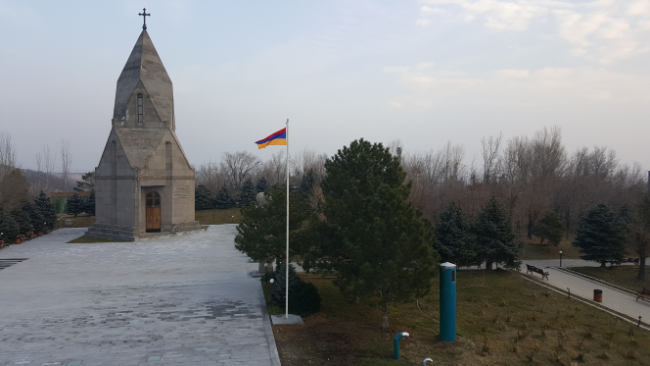
Church at Yerablur
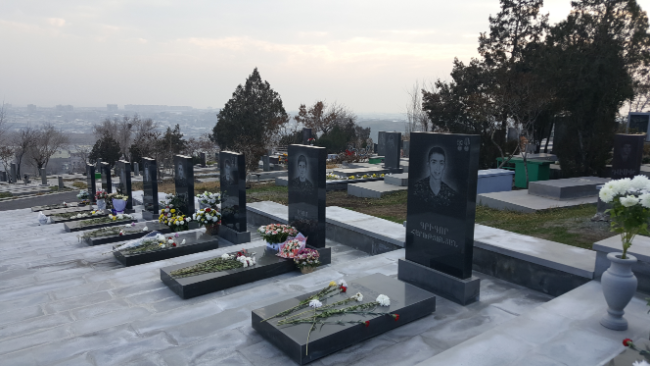
One of the things that makes cemetery visits even more emotional here are the faces of the deceased displayed on the headstones. Reading a name is one thing, but seeing a face makes each person a lot more real.
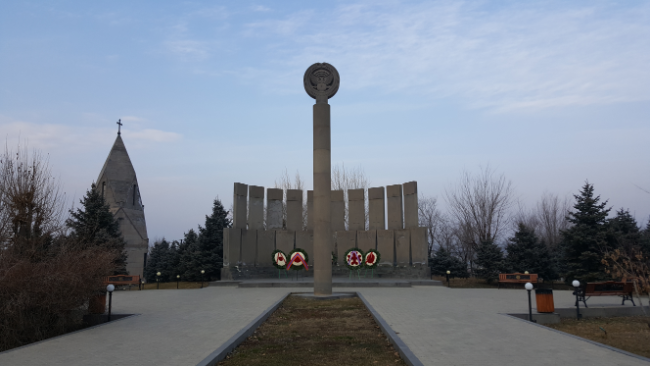
Memorial at Yerablur
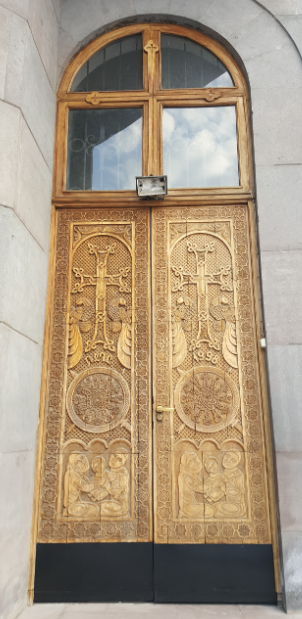
Church doors

One thing that I noticed very quickly was the general youth of most of the people buried there. As much as I feel like I’m getting old, I’m really not. Meanwhile, I would say that at least half of the people buried there never even made it to my age. The youngest person I saw was 15. A huge number of graves were for 18-22 years olds. At 18, you haven’t even gotten to the best stuff in life. Things only get better from there, and none of those people got to experience that.

Most of the graves are from about 25-30 years ago, but so many had fresh flowers on them. Some of them smelled like freshly burned incense. Thirty years, and those families are still feeling the loss. Everyone else might forget or be able to put the war out of their minds, but they don’t have that luxury. Then, there are the families who have sons there now, the kids doing their mandatory two-year military service. I don’t doubt that those families, those mothers especially, don’t let a single day pass without thinking about the war. It’s not right. Life shouldn’t have to be like that.

I hate that this cemetery even has to exist, but they did do a beautiful job of landscaping and giving these families a place to grieve.
This memorial is to the Armenian Secret Army for the Liberation of Armenia (ASALA). I had never heard of it before seeing this at the cemetery and looking it up, but it was an organization that carried out various attacks and assassinations, primarily of Turkish diplomats and politicians. It seems a little shady… that’s all I’m going to say about it, and you can do your own research if you want to know more.
Unknown soldier grave
Cathedral of the Holy Cross

From the cemetery, I could see a shiny church that I wanted to visit since the first time its gold roof caught my eye. I thought it didn’t look too far away… so I walked there. Probably not my best call because despite the fact that the distance was quite walkable, it wasn’t terribly pedestrian friendly. Live and learn… and I did live, so now we can all just laugh it off as a funny story that happened in the past and isn’t a big deal because it all turned out okay (Mom – I’m fine.).
On the bright side, the church was very pretty and worth the visit. There was a groundskeeper who came out to see what I was doing, and I was so busy trying to reassure him that I wasn’t up to anything shady that I didn’t even think to ask if he could open the door and show me the inside. I did my best to peek in the windows, and from what I could see, it looked beautiful. I bet he would have let me in, too. Life lessons: you’ll never know the answer unless you ask. And here, the answer is so frequently yes.

Shiny, right?

I’ve been aggressively tackling my Armenia bucket list over the last few weeks, and this past weekend’s item was visiting Erebuni Fortress. The way I’ve been making my bucket list, especially around Yerevan, is this: I go to google maps. I click on random things on the map that look like they may be interesting. If it looks like anyone has ever been there and liked it, I add it to the list. That means that, besides the mainstream sights, I really have no idea what to expect from things because I don’t actually know other people who have been to them.

Erebuni Fortress was one of those mysteries. I found it while browsing maps and was like, “Oh yeah! This is where the city of Yerevan started!” and I added it to my list. I don’t know anyone else who has been there, besides one old volunteer friend who I found out actually volunteered there… but clearly, it meant nothing to me when she told me that the first time, and I immediately forgot. I suckered Olivia into coming with me, and the plans were set!

Me and Olivia

Erebuni Fortress, also called Arin Berd, is on top of a hill in the southern part of modern-day Yerevan. It was built in 782 BC by King Argishti I and was part of the kingdom of Urartu. It was one of a series of fortresses built along the kingdom’s northern border and became an important political, cultural, and economic center. The name “Erebuni” is thought to mean “capture” or “victory” (but maybe not because there are like 50 other guesses to what it might mean). If you visit the site, the location they selected makes perfect sense. The hill seems to come out of nowhere. Surrounded by flatness, it’s a random mountain, rising up 65 meters (about 215 feet).

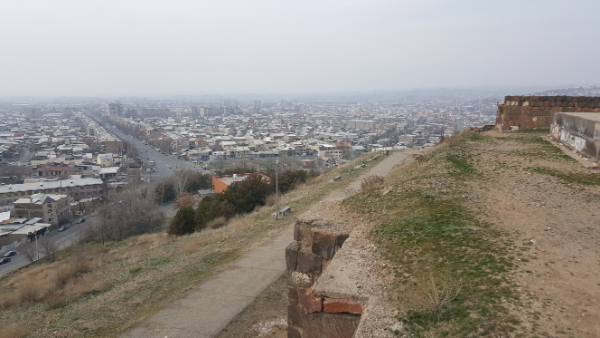
Walls and walls and I don’t know what this is because it wasn’t labeled on the map.

A town was constructed at the base of the mountain, and the fortress had a view of the town, the surrounding settlements, and all roads leading to the fortress. They think that the walls used to be 12 meters high! And if that wasn’t enough defense, there were three layers of walls. And they tied in with the slopes of the mountain, making access seemingly impossible. The fortress had a triangular plan and included a main courtyard, temples to Haldi (the supreme Urartian god) and Ivarsha (some other god), the palace, grain storehouses, and guards’ and servants’ quarters.

The formerly-but-not-currently-12-meter-tall walls
Looking towards the center of Yerevan.

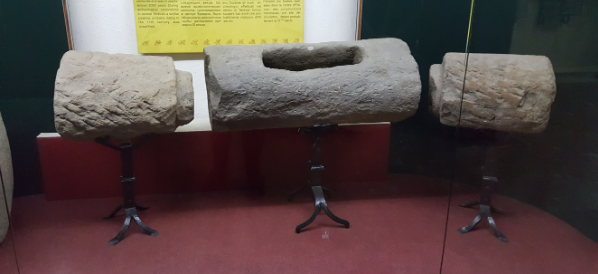
The existence of the fortress was forgotten until excavations in 1950 rediscovered it and revealed inscriptions crediting King Argishti with the construction. They also found the citadel walls, pipes for running water, frescoes, statues, ornaments, weapons, and over 20 cuneiform inscriptions. The water pipes were one of the craziest things because they’re made out of stone, and one of the signs in the museum said the water was piped in from GARNI. That’s like a 40-minute drive from Yerevan which doesn’t sound like much, but it is when you’re CARVING STONE PIPES to span the distance. Crazy.

These are some parts of the water pipe system. The extra hole in the middle one was for maintenance. Can you imagine having the job of carving out all of those stone pipes??? Do you know how hard it is to carve a hole through stone without splitting the whole thing apart?
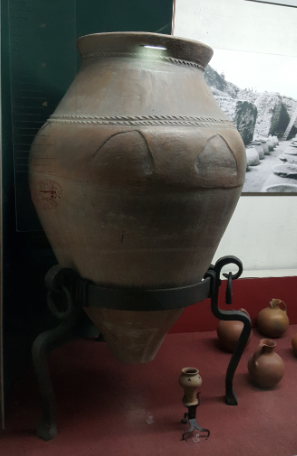
This wine jug was in one of the temples. It’s also huge.

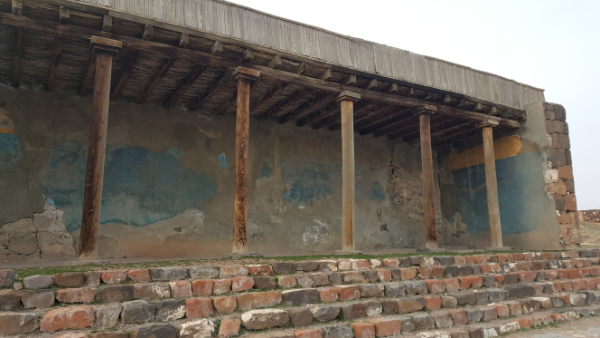
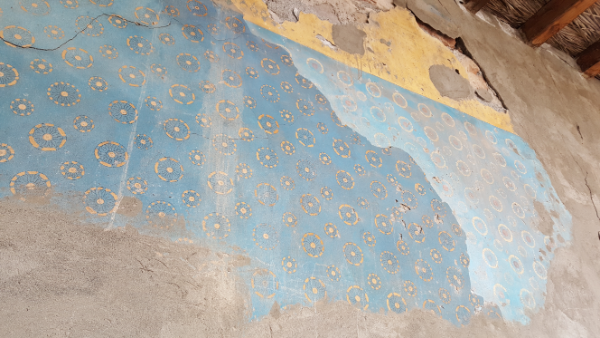
There are also some awesome mural paintings on the walls of the palace and temple. It’s amazing to think about the fact that those paints have survived for almost 3000 years! Mostly, the paintings are just patterns, but some of them also show scenes of the gods.

In celebration of Yerevan’s 2750th birthday in 1968, the fortress was partially restored, and a museum was built on the grounds to display some of the artifacts found during the excavations.

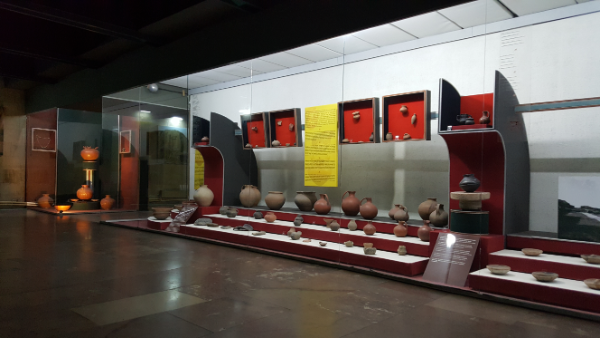
We visited the museum first, and it was kind of underwhelming. I’d still do it again though because it was only 1000 dram (about $2) for admission to the museum and the ruins, so it’s not like I felt gypped. We also didn’t get a guide which maybe would have been a good idea. Eh, it was still interesting enough, and they had some cool stuff in there like the stone water pipes. I think part of the problem was that it was kind of dark and the font on the signs was small, so I just felt like I should be falling asleep.

Museum views. Kind of dark, right?

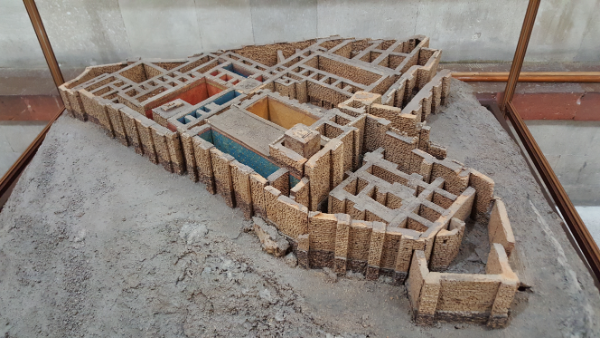
They had a reconstructed model of the site, and when we looked at it and noticed the painted walls, we thought that the modeler had just taken some artistic liberties. When we walked up to the fortress and saw painted walls in the very first building, we were VERY excited and also made mental apologies to the modeler for doubting him/her. To get to the ruins from the museum, you have to walk up a LOT of stairs. Olivia and I pretended to stop periodically to “check out the view”, but we were both just pretending that we weren’t getting winded. I used the excuse that since we were walking up a mountain, the air was thinning out so it had nothing to do with our physical shape and everything to do with the lack of oxygen in the air.

Model of the fortress. the part at the bottom of the triangle is the religious part of the fortress with the main temple, the top left part is the palace complex including the smaller temple, and the top right is mostly servants’ quarters.

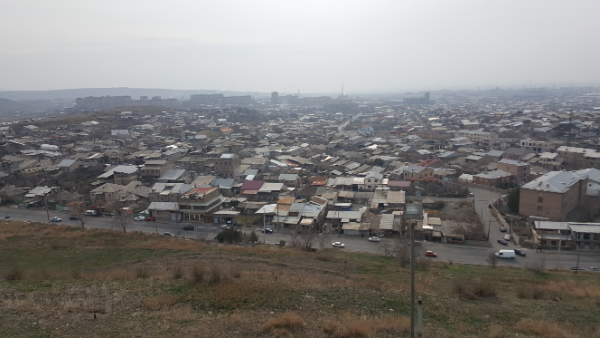
To be fair, the view was pretty great. If we had gone on a clearer day, it would have been spectacular. It’s without a doubt the best view of Ararat in the city, and you can see Yerevan stretching out in every direction around you. I always forget what a sprawling city it is because I live near the center, and if I don’t have a specific reason to go into the outskirts (such as a random sightseeing excursion), I never do.

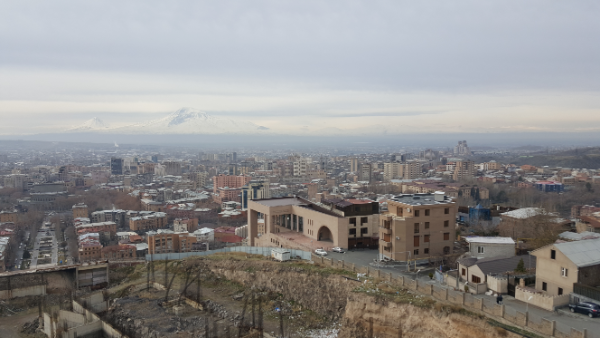
Hey hey, Yerevan! And Ararat is lurking under a whole load of clouds.

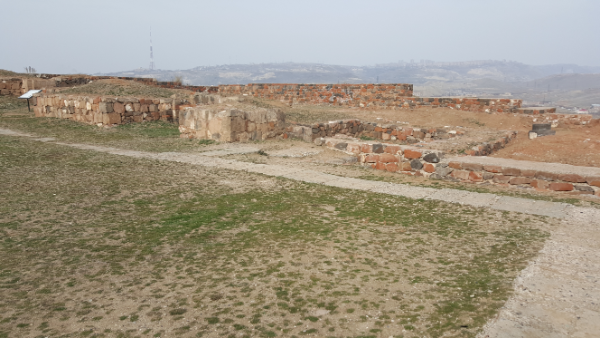
I don’t know what I expected from the ruins, but I think I imagined them smaller and in worse condition. They are not small, and it looks like they did a decent amount of work rebuilding things. The walls are only maybe three meters high, and I can’t even imagine how imposing it must have looked when they were 12 meters. We entered through the original entrance to the fortress on the southeastern side, walking past the famous cuneiform stone about King Argishti coming to this place where there used to be nothing but desert and accomplishing great works upon it… or something to that effect. Very modest guy, that King Argishti.

This was the outer post where visitors came before getting admitted to the fortress. This is when Olivia and I realized the wall paintings were real
They must have looked amazing when they weren’t 2800 years old!
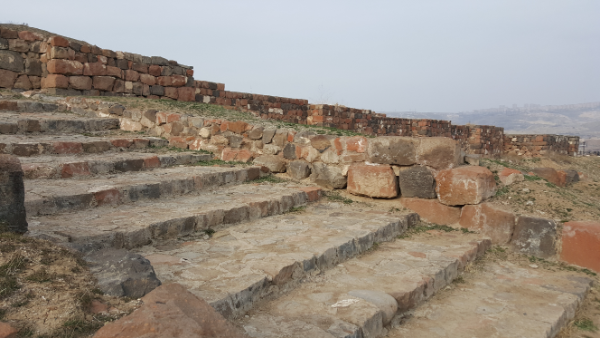
Entrance stairs into the fortress.

We wandered around the ruins for a bit and marveled at how extensive they were. We also both ranted about how no one respects history and “kids these days” because a bunch of the murals had names and other jibberish carved into them. Like come on… do you really have to do that? No one cares about your declaration of love or the fact that you “wuz here” (I don’t know if that was actually written anywhere, but probably). Why can’t people just go somewhere, admire it, and then NOT deface it? I know, crazy talk. Sorry for even suggesting it.

The main courtyard, looking towards the servant quarters.
Looking towards the temple area from the main courtyard.
Temple hall with vandalized walls.

If we had explored the entire fortress, we could have spent hours and hours there. Instead, we explored a decent amount of it and then decided we were hungry and went to get dinner. I think we were still there for a considerable amount of time though because I ate before we went and was famished by the time we left (we’re apparently going to reference my stomach clock instead of actual times… mostly because I don’t remember those).

Anyway, all I can say about the general experience is thank you, google map browsing, for preventing me from missing out on a Yerevan not-so-hidden-but-definitely-underrated gem. Why on earth don’t more people go there???

Courtyard in the palace area.
Palace… kind of… used to be.
The temple area is to the left, and the palace area is to the right.

Included on my list of “must do” things before leaving Armenia was going back to visit Gyumri for a weekend. One of my friends, Lexi, had an apartment there until the middle of February, so I went a couple weekends ago and stayed with her. There wasn’t anything too crazy on the schedule… mostly I just wanted to hang out and enjoy being back in my old hood.

There are three ways that you can get to Gyumri from Yerevan without having your own car (excluding walking):

  1. Taxi – takes 2 hours (unless you have a psycho driver who makes it in 1:30… but that’s really not safe), costs 10,000 dram (about $20) so 2500 each when you have four people
  2. Marshrutka – takes about 2.5 hours, 1500 dram (about $3)
  3. Train – takes 3 hours, 1000 dram (about $2)

This may seem strange to you. In what universe is the train the slowest and the least expensive mode of transportation?? Answer: the strange, strange universe called Armenia. I guess it makes sense that when one of those is true, the other also is… but like, when is the train the slowest mode of transportation??

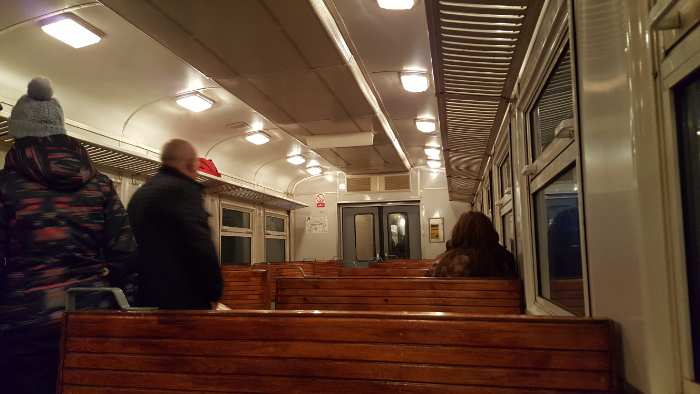
Inside the train

Despite this, the train is without a doubt my favorite way to travel. As long as you’re not in a rush, it’s fantastic! There’s space to stretch, you can walk around if you want, there’s a bathroom, you can get work done because you’re not cramped, and the scenery is beautiful. It’s slightly less beautiful in the winter when everything is brown, but at least the mountains are still there, and they look great coated in snow.

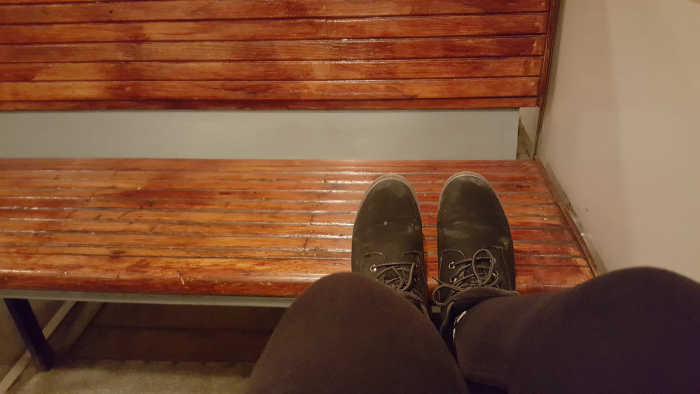
Enjoying all of my space on the train

I woke up bright and early on Saturday to take the first train of the day at 8AM. I had an incredibly productive ride… I worked on my blog, I worked on my journal, I studied some Armenian, I looked out the window… and then just like that, we were in Gyumri!

I didn’t have much of a plan for how to get from the train station to Lexi’s apartment, but turns out that I didn’t need one! I walked out of the station, saw a #12 marshrutka, and vaguely remembered that maybe it went to the right neighborhood. They do have a list of stops written on the side, but there’s no chance it was going to sit there while I tried to figure things out. And I guess I could have asked the driver, but sometimes I like to look like I know what I’m doing so I blend in better. I figured that worst case, I would get off in whatever random part of town I ended up in and call a taxi. Thankfully that wasn’t necessary because we ended up exactly where I thought we would. Score one for my memory!

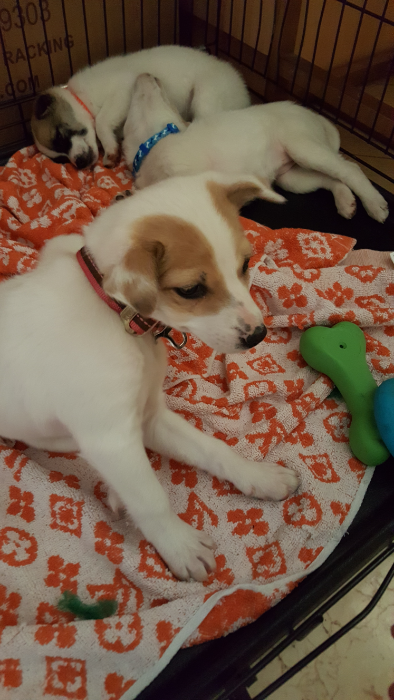
Puppies!

I dropped my stuff at Lexi’s apartment, and we went to have breakfast at her friends’ house. They’re trying to start an animal shelter in Gyumri which is definitely needed. They still have to raise money and work out more of the details, but in the meantime, they’re rescuing dogs on their own and working to find homes for them, both in the US and in Armenia. It’s actually kind of amazing (you can check out their facebook page here). In general, people here don’t see animals as creatures with any value (though there are certainly exceptions to that). There are stray dogs and cats everywhere, and people mistreat them all the time. I’ve seen people kick dogs, people get paid to shoot them, dogfighting isn’t uncommon, and even people who own pets don’t necessarily know how to take care of them.

We went over to their house to see three puppies that they had found roaming around on the side of the highway the day before. After checking out the situation, they realized they had been dumped there and left to die, probably because they were all female puppies, and people want males for dogfighting. They took the puppies in, got them checked out by the vet, and were starting to look for permanent homes for them. Lexi loves puppies, so off we went. I’m not a huge animal person (as in, I’m not interested in picking up poop or getting my face licked, so I’m fine with not owning any myself), but who doesn’t like puppies?

Isn’t it a little weird?

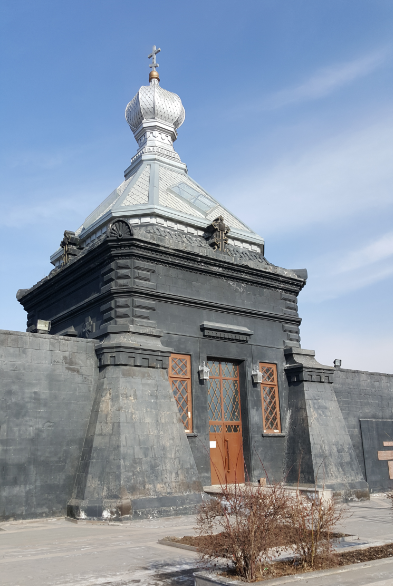
After a little puppy time, we went to cross off the only three things I had on my list for the weekend. I hadn’t been to the Russian church in town, St. Nikolai the Wonderworker Church, so that was my first must-do. It was built in 1880 and is located in what is now a Russian military cemetery. It’s an interesting looking building because the bottom part uses black tuff stone which is classic Armenian, but the roof gives it away as a Russian church. Its nickname is “the shimmering chapel” because of the shiny roof.


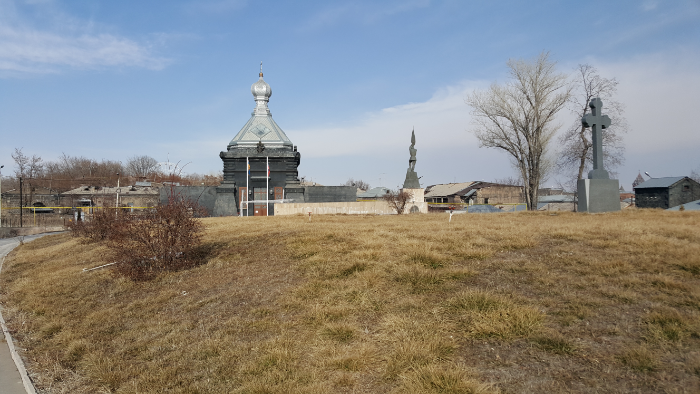
The cemetery with the church in the background
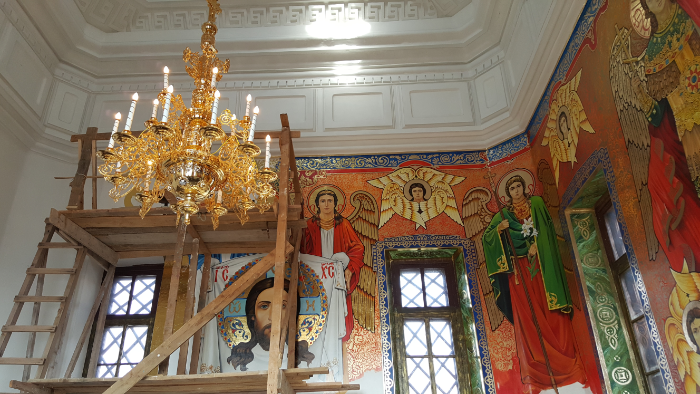
Painting in progress!
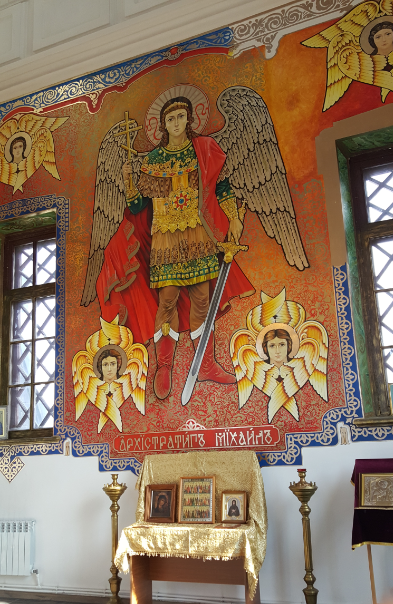
Pretty cool!

I stopped by a few times back when I lived in Gyumri, but it was never open. This time, we were in luck! We walked around the grounds first and then went inside. I guess they’re in the middle of some restoration work because now they’re in the process of painting the walls and ceiling. They look awesome!!! I love painted churches. They still have a bit of work to do, but I can just imagine how incredible it will be when it’s finished.

Number two on my list was kind of stupid, but there’s this road in town that was under construction all summer and is finished now. I mostly was just impressed that a construction project was completed in a reasonable amount of time, so I wanted to check it out. We took a drive down the new street, and it didn’t disappoint. It’s probably the nicest road in town now.

Number three was really the most important. I wanted to have ponchiks at Ponchik Monchik. I am convinced that they make the best ponchiks in Armenia (they’re basically like the most wonderful cream/chocolate-filled donuts). They always make them fresh for you, they’re nice and crispy, and I love them. In their terminology, a ponchik is a vanilla one, and a monchik is a chocolate one. And they’re both delicious, so I got one of each. And I obviously didn’t take a picture of them because that would have kept me from eating them immediately, so you’ll just have to use your imagination. As if those weren’t already enough sugar, I got a hot chocolate too. If that’s not the perfect meal, I don’t know what is. WAIT. I do. Add ice cream to that, and you’ve got yourself a winner.

Unfinished ceiling of the Russian church

The rest of the day/night was spent hanging out, talking, and playing Rummikub (best game ever). It was relaxed and fun, and I think it was exactly what I needed. Sometimes it can get exhausting living in Yerevan. I know that’s crazy to say considering I used to live in Philadelphia which is at least equally as chaotic, but it’s the truth. Yerevan feels like a big city, and Gyumri feels like home.

On Sunday, we took a trip to the vet to get the puppies and Lexi’s cat checked for worms. Ew. I was slightly less than thrilled with the situation because the vet’s office is tiny, and it was packed. There was an old woman with her little dog, a couple of guys with their cat, and a few other dog owners came and went. The woman was losing it a bit because they had to drug her dog. She was so hysterical that I wanted to give her a big hug, and I’m not a hugger. It was nice to see that there are some people who care about animals. She clearly loved that dog. When she and the other people in the office heard the puppies’ story, they declared that whoever left them was a monster. Maybe there’s hope after all!

Post-vet, Lexi and I spent some time wandering around the fields near the neighborhood. We walked around the same fields back in July when we first met (throwback here), so it was a fun full circle for our friendship. There was still some clean, untouched snow to play around in out there, and the mountains in the distance were beautiful and snow-covered. Field walks are also always good for conversations, and it was nice to have some time to catch up.

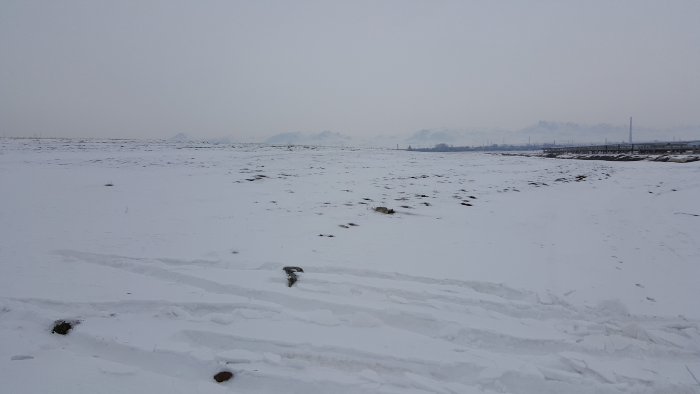
It wasn’t a very clear day so you can’t see the mountains very well, but just trust me when I say they looked great
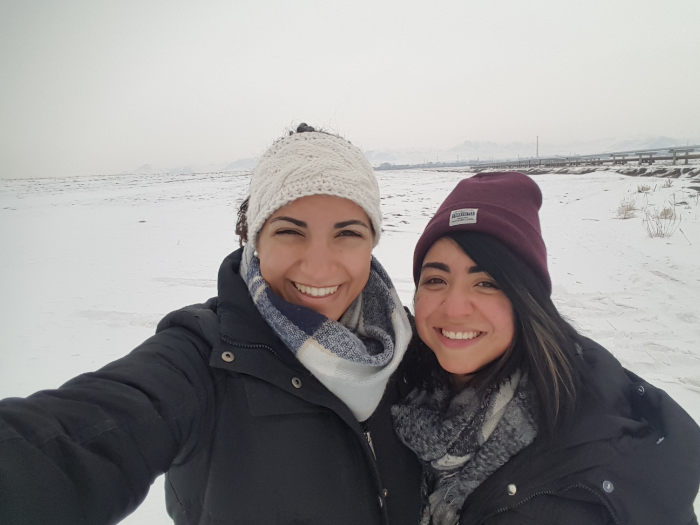
Me and Lexi
You can kind of see the mountains better here… kind of

We had just enough time to eat before I had to get to the train station to catch the last train back to Yerevan. It was kind of crowded this time, so I ended up in the window seat on top of the heater… which tried very hard the entire ride to burn my butt. Slightly less than pleasant, but at least I couldn’t complain that I was too cold! I still managed to be productive though, so it clearly wasn’t that bad (after I folded up my scarf and sat on it!). I finished my Armenian homework, made some flashcards, and by the time we were back in Yerevan, I had them memorized.

I thought the weekend might feel rushed since I was only there for one night, but I’m so glad I went. It was just the relaxing escape I didn’t know I needed!

I’m starting to have the feeling that I’m running out of time, and I’m not going to be able to do all the things I want to do before I leave Armenia. That feeling has given me renewed motivation to use my weekends wisely and start crossing things off my list again.

One of the big things that I’ve repeatedly put off is a visit to the Matenadaran, the manuscript museum and repository in Yerevan. Sarah and I tried to go when I first came to Armenia, but we went on a Sunday and it was closed. My family thought about going, but the week was already too museum-packed. I didn’t want to go alone, and that’s why it was put off for so long. Finally, I decided that I was going to go no matter what. I still asked a couple friends if they wanted to come along, and one said yes! I guess all it took was for me to make up my mind, make a firm plan, and THEN ask someone to join. That works much better than saying, “Do you want to do this together at some point?” because ‘some point’ never ends up getting scheduled.

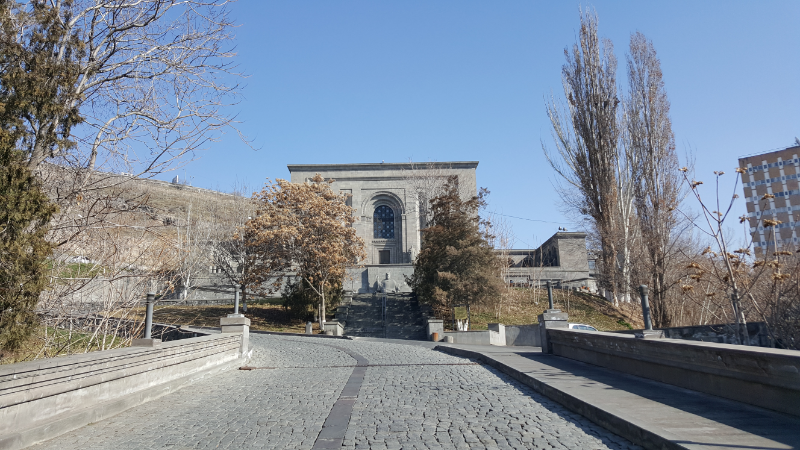
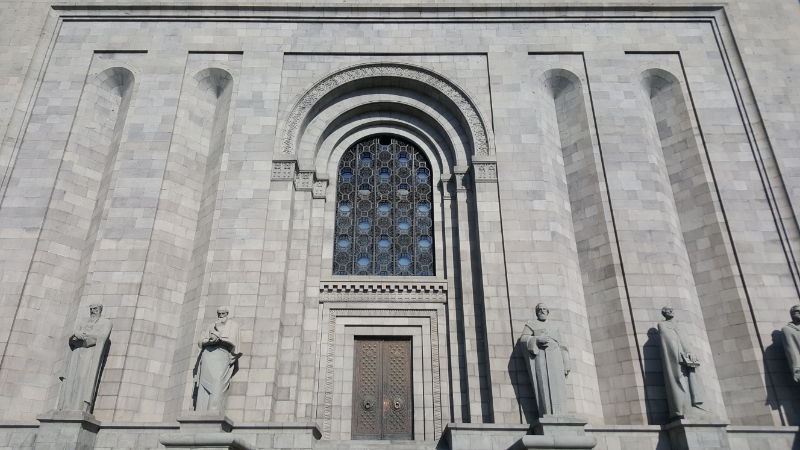
Matenadaran on the approach
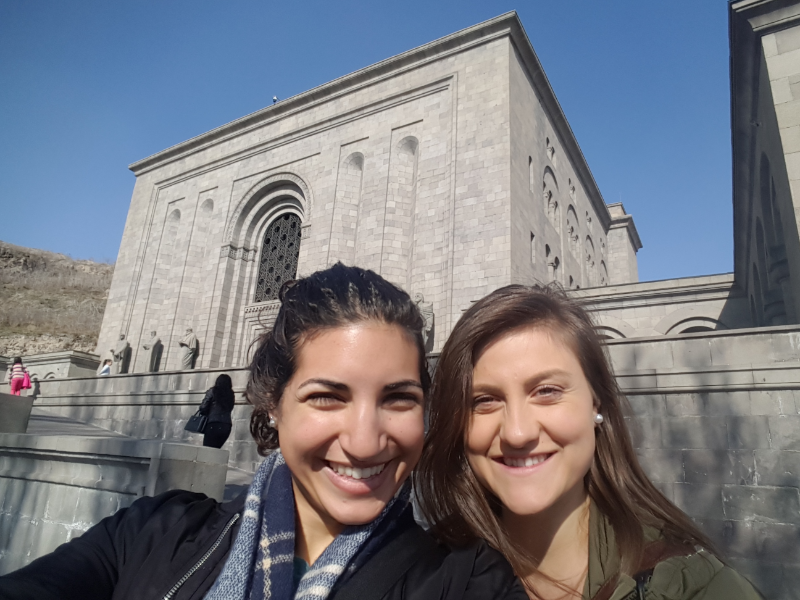
Me and Zoe

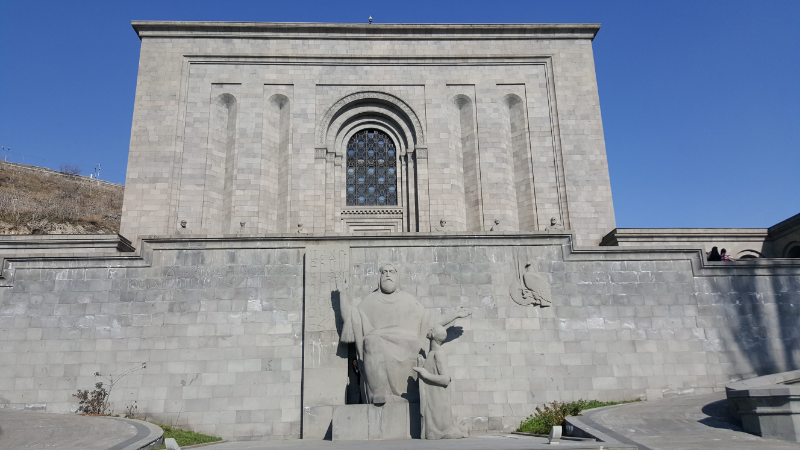
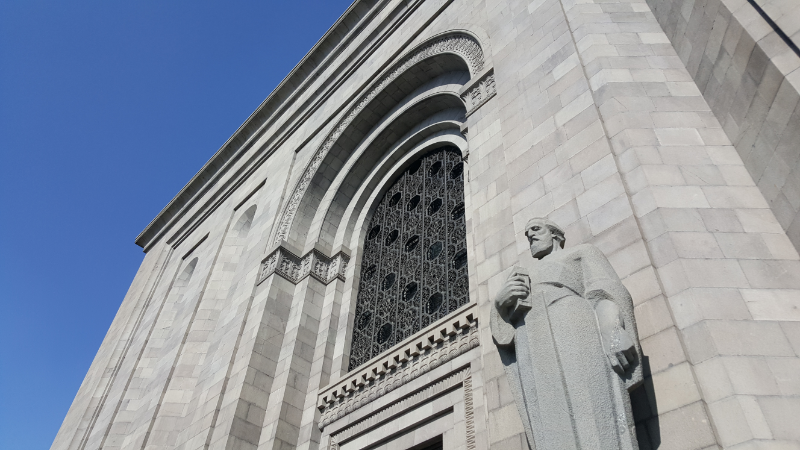
I met Zoe, my friend from church, outside the Matenadaran. It’s a pretty epic building, set at the top of a hill on the edge of the Yerevan city center. Aptly, it’s on Mesrop Mashtots Street, and out front, there’s a statue of Mashtots sitting next to a stone tablet displaying his prized alphabet. Makes sense that the creator of the Armenian alphabet would be the hero of the manuscript museum!

Can you find me in this picture?

The Matenadaran was completed in 1957. Before then, most of the manuscripts were kept at Etchmiadzin and the State Library. Today, the building houses around 20,000 manuscripts. Only about 1% of the collection is on display, and the rest is kept in environmentally-controlled storage for preservation purposes. They still receive new (old) manuscripts to add to the collection, mostly from the diaspora.

So epic!
Those doors weigh A LOT
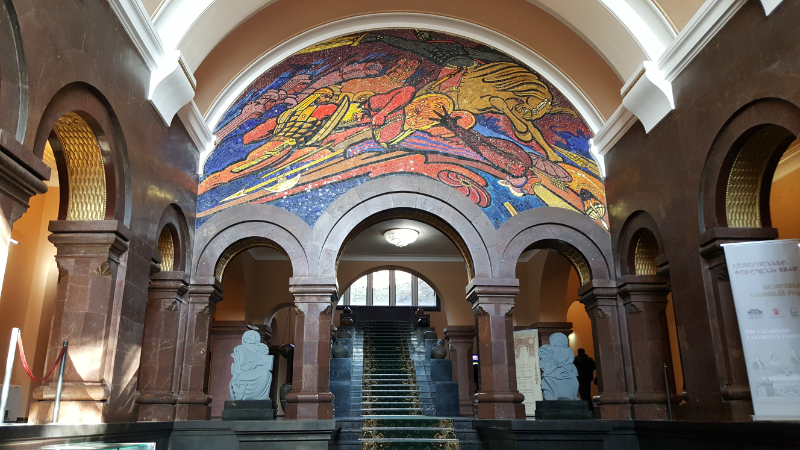
Entry area of the museum
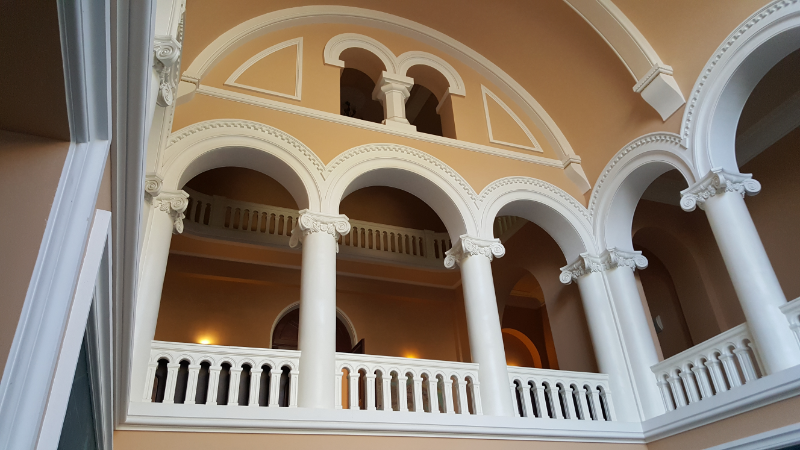
Inside the Matenadaran
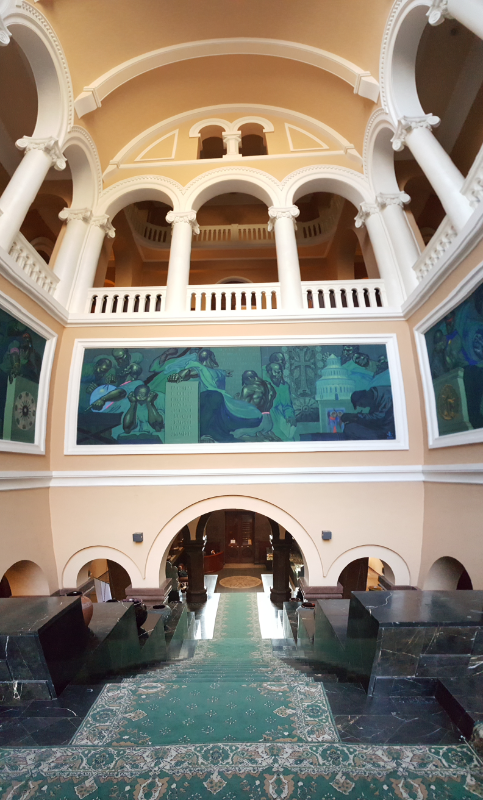
Grand staircase (it’s a panorama picture which is why it looks warped)

One percent of the total collection might not sound like a lot, but trust me, it’s plenty. I knew that it would be a waste to go to the museum without a tour guide, so we sprung the extra $5 (split between the two of us) for a tour. As always, it was MORE than worth it. Zoe was a great museum buddy too. We both asked the guide a bunch of questions which she patiently and thoroughly answered. If we had just gone on our own, I wouldn’t have even gotten half as much out of our visit. Most of the stuff I’m going to say is based on what we learned from the tour, so if something is wrong, I’m passing off the blame!

The Armenian alphabet was created by Mashtots in 405AD in order to translate and record the Bible in Armenian. The first Bible was translated, and many other books followed. There were a lot of books translated from the famous Library of Alexandria in Egypt, and our guide said that when that library burned down, a number of books were translated from Armenian back into the original languages to replace those that were destroyed.

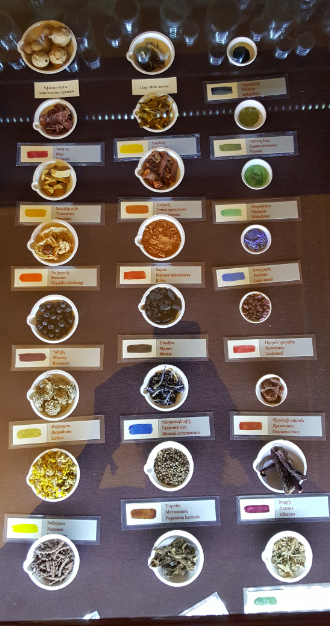
The materials used to make the different ink colors.

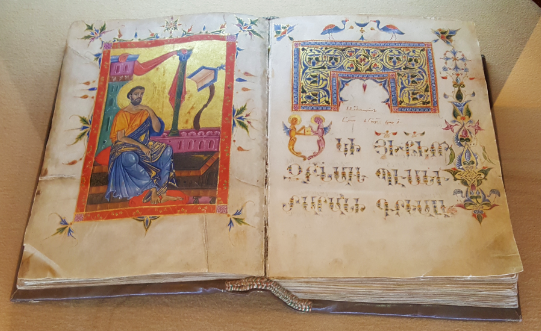
The first books were written on lambskin and later parchment. They used all-natural inks, so the colors have been preserved in their original quality throughout the years. Blue is from lapis lazuli, a rock known for its rich blue color. Green is from copper oxide. Red is from the Armenian cochineal bug, found in the Armenian highlands. The bugs live underground and only emerge for a few hours each morning from mid-September to mid-October to mate. Gold is real gold, and it’s attached to the pages with garlic juice. How on earth did people figure this stuff out?? (Excuse the upcoming series of horrible pictures because it’s not easy to take good pictures of things covered in glass.)

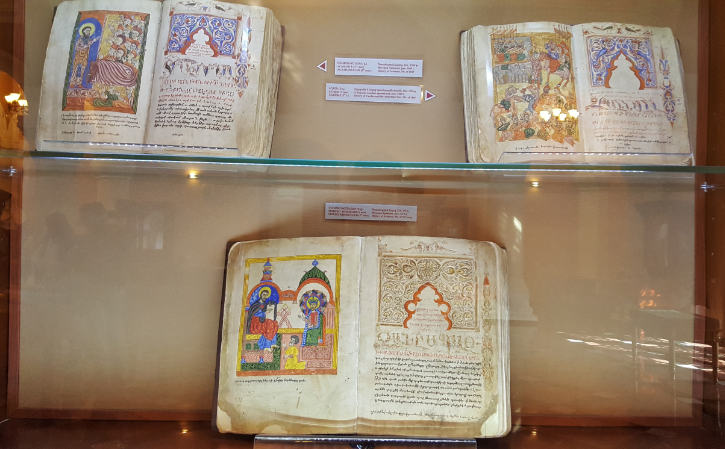
It’s amazing that the ink is unrestored! This copy of the gospels is from the 13th century.
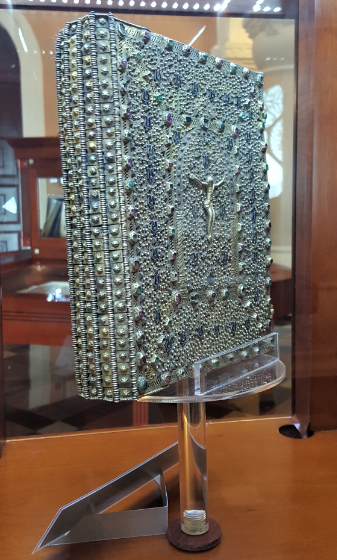
That’s one serious Bible cover

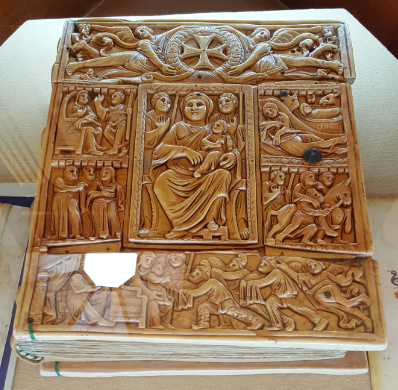
The Bibles especially have very beautiful covers because the quality of the cover should reflect the importance of the contents. Mostly, Bibles had silver, leather, or velvet covers. One Bible that they have on display was copied at Etchmiadzin and has a 6th-century ivory cover.

After the alphabet was invented, Bibles and other books started being copied all over Armenia, mostly in monasteries. It could take around two or three years to complete one copy. That sounds like long, but when you look at the amazing penmanship and drawings inside, it almost doesn’t seem like it should be enough time!

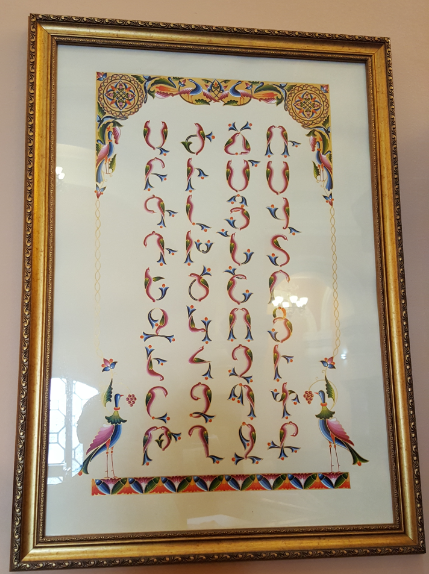
The original 36 letters of the alphabet as designed by Mashtots. For the old numbering system, the first column is ones, second tens, third hundreds, and fourth thousands.

Until the 10th century, everything was written in all capital letters. They think that Mashtots only made the capitals, and lowercase letters were developed later on. They also used to use the alphabet for numbers. When the alphabet is written in four columns from left to right, the first column is ones, the second is tens, the third is hundreds, and the fourth is thousands. From top to bottom, the letters are 1-9. There’s no way to write zero, so don’t ask me how they dealt with that. For numbers greater than 9999, a horizontal line drawn over a letter meant that the value of that letter should be multiplied by 10,000. The western Arabic numbering system started being used in the 16th century… thank goodness because that old system is confuuuuuusing.

Ivory covered Etchmiadzin gospel
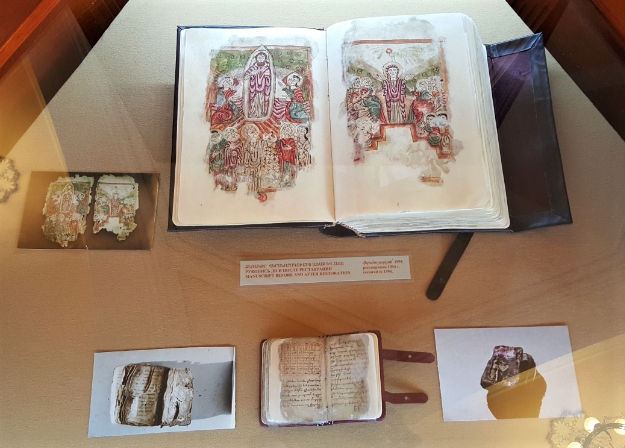
These are some books that were in very bad shape and had to be grafted onto new pages to keep them from falling apart. You can see the original pages in the little pictures to the left, and the book shows those pages attached to new ones.

Armenians also used to have their own system for music. There are 49 classical Armenian musical notes and the great tragedy is that no one knows how to read it anymore. They can’t find a key that explains it, so all of the music that they have is unusable. I feel like someone should write a historical mystery novel where the characters are searching for the lost key (if anyone out there wants to write it, you don’t even need to give me credit… just send me a free copy of your book when it’s finished).

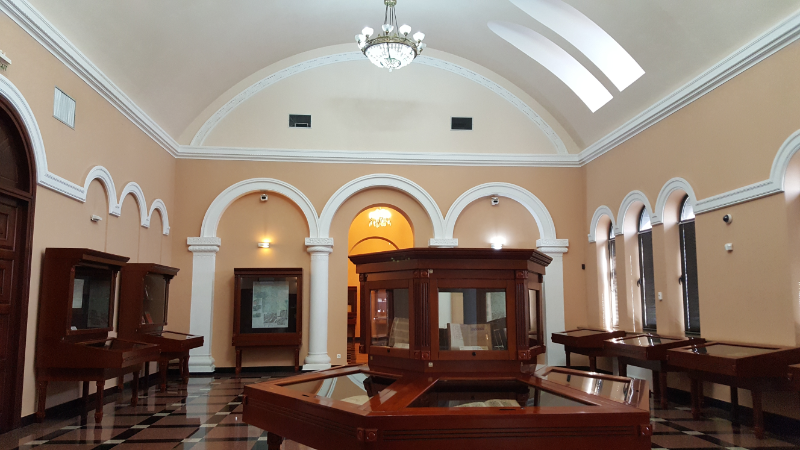
I just love how museums look. So neat and organized!

There are more than just Bibles at the Matenadaran, though at this point it might sound like that’s the extent of the collection. There are definitely MOSTLY Bibles, but they have a bunch of other cool things too. There’s a 6th-century book written by David the Invincible, the first Armenian philosopher. There are 5th-century Armenian history books, including one written by Movses Khorenatsi that was the first attempt to create a complete history of Armenia from its origins. Armenia’s first legal text is displayed, written in the 12th century by Mkhitar Gosh (he also founded Goshavank Monastery). Since, as you know, everything was done first by the Armenians, Anania Shirakatsi’s work is also displayed, showing that he claimed in the 7th century that the earth is round and that the moon has no light of its own and instead reflects the sun’s light, though he had no way to prove either claim (Galileo didn’t come along until the 16th century). There are also 3,500 manuscripts written in languages other than Armenian.

History books! Why did I never have any history books with such awesome pictures?
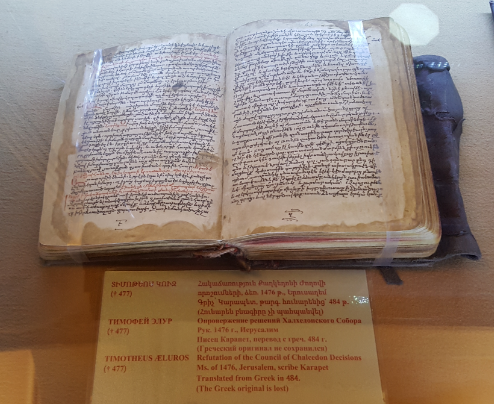
This is an example of a book that was copied from one at the Library of Alexandria, and now the original no longer exists
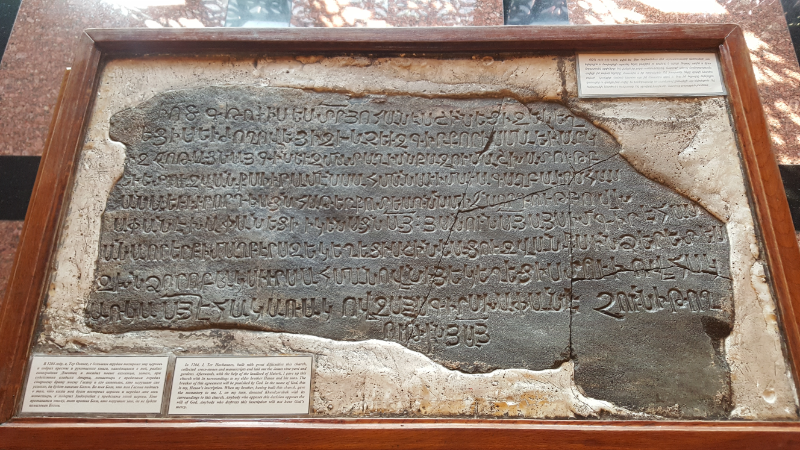
This inscription was found at a destroyed church. It is the only thing that survived. It was written by the builder and says that he gives it to his brother and his sons. Then, the brother adds on saying that anyone who destroys the inscription will not have God’s mercy. It was the only part of the church that was left untouched.
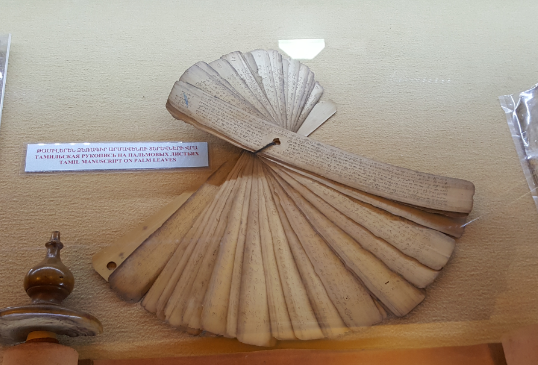
This is written on palm leaves in the Tamil language (spoken in parts of India, Sri Lanka, Singapore, etc)

The printing press was invented in Germany in 1440, and the first Armenian book was printed in 1512 in Venice. The first Armenian Bible was printed in 1666 in Amsterdam. Etchmiadzin eventually got its own press, and it printed its first book in 1772. All of those books are displayed in the museum.

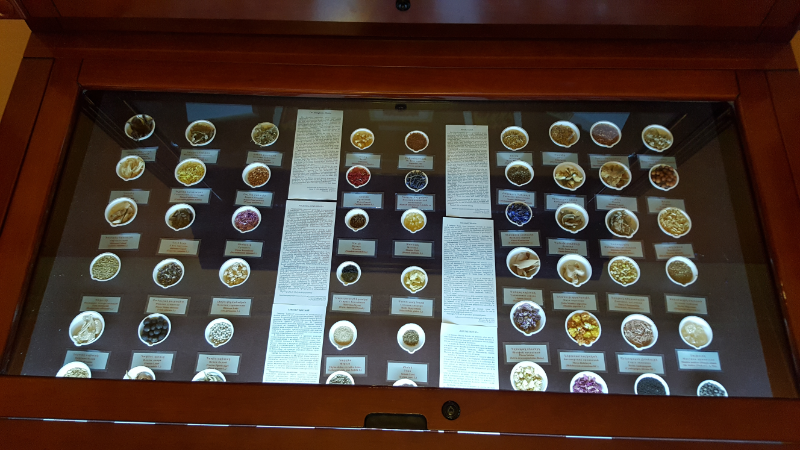
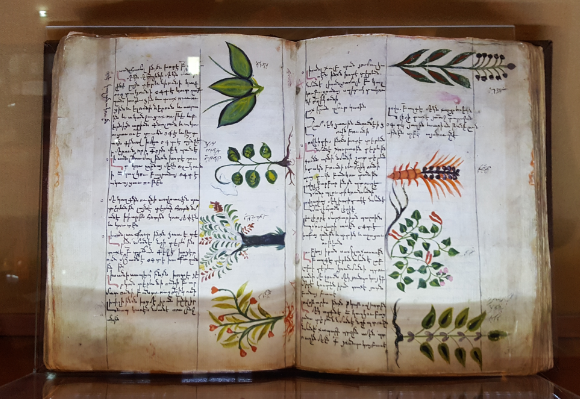
There is also an entire medical section. Mkhitar Heratsi, the father of Armenian medicine, lived in the 12th century. Some of his books are there, plus many others. There are books talking about different herbs, Armenian and imported, and their medicinal qualities. At the Matenadaran, they have used some of the recipes for elixirs and lotions and other beauty products in the old books and recreated them! Isn’t that cool?? One of them, the “royal elixir” is made from 54 herbs that are gathered on specific lunar days in order to make the elixir stronger. It was used in the Middle Ages to give the kings “youthfulness and zest” and it “heals the heart and makes the spirit happy”.

These are the 54 spices used to make the royal elixir.
Medical book talking about herbs and their uses.
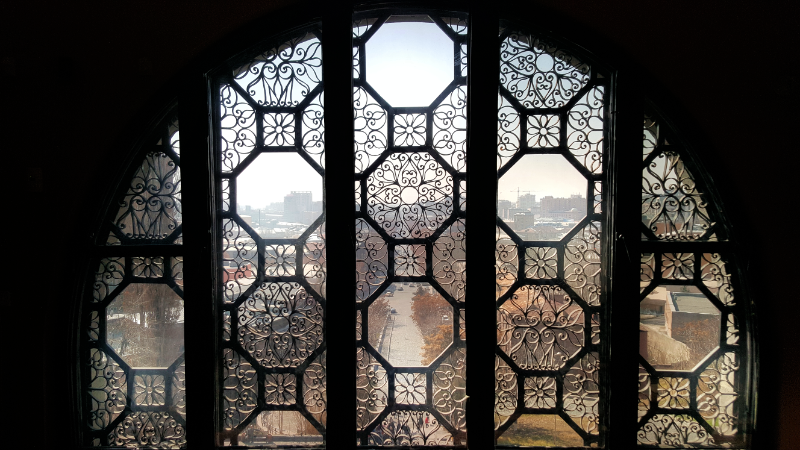
Looking out at the city.

Side tidbit: when we were talking about the royal elixir, our guide brought up the fact that at Etchmiadzin, they make myrrh every seven years. Armenian priests come from around the world to take some back with them and use it sparingly until the next batch is made. Each new batch is mixed with the old, so there’s continuity from the very beginning of the Armenian church. It contains over 40 herbs and is mixed in a big, silver cauldron.

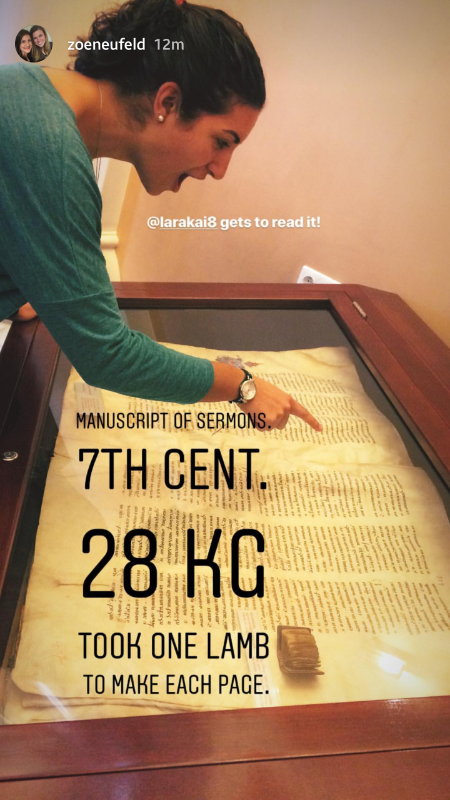
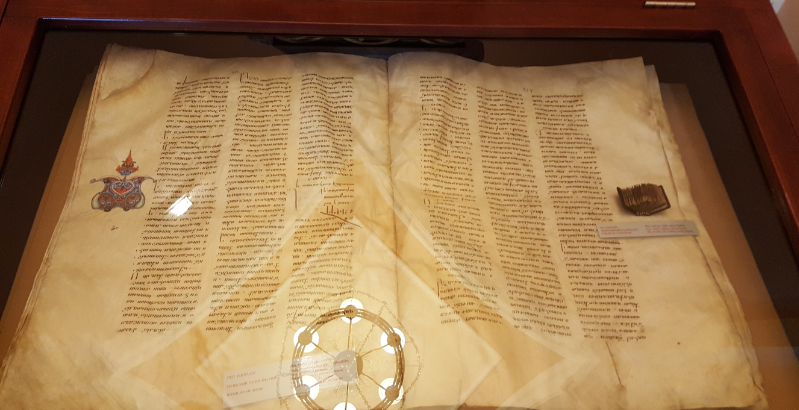
Reading the biggest book. Captions courtesy of Zoe.

Finally, the funniest display they have is a contrast between the biggest and the smallest books in the museum. The largest one is 604 pages, and each page is an ENTIRE lambskin. That means that 604 lambs went into the creation of that book. Like what. It weighs 28kg and is the Homilies of Mush. It’s now split into two parts because two women decided to save it during the Armenian Genocide. They found it in the ruins of the church in Mush, split it in half, and both headed towards Etchmiadzin. One woman made it. The other did not, but before she died, she buried her half at a monastery. It was found years later by a Russian soldier. Those two women saved that book from sharing the fate of the estimated 20,000 manuscripts destroyed during the Armenian Genocide.

The smallest book doesn’t have a story to go along with it, but it weighs 19g and, in contrast, did not require one lamb for the creation of each page. It’s a church calendar, and apparently you can’t really read it with the naked eye which seems a little inconvenient to me… Oh well.

The biggest book and the smallest book!

It would have been a shame to leave Armenia after 9 months without visiting the Matenadaran. It was absolutely worth the visit, and absolutely x10000000 worth the tour. I am a lover of books, art, and architecture, so it was kind of like heaven to me, but I think that even if you weren’t, it would be an interesting and worthwhile trip.