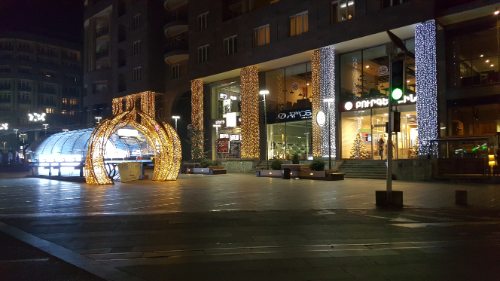
My first few days in Lebanon were rainy. When I say “rainy”, I’m not talking about just overcast skies and some little showers here and there. I mean that for three straight days, it was like the sky decided to finally unload some serious emotional baggage. I usually don’t believe in umbrellas (don’t bother trying to make sense of me), but no chance was I going out in THAT with just a rain jacket.

We started out by planning “rainy day activities” and ended by defiantly going outside despite the rain. The National Museum of Beirut was stop #1 on the rainy-day Beirut tour, and it was a great way to start off my time in Lebanon! It’s an archaeology museum, and they have a huge variety of artifacts. There are so many different types of things, and they span thousands of years of history. The museum has over 100,000 artifacts, and about 1,300 of them are displayed. If you think that sounds like they’re kind of gypping you, trust me when I say that 1,300 is more than enough. The museum is incredibly well done with enough stuff to make you feel satisfied but not so much that your brain is mush by the time you leave. I was also impressed with their audio guide… they give you an ipad! And you go around the museum scanning barcodes to bring up more information about certain objects. So high tech!
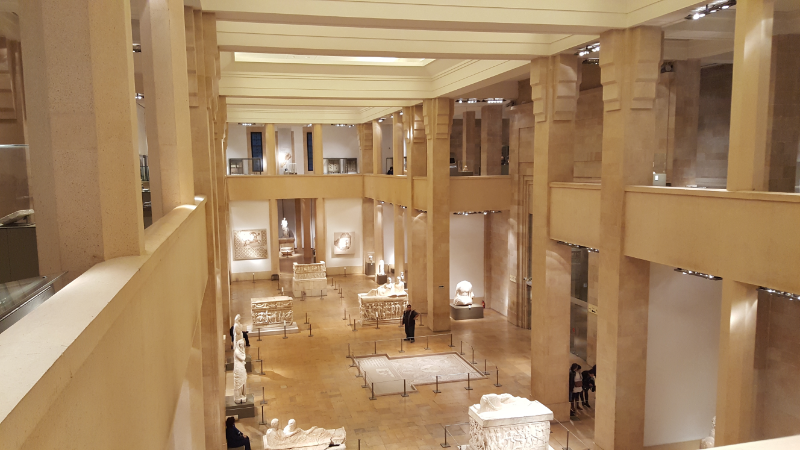
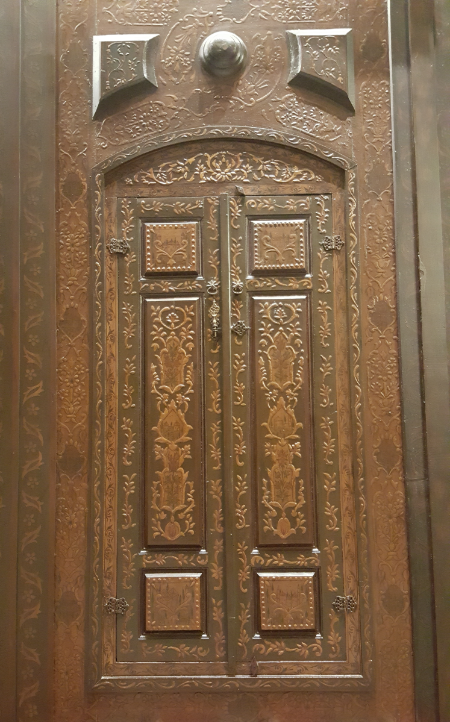
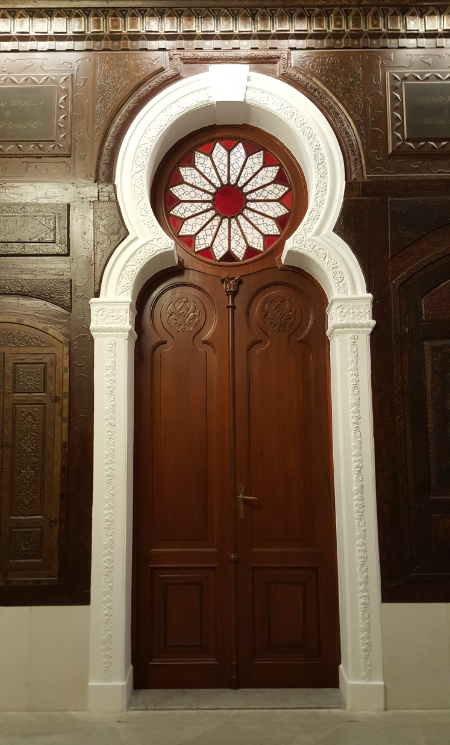
Doesn’t this just look exactly the way you think an archaeology museum should look?

The museum is located right along the road that served as the separating line between the east and west sides of Beirut during the civil war. That meant that there was no chance of the building making it through the war unharmed, so the curator of the museum at the time undertook measures to protect the collection. Some artifacts were relocated to other parts of the country, and other small objects were hidden in the basement. Those storerooms were walled in so that no one even knew they existed, aside from the very few who were involved with the installation. Larger, unmovable objects, such as the mosaics set into the floor and large statues, were encased in wood and concrete and left in place.
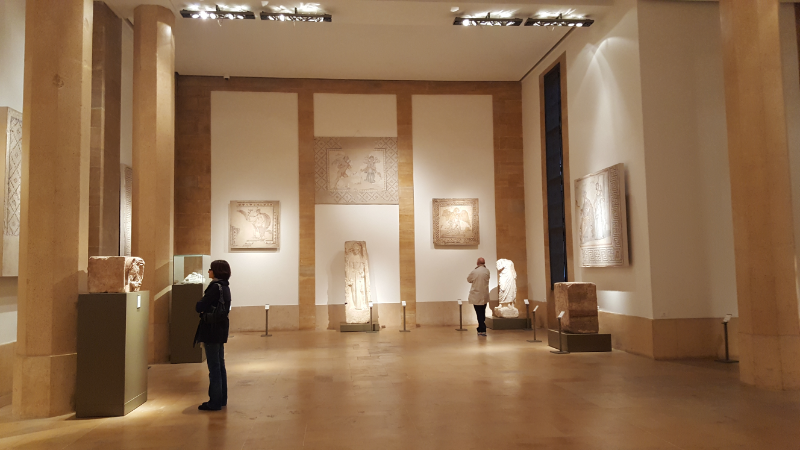
Museums are the best.

The war lasted longer than expected, so despite these protection measures, the collection still suffered greatly. The artifacts hidden in the basement storerooms were in an uncontrolled environment for 15 years. Flooding in the museum led to high humidity levels (around 95%). A fire caused by shelling resulted in the destruction of museum records and artifacts. Large objects suffered damage from the salt in the concrete and the lack of ventilation in their emergency casings. Looting scattered the collection across the world. The building itself was covered in shell and bullet holes and graffiti.
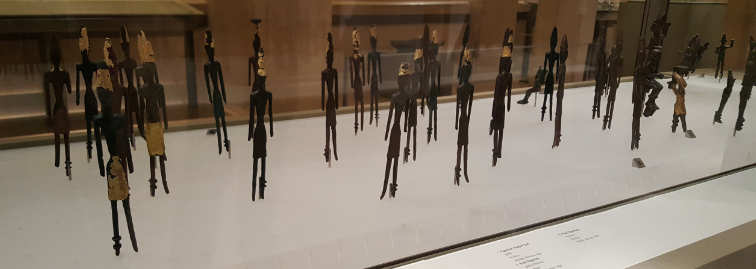
I’ll be honest, I don’t remember what these are. I imagine they’re like the ancient version of little green army dudes (ignore me).

It took 21 years after restoration began for the entire museum to open again. The building needed a serious overhaul, and the collection had to be inventoried and restored. In 1999, four years after restoration efforts began, the museum permanently reopened, but the final floor wasn’t completed until October 2016. The museum is STILL working to track down artifacts that were stolen and sold during the war.
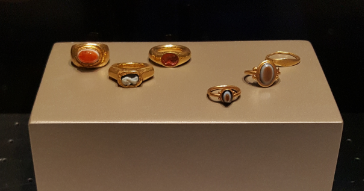
Some cool rings that they found buried with the anthropoid sarcophagi.

I was lucky that the basement was open by the time I visited. It included some of the coolest stuff in the whole museum… there were three naturally mummified people who were found in a cave, a huge collection of anthropoid sarcophagi, and a 2nd-century frescoed tomb that was relocated from Tyre. I don’t have pictures of the people because it seemed disrespectful or of the tomb because photography isn’t allowed, so I guess you just need to visit Lebanon if you want to see them…

I checked out the National Museum solo, but Badveli and Maria joined me for the next museum on the list, the Nicolas Sursock Museum. During his life, Sursock was an art collector, and his will left his house to the city of Beirut to be converted into an art museum. I’ll be honest, 90% of the reason I wanted to go was just to see the house. It’s a modern/contemporary art museum, and we all know the complicated relationship I have with modern art. I figured that no matter what the art was like, the building would be worth the trip. Badveli was interested in checking out these 19th-century pictures they have of the ruins in Baalbeck, so we made it a family trip!
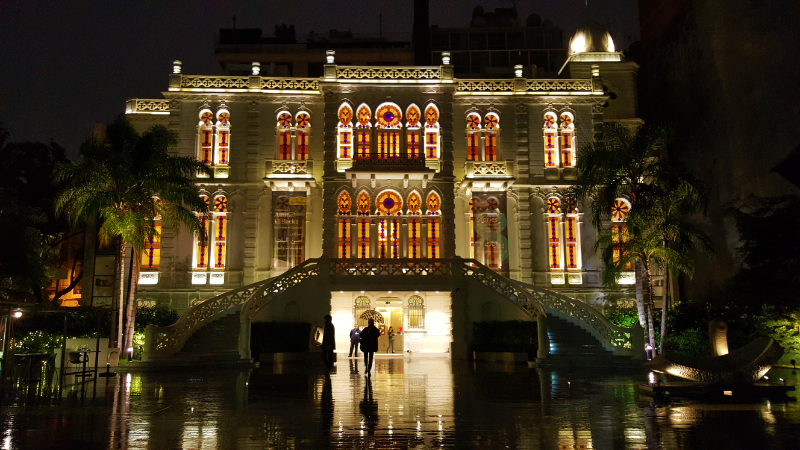
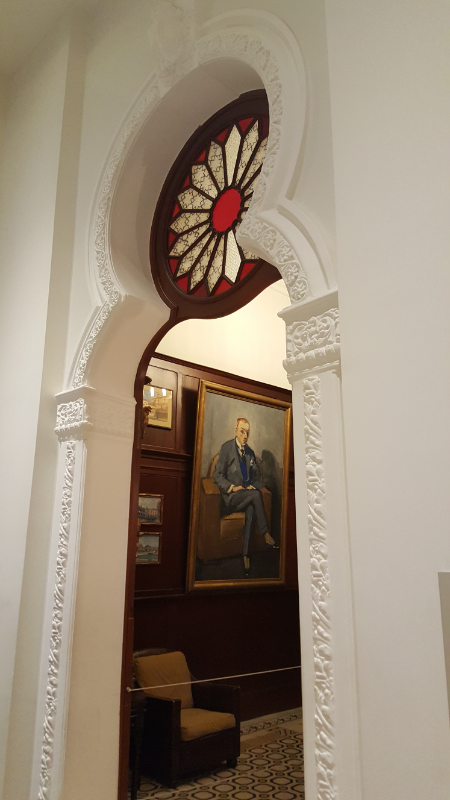
That stained glass though…
Talk about an epic doorway!

The house was built in 1912 and is a cool mix of architectural styles, including some elements inspired by Venetian and Ottoman architecture. It also has a bunch of stained glass which basically guarantees that I’m going to like it. The museum first opened with the house kept in its original condition, and exhibitions were shown in the many rooms of the mansion. Eventually, a project was undertaken to reconfigure some of the rooms into more traditional gallery spaces. Recently, a much larger project was completed that added four underground floors beneath the house and garden. I can only imagine how fun that construction process must have been, figuring out how to levitate a mansion while constructing another building underneath it.

For the most part, the exhibitions were about what I expected… weird. There were a few cool pieces, but it was largely baffling, as is the way with modern art. Don’t get me wrong, I have no issues with weird. I love weird things! But the weirdness of most modern art is a type that must be incompatible with my personal brand of weird. There was one thing though… as we were leaving, we walked past a curtained doorway marked with a sign saying, “Please do not touch the floating burger.” I was intrigued. Burger like hamburger? Why was it floating? What about it made touching it so tempting that they explicitly had to tell people not to? I peeked my head inside, and somehow what I saw was simultaneously exactly what I expected and the last thing that I expected. It was a floating burger. The room was completely dark, a blacker darkness than any I’d ever experienced. The only light shone directly onto a floating hamburger. It was like a beacon, calling you towards it. The burger practically screamed, “TOUCH ME!” I’m not an uncultured scrub… I know that you’re not supposed to touch things at museums, but I’ll be honest. I wanted to touch that burger. HOW DID THEY KNOW?  It was like I was hypnotized. There was also a museum staff woman standing by the entrance, probably making sure that the burger was left untouched because I bet she’s felt the same, inexplicable desire that I felt to touch the forbidden burger.
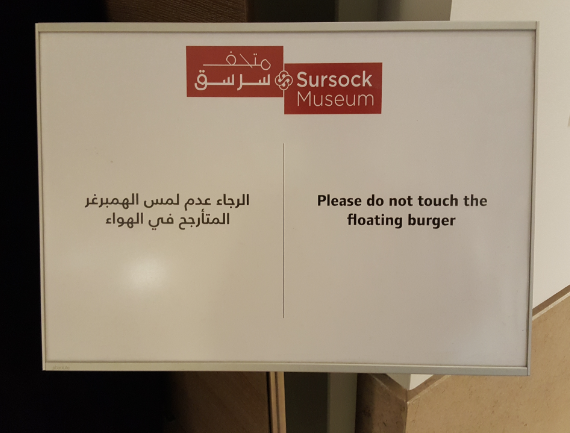
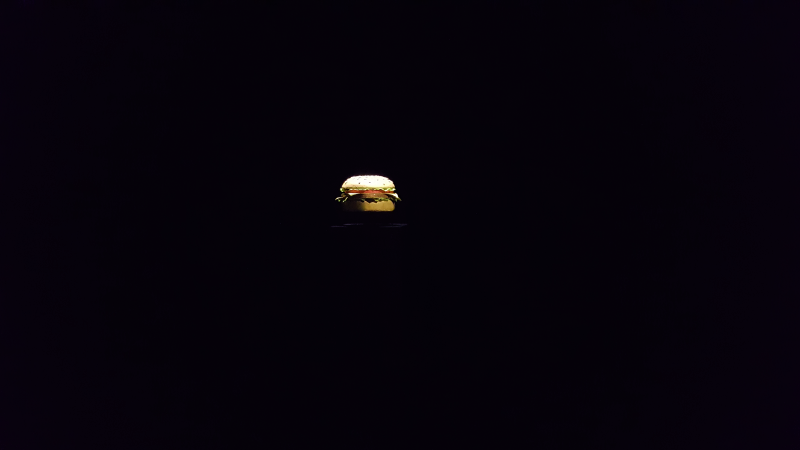
Like… how could you NOT look after seeing this??
Genius.

I felt like my faith in modern art was restored… until we left the museum and I read the pamphlet that accompanied the piece. It was something about capitalism and blah blah blah profound symbolism blah blah blah. I immediately forgot what I read because I knew that trying to assign too much meaning would inevitably ruin the whole thing for me. Maybe that’s the problem. I want modern art that has no explanation besides “I made this because I thought it was weird and funny.” Otherwise, it gives me flashbacks to university where we’d make a design that we thought looked cool and then go back later to make up some stupid, symbolic meaning because the project required it. What’s wrong with just saying, “I did this because it looked cool”? To be fair, sometimes the explanations feel legitimate, but most of the time they seem like a bunch of hooey.
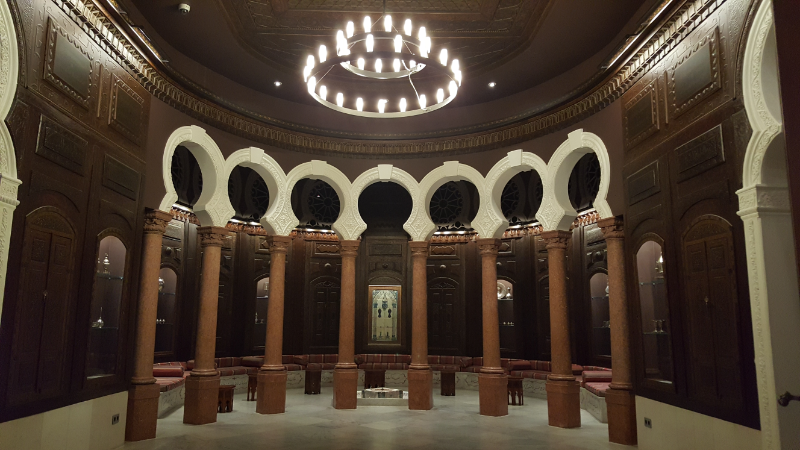
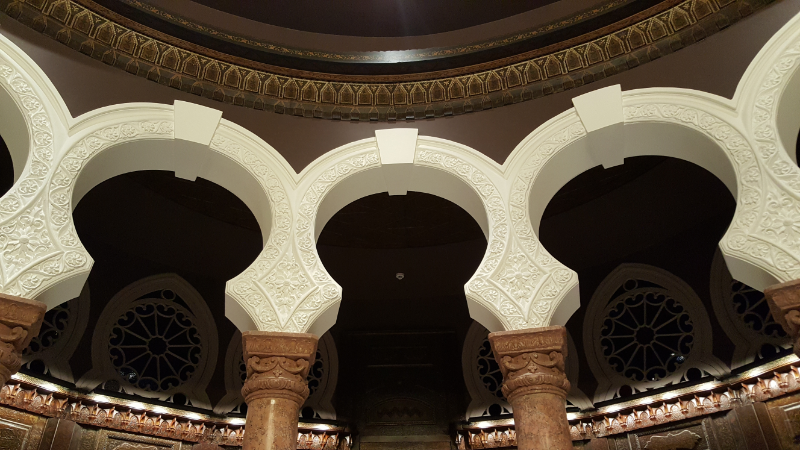
This is the salon where Sursock would entertain guests. It’s a ridiculous room but also kind of awesome.
I couldn’t get over how much detail there was in EVERY aspect of the room.
The wood paneling on the walls was brought in from Damascus.
Geez.

What a day! I just spent WAY more time than expected trying to understand the history of Lebanon from 1915 to the present, and I kind of think that my brain might fall out of my head. I’m one of those people who really likes math because there’s always a clear answer. It’s straightforward. This, on the other hand, is not. There are too many details and too many people involved and too many things happening. My. Brain. Hurts.

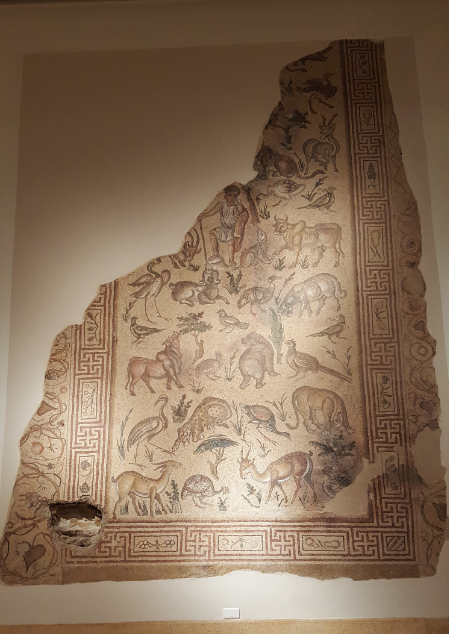
I’m going to show some various war-damaged things, but some of them have longer stories that I’ll talk more about later. For now, I’ll just caption them briefly. This is a mosaic in the National Museum. The hole in the bottom left is from a sniper who shot at bystanders through the wall behind the mosaic.

You might be wondering why I’m spending so much time on history instead of just getting right to the fun, pretty things I saw. One thing that I’ve realized more and more over the last year is how much better you can understand the people and the situation of a country if you take the time to look at their history. I know, that’s another “DUH” statement, but it’s something that I didn’t used to do. Usually, when people travel internationally, they go to a country, they see the sights, they decide all the things that they like and don’t like about how the country works and how the people behave there, and they go home, usually with some feeling of superiority about their country and the way that they live. I know that’s not true for everyone, but from what I’ve seen, it’s not uncommon. I’ve heard people talking about experiences in other countries and ending with the basic statement of, “They just aren’t as civilized as we are.” That statement. Is horrible. People are different. Different cultures value different things. My idea of “civilized behavior” isn’t the same as that of someone born in India or someone born in Ghana. Does that make any of our ideas wrong? Yes, there are some universal morals that stand despite any cultural argument. More often than not, though, the things that we find so offensive in others are based on nothing more than personal preference and stereotypes.

Sorry for that rant. Mostly I’m not even talking about Lebanon anymore, but this is just something I’ve been thinking about a lot lately. So, like I was saying, if you want to be able to identify WHY something is the way it is, something you may not like, you need to have some context… which leads us back to the history lesson. On that note, here is my attempt to explain the last century the best I can without making your brain hurt too.

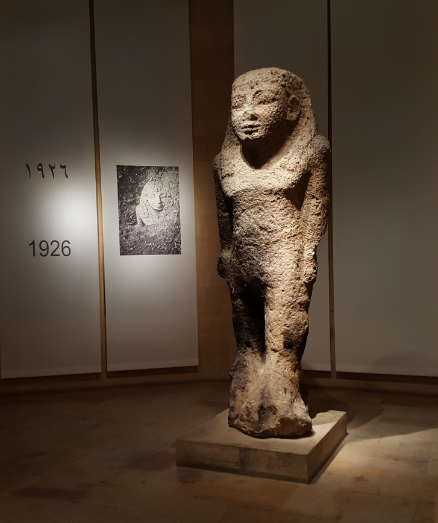
Many of the large pieces in the National Museum that couldn’t be moved during the civil war, including this one, were encased in concrete for protection. Smaller artifacts were hidden in the basement behind fake walls so that no one would know they were there.

I left off my last post at the end of World War I when Lebanon and Syria were put under French control. During the Ottoman years, the size of Lebanon was greatly reduced. Much of the eastern and southern land was cut from Lebanon’s territory by the empire. In 1919, a Lebanese delegation presented their argument for an extension of Lebanon’s borders back to their previous locations. This was mostly driven by the Maronite Christian population who wanted a Lebanese nation. Interestingly, those territories were majority Muslim populated, so the addition of that land to Lebanon practically eliminated the Christian majority.

A constitution was written in 1926 that was supposedly meant to balance power between religious groups but was really favoring the Maronites. The President was a Maronite Christian, the Prime Minister a Sunni Muslim, and the Speaker of Parliament a Shiite Muslim. The Parliament seats were divided into a 6:5 Christian:Muslim ratio based on census information at the time. The President had a very strong and influential position, and this is still mostly true today, though some things have changed since the original constitution (and the Parliament ratio has changed to half and half of Christians and Muslims).

During World War II, Britain sent troops to Lebanon because Germany was moving weapons through the country. In 1941, the British recognized Lebanon’s independence. There were elections in 1943 that weren’t recognized by France, and the new leaders were thrown into prison. International pressure convinced the French to release the leaders and recognize the new, independent Lebanon!

From the time of independence until around 1958, Lebanon prospered. The economy was booming, and tourism, agriculture, and education were flourishing. Then, in 1958, Arab nationalism was on the rise in the Middle East, and Egypt and Syria joined together to create the United Arab Republic. They wanted to unite all Arab nations into one country which required eliminating any governments seen as “pro-West”. After Iraq’s government was toppled, the Lebanese president asked for help from the US to keep Lebanon independent. Some Lebanese, mostly Christians, wanted to remain aligned with the west, while others, mostly Muslims, wanted to join the new Arab nation. The US intervention successfully stabilized the country, though 2000-4000 people were still killed.

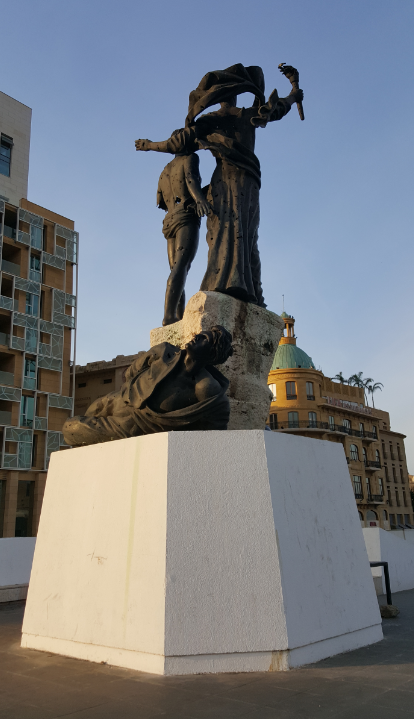
This is Martyrs’ Monument. After the war, it was restored, but some of the war damage was left as a reminder. You can see holes in all of the statues, and one of them is missing half an arm.

The beginning of the 1960s was relatively calm, and Lebanon continued to grow economically. Then, in 1967, more Palestinian refugees fled to Lebanon after the 1967 Arab-Israeli War, joining the over 100,000 who had already settled there after the 1948 war. The Palestinian militant forces, previously operating out of Jordan, were kicked out and also moved to Lebanon. The Palestinian Liberation Organization (PLO) started using southern Lebanon to launch attacks on Israel. Israel retaliated, and the Lebanese people were split between pro- and anti-Palestinian groups (the former was mostly Muslim and the latter mostly Christian).

An agreement signed in 1969 gave the PLO control over the refugee camps and access to northern Israel, and it had to recognize the sovereignty of the Lebanese government. The Lebanese army then had to leave the PLO alone, and Maronite militias took their place. Before this, Lebanon had managed to stay out of all conflicts with Israel. The PLO ended that neutrality when it set up what was effectively a mini-state in southern Lebanon and stepped up its attacks. Israel retaliated by bombing Lebanon. The Lebanese government was weak and divided and couldn’t really do anything to defend its people.

The Lebanese Civil War started in 1975. The fighting between the Maronite militia and PLO spread to Beirut. It started with a few minor clashes and then erupted into an all-out war. More and more militias started to emerge, each generally tied to a religious group. Practically everyone had their own militias – the Maronites, the PLO, random secular groups, the Druze, the Sunnis, the Shiites, and the Armenians. Everyone had their agendas, supported different sides for different reasons, and were funded by different outside sources. The Armenians mostly tried to remain neutral and only fought when they needed to defend Armenian areas. The western part of Beirut turned into the “Muslim side” of the city and the eastern part the “Christian side”, and they were separated by a road that became known as the “green line”. People fled to the appropriate sides for safety.

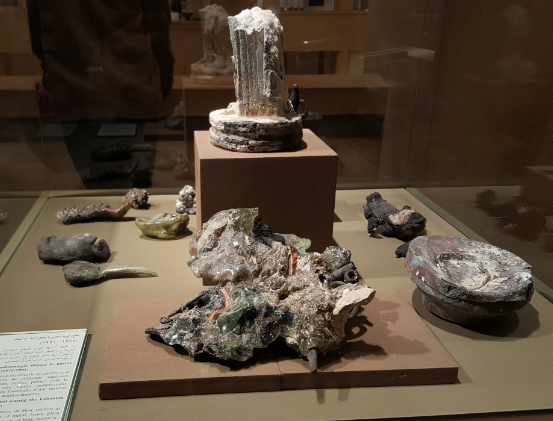
These are some objects in the National Museum that were damaged during the civil war. The storage room where they were located was shelled, and the resulting fire fused together all of these different materials.
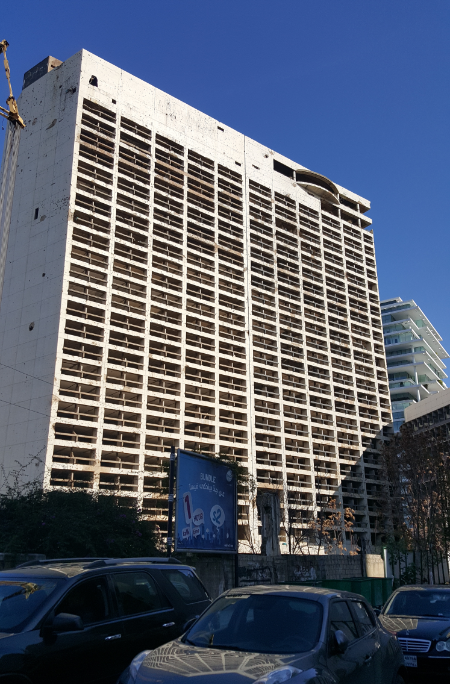
The part of the city with a bunch of nice hotels became a battleground with militias fighting each other from building to building. This one, the old Holiday Inn, had only been operating for a couple years before the war started. It is the only hotel in the area that’s still left in its post-war condition due to disagreements about its future between the owners.

Meanwhile, the leader of Syria declared that “Lebanon is part of Syria, and Syria will take it back”. Syrian troops entered the country and started fighting for control of the land and the Palestinians. The Maronite militias, the PLO and pro-Palestinian Lebanese National Movement (LNM), and the Syrian army fought each other and also massacred innocent civilians during random attacks on villages, camps, and neighborhoods. A ceasefire was negotiated near the end of 1976, but the PLO continued to attack Israel, and Israel continued to retaliate.

In 1982, after Israel invaded Lebanon all the way to Beirut, there was an international attempt to move the PLO and Syrian forces out of Lebanon. Israel was told to withdraw from Lebanon as well as stop its attacks. Foreign troops landed to supervise the PLO evacuations. Fighting continued with Maronite militias attacking Palestinian refugee camps and killing innocent people. The Syrian army refused to leave, and suicide bombers attacked the US and French troops who were there for peacekeeping, eventually forcing them out of the country.

The fighting didn’t stop, but it was a little more sporadic after that. A new extremist group, Hezbollah, entered the mix in the early 1980s, backed by Iran and Syria, and worked with Palestinian forces to attack Israel. Raids on towns continued by all of the various groups, and civilians continued to be killed. There were bombings and shellings and assassinations.

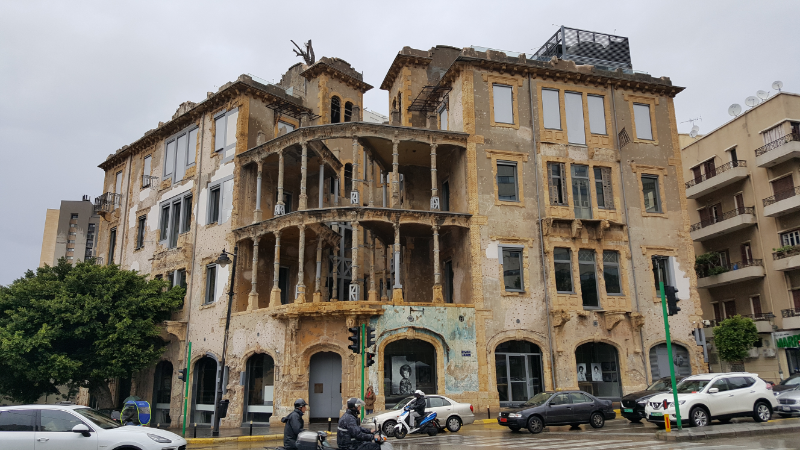
This building, the Barakat house, had tenants before the war who all moved out because it’s located right near the green line that divided the city. Thanks to its open architecture, it was the perfect place for snipers to hide and be well protected. It was a big strategic location during the war.

Finally, in 1989, an agreement was signed to try to end the war. It called for the Syrian army to withdraw within two years, which they rejected. The war ended in 1990 when the Syrian Air Force bombed the presidential palace, driving the interim prime minister, General Michel Aoun (Lebanon’s current President) into exile. The government was restructured to give equal representation to Muslims and Christians. The militias were disarmed, except for Hezbollah because it was a “resistance force” fighting Israel (and had Western hostages to use as leverage). Over the next few years, Syria did all it could to keep the Lebanese government dependent on it to run the country.

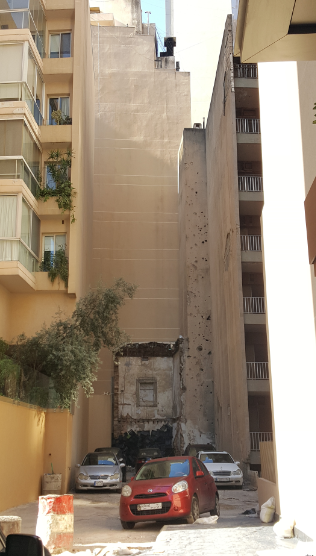
This is a random alleyway I wandered down, and I was thrown off by the fact that there are all of these rebuilt and refinished buildings except for this one little swiss-cheese wall that still shows war damage.

General elections were held again in 1992 and were boycotted by the vast majority of citizens because they were organized by Syria. Despite the civil war being “over”, there were still ongoing incidents. Hezbollah and Israel continued to actively fight, even after Israel withdrew the rest of its forces in 2000. In 2005, there was a series of assassinations of government leaders. The same year, the remainder of the Syrian troops finally withdrew. In 2006, another war broke out between Hezbollah and Israel. The infrastructure of Lebanon took a hard hit with Israel’s bombing of many of the bridges throughout the country.

Since then, things have settled down, and the country is in a weird limbo of simultaneously rebuilding and still having a bunch of unresolved issues. The Syrian war has put extra strain on the country in the form of an estimated 2 million refugees. For a country of only about 4.5 million people, that’s significant. Plus, there are still about half a million Palestinian refugees in the country. That is a huge economic challenge, and it’s expecting A LOT from the country’s infrastructure.

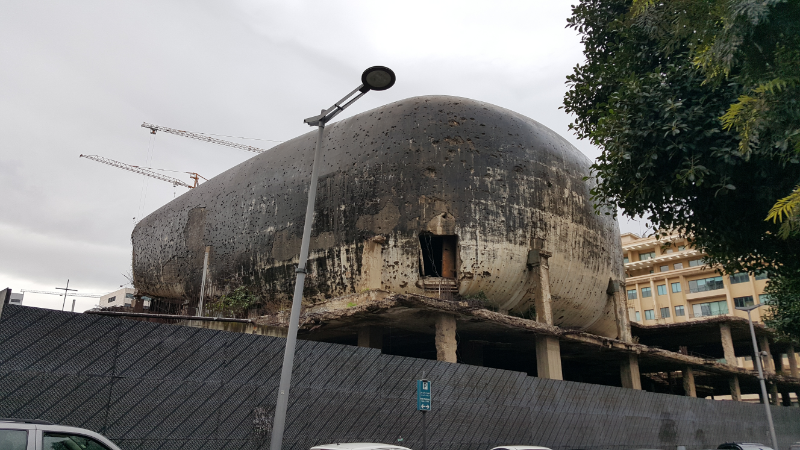
“The Egg” was part of an unfinished construction project when the war started. It was meant to be a movie theater. Now, it just looks like a weird, concrete bunker.

Lebanon has so much potential in so many ways. It’s beautiful, for one. It used to be a hopping tourist destination, and there’s no reason why it shouldn’t be able to get there again. There have been so many conflicts in the country’s history, and after many of them, it was able to enter a period of peace and prosperity. Maybe I’m just optimistic, but I hope that’s something that can happen again. Let me try to help out with the tourism revival… you should visit Lebanon! I never felt unsafe, and it was so interesting to visit a place with such a complex history.

Now that you’ve read more historic details than you probably ever wanted, my next post will get into the fun stuff!

The rebuilding had the unexpected side effect of revealing hidden ruins, and the unique circumstances gave archaeologists a chance to investigate things that had previously been inaccessible. Their findings led to the conclusion that the city of Beirut may date back as far as 3000BC!

Remember when I said that Lebanon is super old? As you might expect from a very old place, there are a lot of museums in Lebanon displaying very old things. I went to two of them, the National Museum of Beirut and the American University of Beirut’s Archaeology Museum. Beyond just museums, there are ruins all over the city (and under the city) and the country. It would be impossible to give you a thorough history of Lebanon, mostly because you would be bored to tears reading it, and I would react similarly to writing it. Instead, I’m going to give you the highlights deemed most interesting by me.

(Disclaimer: as usual, I’m at like 90% confident that what follows is accurate, but I’m not a scholar of ancient history which means that looking at this stuff for too long makes my head hurt. I did my best.)

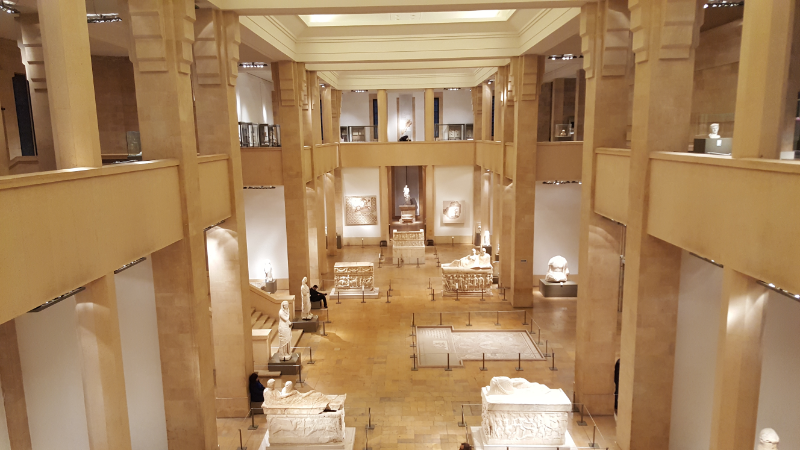
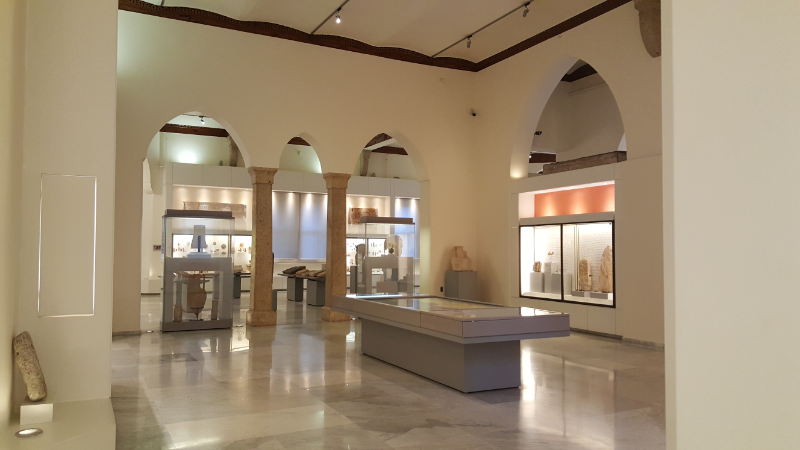
View of the main hall in the National Museum of Beirut.
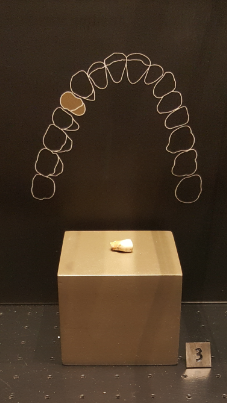
Ancient molar! It’s dated to 200000-50000 BP.

To talk about the first humans in Lebanon, we have to go back… waaaaaay back in history to AT LEAST 48000 BC. Oh yes, that’s right. The National Museum has a molar that has been radiocarbon dated to 250000 – 50000 BP (BP means the number of years before 1950). That, yes, seems like quite the range of dates. I know this is complicated stuff, but you’d think they could come up with a gap of less than 200,000 years. Anyway, that’s beside the point. The point is, even if it’s only from 50000 years before 1950, it’s still ridiculous.

The first permanent settlements are estimated to have emerged by 5000BC. By 4000BC, the land was inhabited by the Canaanites, or Phoenicians. They lived in coastal cities, and the inland was covered in forests. Those cities are still in existence today: Tyre and Sidon were big maritime and trade centers, and Gubla (Byblos) and Berytus (Beirut) were trade and religious centers. The Phoenicians thrived because of their location and many tradable resources. They established a trading relationship with Egypt, bringing in wealth and foreign goods.

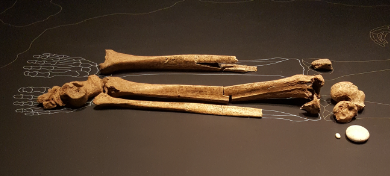
These bones from a woman are dated to 15000 BP. They’re laid out exactly as they were found.

In the 1400s BC, Lebanon became part of the Egyptian empire for a couple of centuries. Egypt was just the first in a long line of powerful outsiders to come in and rule over the land. Post-Egyptians, the Phoenicians enjoyed a few centuries of independence, thriving again and mastering the arts of textiles, ivory work, metalwork, and glassmaking. The Phoenician alphabet spread, making it possible for common people to learn to read. Many modern alphabets can be traced back to the Phoenician alphabet. It was during this period that Sidon and Tyre first entered the story in the Bible, when cedar trees and craftsmen were provided to Israel’s King David to build his palace. Later, Jezebel, the queen of Israel who led the Israelites astray by worshipping the Phoenician god Baal, was the daughter of the king of Sidon.

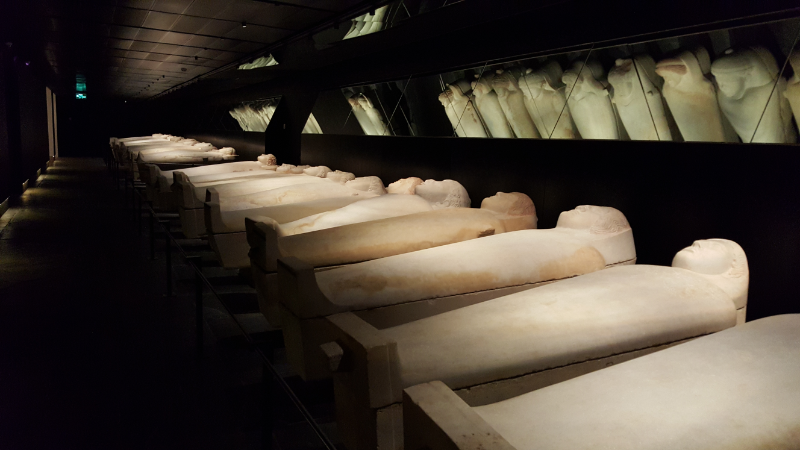
Thirty-one anthropoid sarcophagi were found near Sidon. They’re from about the 5th century BC and show both Egyptian (the sarcophagi) and Greek (the style of the carved faces) influences.
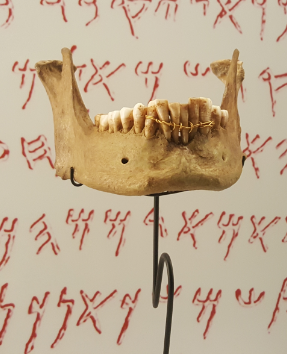
Ancient braces! This is dated back to the 5th century BC, during Phoenician times. It’s the earliest known example of “retentive dentistry”.

When the Assyrians conquered the Phoenicians in the 9th century BC, they ruled oppressively. Any uprisings were squashed, and the people were punished for their rebellion. The Babylonians were similarly harsh rulers. The Babylonian king Nebuchadnezzar sieged Tyre, an island city, for 13 years before gaining control. This siege is described by the Old Testament prophets Jeremiah and Ezekiel. Next came Persian rule and a period of peace until they started imposing high taxes, and the people rebelled.

When Alexander the Great and the Macedonians came onto the scene in the 300s BC, most cities didn’t resist and instead welcomed them in. Tyre, on the other hand, refused to allow entry into the city. The Macedonians sieged the island for seven months and ended up victorious after constructing a causeway from stones, timber, and dirt that linked the island to the mainland. Without its water defenses, the city fell, and its inhabitants were harshly punished for their resistance. Over time, the causeway widened as more and more sand and debris washed up, and today, Tyre is a peninsula. The fall of Tyre and its failure to ever recover its previous status as a world-wide trading center was described by the prophet Ezekiel.

After Alexander died, his great kingdom fell apart under the conflict-filled rule of his successors. The Romans took over, and Pompey added Lebanon as a Roman province. The inhabitants of its major cities were given Roman citizenship. The language switched from Phoenician to Aramaic. It was a time of economic prosperity.

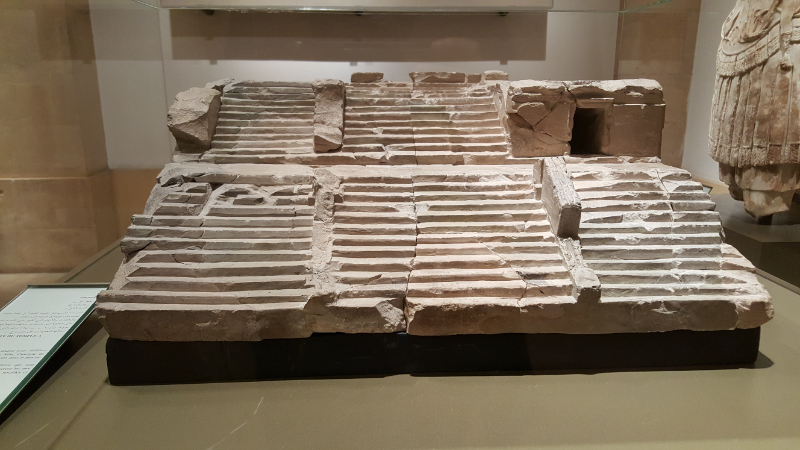
This is a model of a 2nd century AD temple. It was made to guide the builders… architectural drawings, classical style! Imagine being an architecture student in those days and having to make your models out of limestone… I thought cardboard was bad enough!

This was also the time period in which Jesus performed his first miracle in Qana, in the south of Lebanon, turning water into wine at a wedding. He visited Tyre and Sidon as part of his ministry. Later, Paul also briefly visited both cities and met with disciples in each. Christianity spread quickly, leading to a Christian majority in the area. The Maronite church emerged at the end of the 4th century from the followers of Saint Maron, a monk.

Natural disaster in the form of earthquakes struck in the 4th and 6th centuries AD. The 4th century earthquakes were accompanied by tidal waves that destroyed the coastal cities. The 6th century’s destroyed Baalbeck (originally a big pilgrimage location for the Phoenician god Baal and later the location of Roman temples) and Beirut, killing thousands. Between these disasters and internal conflicts in the empire, Roman control of the area weakened.

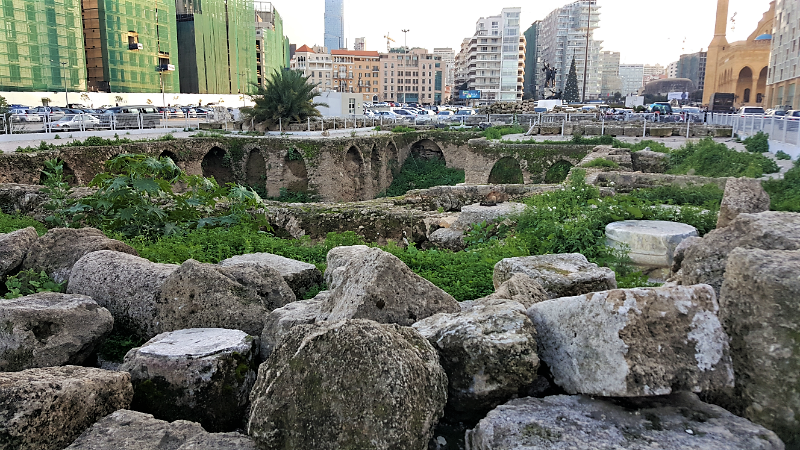
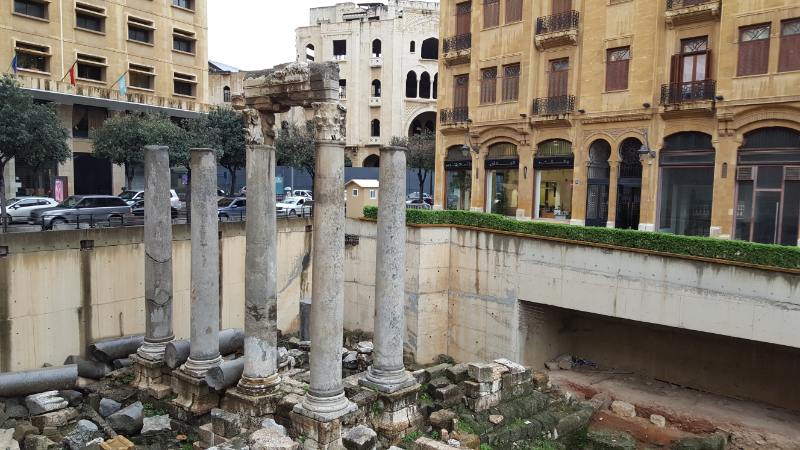
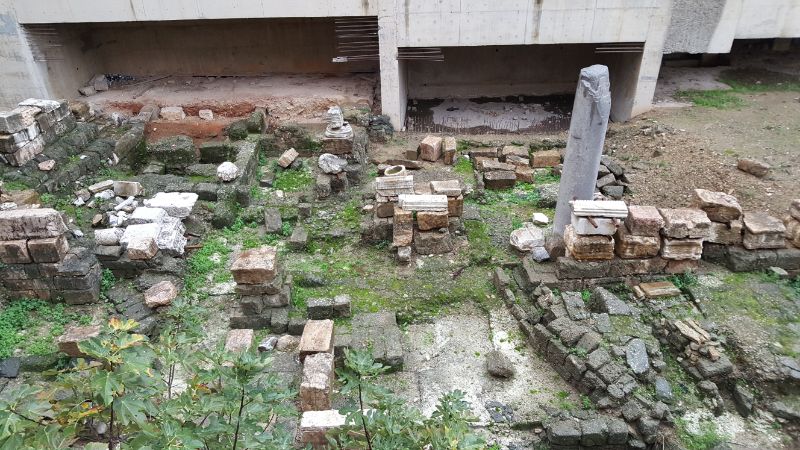
These ruins are guessed to be the remains of the famous Roman law school in Beirut. They haven’t found any decisive evidence of this, so really it’s just a guess because they don’t know what else it might be.

Islam was introduced by the prophet Muhammad at the beginning of the 7th century, and the Muslim Arabs took control from the Romans in the same century. Islam began to spread, and Arabic was introduced as the new language. The Maronite community clung to Christianity and was treated with varying levels of tolerance depending on the ruler at the time. The Druze faith also emerged around the end of the 10th century.

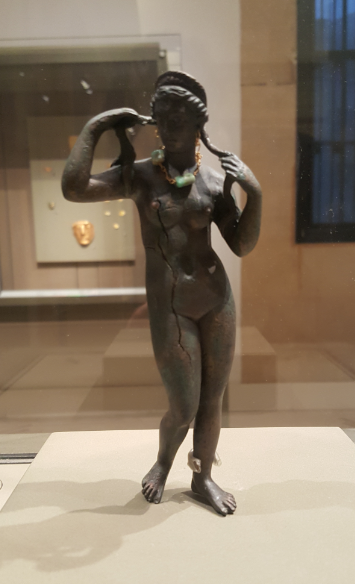
This is some Roman goddess… maybe Venus? I can’t remember, but I thought the fact that she’s wearing a necklace and earrings is pretty cool.

The Crusaders swept in during the 11th century, organized by Western European Christians who were trying to reclaim the Eastern Mediterranean. Lebanon became part of the Crusader states, split between two of them. The Maronites formed a connection with the French and pledged their allegiance to the pope in Rome, rather than to a more local patriarch, bringing them support from both France and Italy.

Muslim control resumed in the late 13th century. The Ottoman Turks were growing their empire, and Lebanon became a semi-autonomous part of it. Fakhr-ad-Din II was a Druze leader who ruled in the 16th century and worked to unify Lebanon. He resolved religious conflicts and enforced tolerance, enlarged the emirate, and is considered the founder of modern Lebanon. His rule led to economic and cultural prosperity, and he wanted Lebanon to gain its independence from the Ottoman Empire. They obviously didn’t like that very much, and his execution was eventually ordered by the sultan.

The AUB museum. It’s very pretty.

Fakhr-ad-Din II’s rule was a high point, and after that, things went downhill. Conflicts between the Maronites and Druze got increasingly violent in the 1800s. The Ottomans helped the Druze conduct massacres of the Maronite population. The Maronites grew more and more discontented with Ottoman rule and were fighting with the support of the French. The British backed the Druze. The Ottomans wanted to maintain the conflict to maintain control. Eventually, foreign powers threatened to intervene, and the Ottomans worked to end the conflict to avoid foreign meddling.

The latter half of the 1800s was more peaceful. The next big disaster struck during World War I when food shortages led to the deaths of almost half of the population. At the end of the war, with Ottoman assets being divided up, control of Lebanon and Syria was given to the French who were meant to prepare the countries for independence.

That’s where I’m going to leave off for now because I’m exhausted, and I assume that if you’ve managed to make it this far with me, you’re also exhausted. Sorry to anyone who fell off somewhere in the middle. I tried to stick to the most interesting and important parts, but we just went through about 7000 years of history so really there’s only so much you can do.

To be continued… HERE

More of the AUB museum.

Maybe it doesn’t make complete sense for me to welcome you to Lebanon because I’m back in Armenia now, but since we’re on a virtual journey together that is now headed to Lebanon, let’s just go with it.

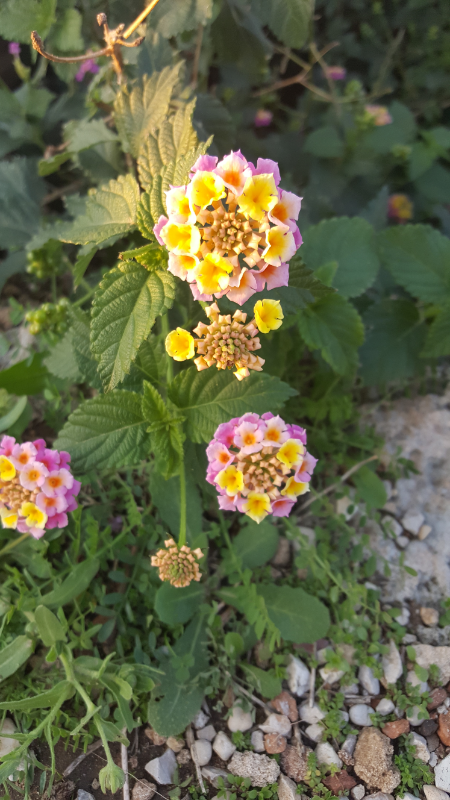
Funky flowers

I, of course, thought that I was going to have plenty of time to start posting about my Lebanese adventures while I was still there. Ha! You’d think I’d know better by now. I took all of my Armenian language study materials and didn’t even glance at them. Took my Kindle and never turned it on. Took sneakers to work out… guess what happened with those. Nothing. I wrote some notes while I was there to keep track of what I did and my observations and impressions, but I was too busy having the absolute BEST time to do much more than that (and I’m not just saying that because my hosts also read my blog). Between the place and the people, it was an unforgettable trip.

Over the next couple of weeks, I’m going to fill you in on all of the awesomeness that happened. I have A LOT to tell you. Meanwhile, it’s back to the usual in my Armenia life. It’s still a daily adventure, but we’ll have plenty of time to keep talking about that later.

Okay, ready for this? Here we go…

Welcome to Lebanon!! My flight landed in the morning, so I stumbled off the plane all bright-eyed and bushy-tailed, ready to conquer the day. Badveli met me at the airport and asked if I needed to rest since my night’s sleep consisted of 9 hours of plane sleep and 3 hours in an airport. I obviously said no because I don’t believe in jetlag. Jetlag is for the weak! And for the people who can’t sleep on planes. And for the people who aren’t completely nuts like me. Anyway, jetlag shmetlag!

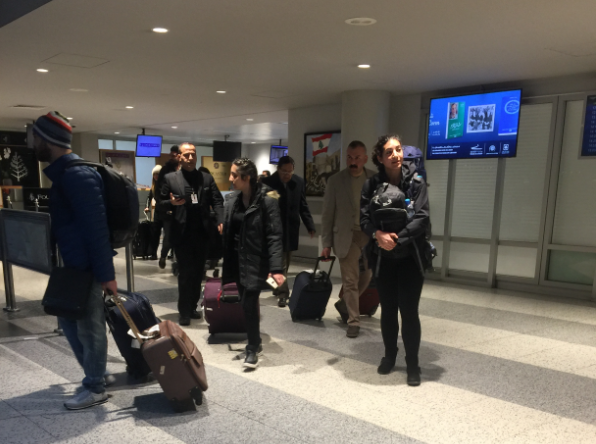
My first moments in Lebanon, courtesy of Badveli.

After getting back to Badveli and Maria’s apartment and organizing my stuff, we hit the town to walk around a little and help me get my bearings. Here are some of my first impressions of Beirut:

  1. Lebanon is OLD. I know what you’re probably thinking: “DUH, LARA.” This must be the same feeling that people get when they go to places like Jerusalem and Egypt. I don’t know. I haven’t been to those places, so that’s all speculation. In the Bible, in the OLD Testament, it talks about some of the cities in Lebanon. Places like Sidon and Tyre. Heck, how many times are the cedars of Lebanon mentioned? It’s easy to think of those places like something out of a fairy tale when you’re reading about them from halfway around the world. But then, when you’re literally just a drive away, it’s like… whoa. Those places are real, and here they are!

    See? Old stuff.
  2. Traffic. I had kind of forgotten what it’s like to fear for your life when crossing the street. As horrible as many of the drivers are in Armenia, I’m generally confident that they’re going to stop for me. I did not have that same confidence in Beirut. Besides that, I forgot what it’s like to have motorcycles on the road. Did you know that road rules don’t apply to motorcycles? I may have just completely made that up, but if it’s not true, you’d never know by looking at how they drive. Lunatics! Did you know that the lines on the road are meant to be driven over by the cars and not between? I may have also just made that up, but who knows? Certainly none of the drivers in Lebanon. Line painting is a waste of money.
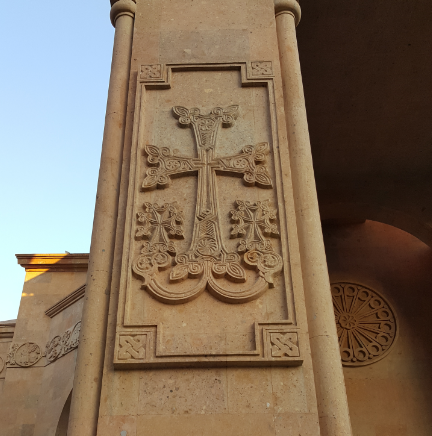
  3. Stellar sidewalks. Ah yes, I also forgot to mention all of the shops that put merchandise on the sidewalks and the people loitering outside will definitely not move for you.

    Sidewalks. The sidewalks are horrible. Well, before I say that, I have a question. Can something be horrible if it doesn’t really exist? Imagine this. You’re walking on a nice sidewalk. After a few steps, the width decreases by half. After a few more, there’s a car parked on it. Or maybe it’s not a car but rather those bollards that are meant to keep cars off the sidewalk… but they also have the effect of making it literally impossible to walk because they’re in the way. So, you walk in the street with the motorcycle lunatics and horn-happy drivers.
  4. Horn-activated traffic signals. Credit for this one goes to Badveli. Did you know that if you make enough noise, the traffic lights change faster? In Beirut, everyone knows about this trick, so they spend their entire time at a red light exercising their car horns to make sure it knows that they’re waiting. And you know what? The light ALWAYS changes! It’s amazing! Question – if a car horn stops working and is unfixable, the car is totaled, right? I mean, how on earth are you supposed to drive without a horn??
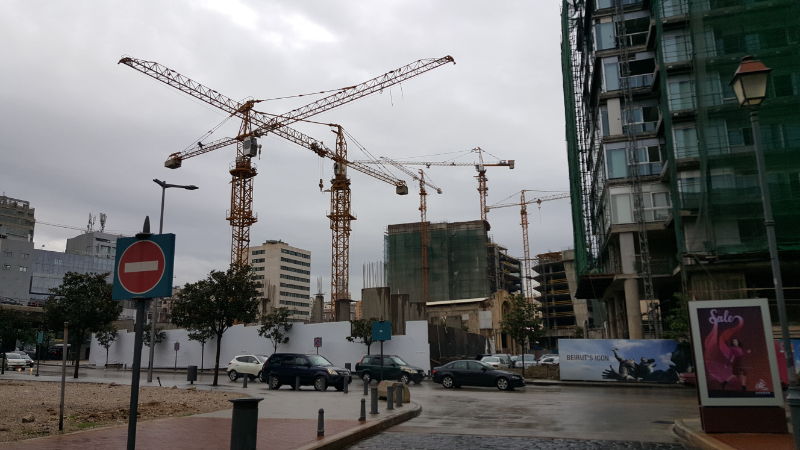
  5. Construction. Everywhere. It seems like the kind of place where your walk to work in the morning never looks the same twice. Today, there’s a building here. Tomorrow, that building’s gone. The next day, a new one stands in its place.

    If anyone needs a tower crane, I can tell you where to find a few.
  6. So fun!!!

    Plant balconies. This might be one of my favorite things. The city is VERY developed which means barely any green space. People must have a thing for potted plants, though, because there are some magnificent balcony gardens. They are the coolest. Maybe I’m especially impressed because every potted plant I’ve ever had has died (sorry, aloe plants 1 and 2 and inevitably 3 when I get back to the plant-owning life), but I have a feeling they’re objectively cool too.

  7. Army. The army is everywhere. Carrying big, scary looking guns. I’m sure that you have nothing to worry about if you’re not doing anything wrong, but I have this problem where I literally convince myself that I must be doing something wrong and then proceed to act suspicious because I think, “Okay, don’t act suspicious.” I’m only guilty of being incredibly awkward, I promise.
  8. Internet. The internet is slow. Very slow. And very expensive. For all of Armenia’s struggles, the internet access/speed/pricing here is impressively good. The internet in Beirut is 10 steps below Armenia and like 3 steps above Ghana. It exists, but only just. Patience is key.
  9. This is the best. Doesn’t it look like someone just picked that house up off of the ground and plopped it on top of a store?

    Power outages. Every day in Beirut, the power goes out for three hours between 6AM and 6PM. The time of the outage rotates from day to day. Say it’s from 3PM-6PM today. Tomorrow it will be from 12PM-3PM, then 9AM-12PM, then 6AM-9AM, then repeat. A lot of people either have generators or pay for generator service to their houses to fill in those gaps. I guess at least you know when your power is going to be out, but still. Annoying. It’s amazing how common power cuts are in so many countries, and meanwhile, it probably seems insane to someone who hasn’t had to think about it before. Even though I am pretty used to it by now, I STILL think scheduled cuts are wacky. I bet they could fix it but just don’t feel like it.

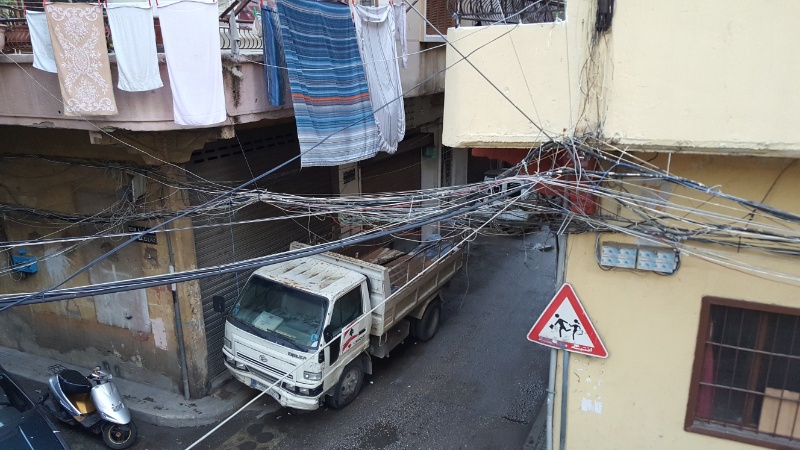
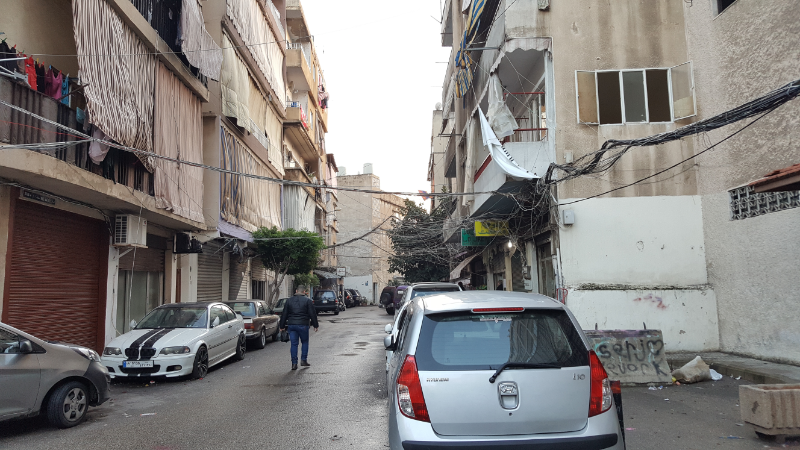
  10. Power lines. Speaking of electricity, there are power lines EVERYWHERE. And they’re hideous. And I’m guessing that half of them are probably inactive, but no one will ever know. There are the official power company lines, plus the shady generator lines, plus whatever cables everyone had sitting around the house because they thought it would look nice if there were a few more strung about. They’re like yearlong holiday lights but without the lights aka the whole point.
    My compliments to the designer!

    Gotta love those festive power lines.
  11. Public transportation. Also not good. I asked if there was a place to look up bus routes, and Badveli laughed at me. Even Armenia has a place to look up routes, and they’re usually quite accurate. Beirut doesn’t have as many routes, they’re not as regular, and they’re not as easy to figure out.
  12. Handshakes. Picture this. I, a woman, meet a man for the first time. He introduces himself, looks at me like I exist, and offers his hand. We shake. He initiates polite conversation. *GASP* What a concept. In Armenia, it usually goes more like: I, a woman, meet a man for the first time. He kind glances at me and looks for a man to talk to instead. I stick out my hand. He looks at it like I’m holding out a rattlesnake. He decides that my hand won’t go away unless he shakes it. We shake. He looks for a man to talk to instead. It took my being treated like a full human again to realize that I have gotten used to being semi-ignored. Every time I met someone (especially a man) who actually acknowledged my existence, I was thrown off. Good job, Lebanon. Thank you for reminding me how these things are supposed to work.

There you have it, a few initial impressions/observations of Beirut. As with anywhere else, there’s some good, some less good, some weird, and some funny. That’s what keeps life interesting! Okay, I’ve talked your ear off enough for now. Don’t worry, there’s plenty more to come. Get ready to do some exploring!

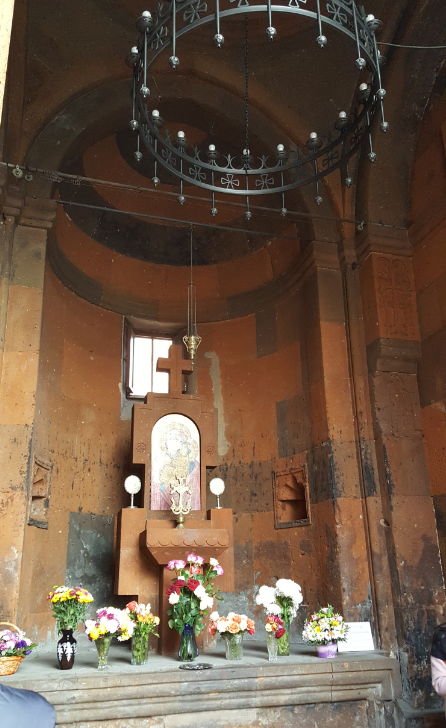
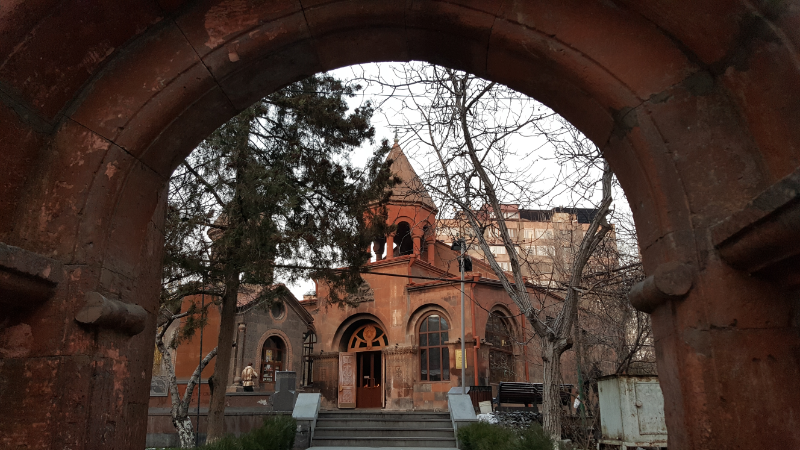
New church, Kathoghike Chapel

A couple weekends ago, my determination to not waste the time I have left in Armenia led me to a mini church tour around Yerevan. By the time I motivated myself to go outside into the cold weather, it was already the afternoon. That limited my options a bit, but there were a couple churches on my list of places to visit that are right in the Yerevan city center. I’ve walked past one of them probably twenty times and have always thought, “I’ll have to come back to look at this, but I just don’t have the time right now.” The other was a bit hidden, but I’ve been within a block or two of it more times than I can count. I guess this goes back to the whole “walking around with your eyes open” thing.

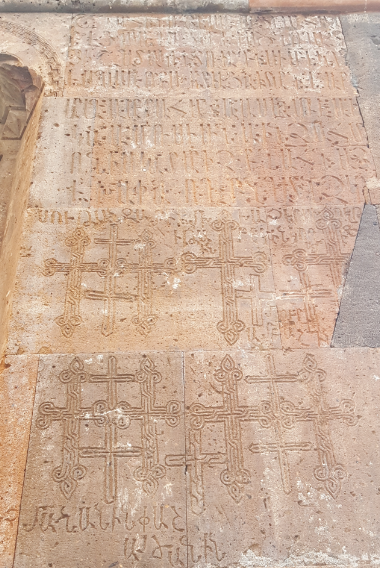
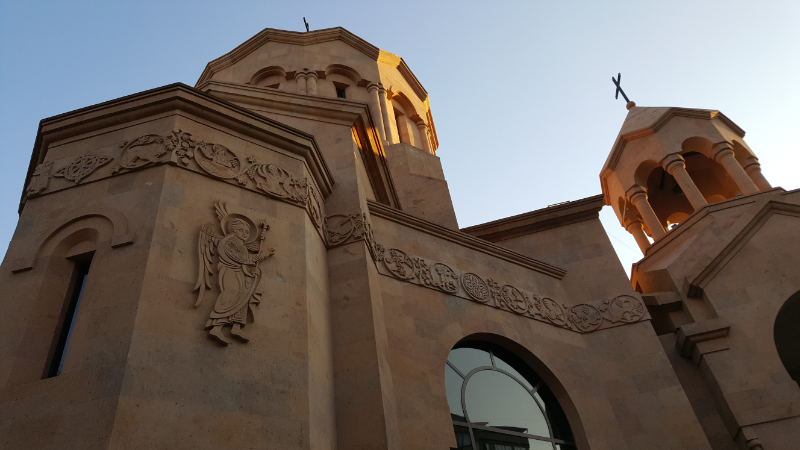
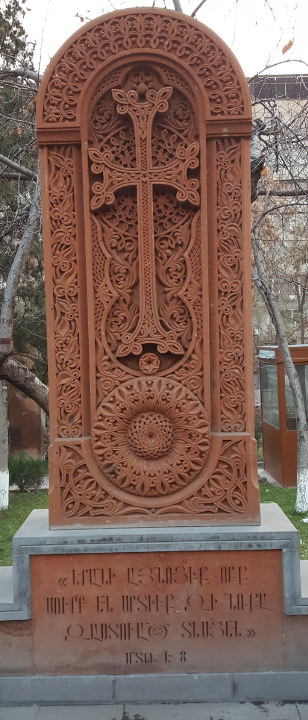
Carvings on the outside of the chapel

My first stop was the Holy Mother of God Kathoghike Church. It’s the oldest church in Yerevan, and it has an interesting history. According to inscriptions on the walls of the church, it was built as early as 1229. There was a large earthquake in 1679 that destroyed the other churches in the city, but somehow, this little chapel survived. A new church was built on the site in the 1690s where it sat until Soviet years.

Fast forward to 1936 when Soviet authorities ordered the demolition of the “new” basilica so that apartment buildings could be constructed in its place. They did make the concession that the large church could be disassembled and cataloged by archaeologists and historians, and during this deconstruction, the little chapel was found built into the larger church. They could tell that it was a different, older church because of the inscriptions carved into the walls.

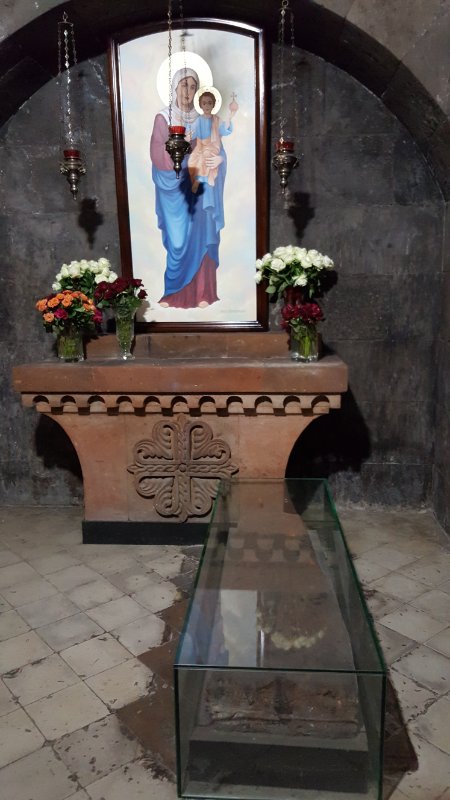
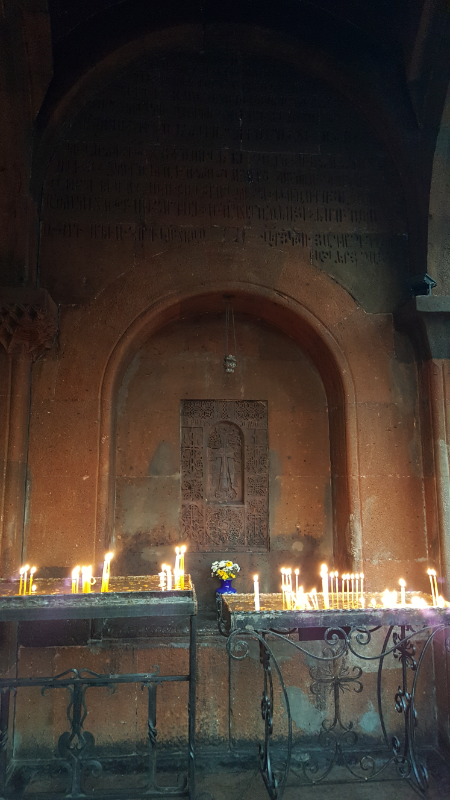
Inside the chapel

After discovering this previously hidden cultural gem, archaeologists protested the demolition orders and asked authorities to spare it due to the historical significance of the structure. The request was granted! Buildings were constructed all around it, but the chapel was allowed to remain. After the end of the Soviet Union, the surrounding buildings were demolished, and now it’s a part of a religious complex that includes a new church and the Yerevan residence of the Catholicos.

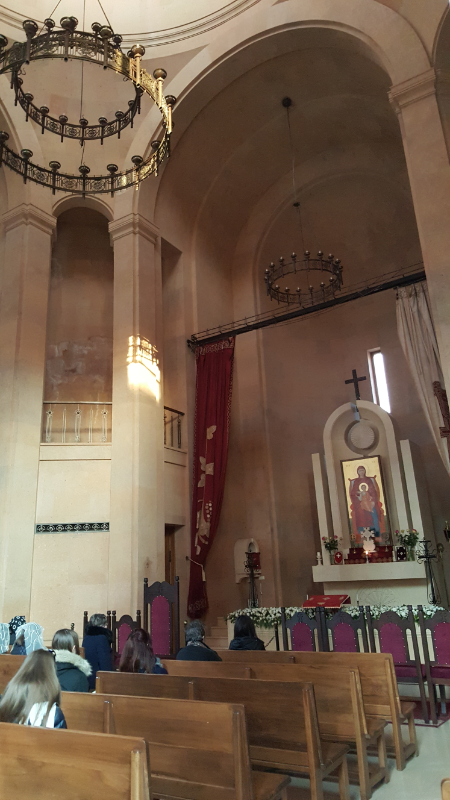
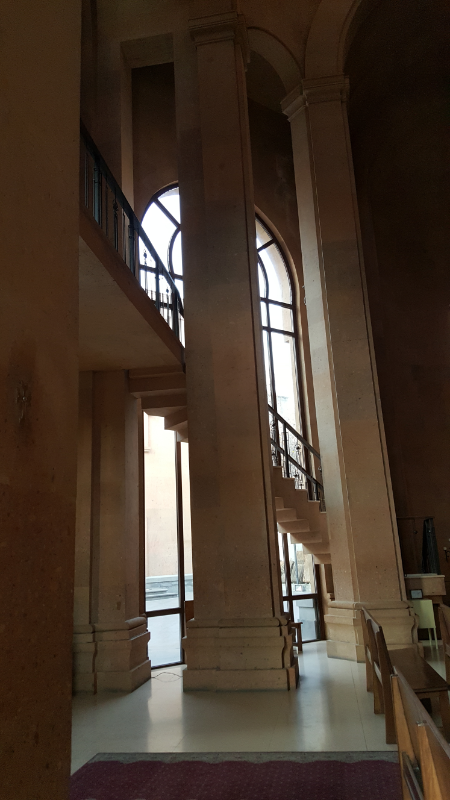
The chapel is only used for praying because of its size. Unlike so many Armenian churches, the chapel and the new church are nice and bright inside. That’s because one entire side of the chapel is glass, and the church has two gigantic windows! I didn’t think twice about (or even really notice) the church windows until I was inside and was trying to figure out what made it feel so pleasant.

Lots of pretty carvings! And you can see the top of one of the windows too.
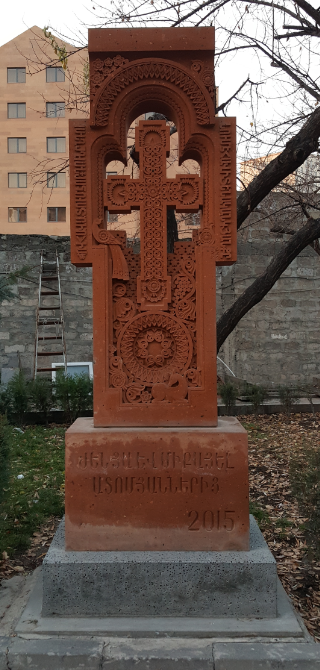
Carved cross at the entrance to the church
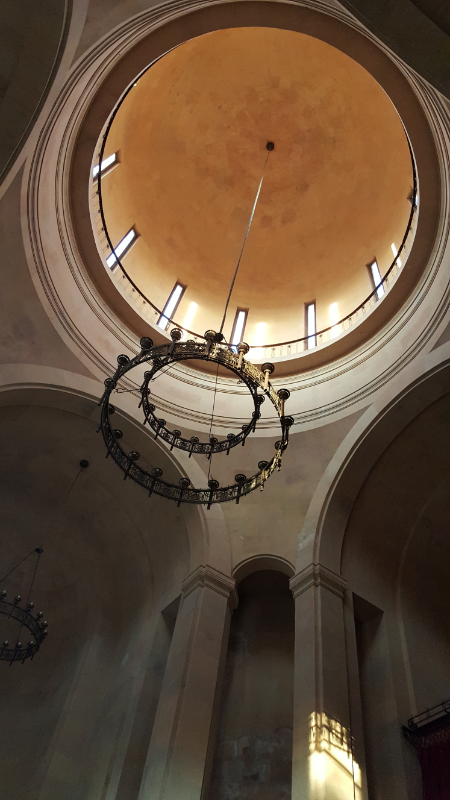
Inside the new church
HUGEEE window… and there’s another, identical one on the opposite side of the church
Looking up!

From there, I walked a few blocks to Zoravor Surb Astvatsatsin Church. This place was barely on my radar and ended up being full of surprises! Getting there was the first adventure. It’s hidden in the middle of a bunch of tall apartment buildings. If I hadn’t read about it ahead of time, I would have thought that I was going the wrong way. I was still second guessing my route a bit, and then, out of nowhere, there it was! The church isn’t anything grand or magnificent, but I liked it. There was a service going on inside, and everything about the building felt cozy and homey rather than cold and impersonal like some other churches.
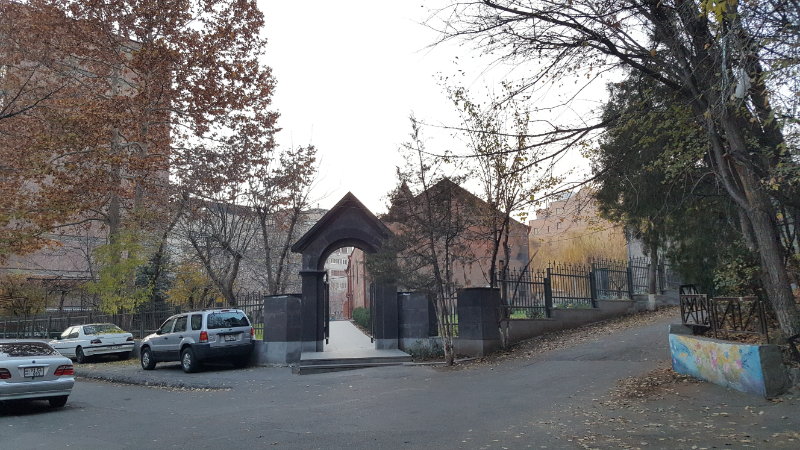
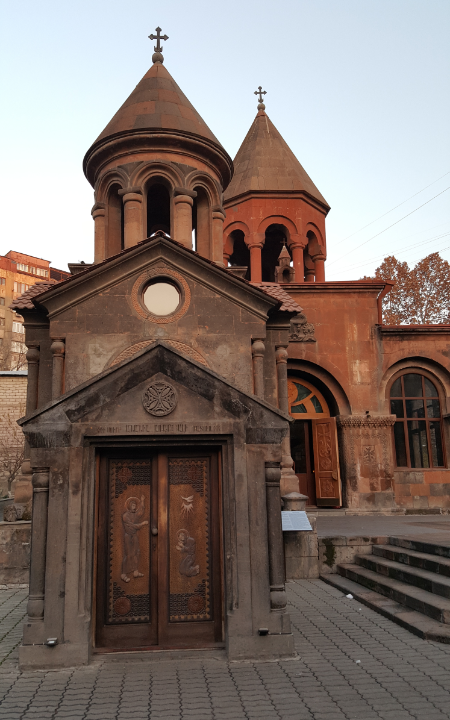
Discreet, right?
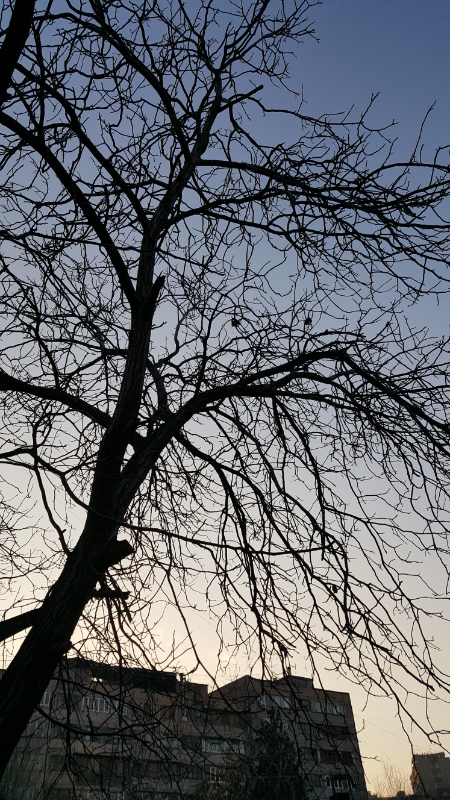
Eerie tree outside of Zoravor Surb Astvatsatsin

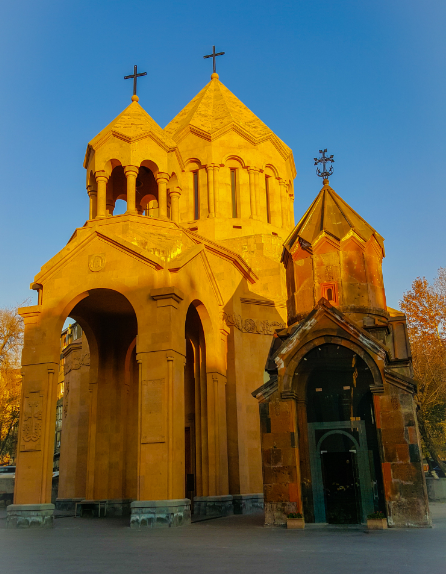
The original church was part of a monastery complex built in the 1630s, but after the earthquake of 1679, the entire complex was destroyed. The church was rebuilt on the same site in the 1690s. The thing that makes this church unique is the second building on the grounds, Saint Ananias’ Chapel. In case your brain isn’t a Bible dictionary, here’s a refresher on Ananias. When Saul (later called Paul) was visited by the resurrected Jesus, he left the interaction blind. God spoke to Ananias, told him about Saul, and sent him to restore his vision. After Ananias prayed over Saul, he could see again, stopped persecuting Christians, and was baptized. That’s the only mention of Ananias in the Bible, but according to historians, Ananias was eventually martyred.

Did you know that relics are often actual body parts/bones? I didn’t. Maybe I should have, but I didn’t. Is it just me, or is that a little weird?? When we went to visit the museum at Etchmiadzin, there were all of these “right hand reliquaries”. I thought that was just some clever name or weird Armenian Apostolic thing that I didn’t understand. Well, I guess the latter is partly correct, but I thought there was just some symbolic reason for the fact that they were shaped like hands… NOT because they contained ACTUAL parts of the saints’ hands! Freaky.

Saint Ananias Chapel in the front, church in the back

The chapel includes a mausoleum for Ananias. I’m not sure if there are currently any parts of him there, but they used to have his right hand reliquary until it was moved to Etchmiadzin’s museum. Each year, it is brought back to Zoravor Surb Astvatsatsin for the commemoration of Saint Ananias. According to the signs at the chapel, “his sacred relics bear miraculous power”. Okayyy. I understand why people want relics if they believe that they bear power, but at the same time, wouldn’t it be nicer to leave people’s bodies intact?? I’m obviously missing some essential piece of understanding because I still don’t quite get it.

The church and the chapel are simple, but I thought they were beautiful. There are some nice carvings and pretty khachkars on the grounds. They also have heat in the building which I was not upset about because it was a chilly day. For a last-minute, reluctant sightseeing excursion, it was great! It’s amazing how many random, hidden gems there are to see in this city. You could live here forever and never see them all which is precisely why I need to make the most of my time here! Sometimes I peruse Google maps to see what less mainstream things might be worth a visit. That’s how I found Zoravor Surb Astvatsatsin! There are SO many churches and other places to visit here that even some cool ones end up getting filtered out when you look for sightseeing recommendations. Goal: find and visit as many random, underrated sites as possible before leaving Armenia.

That’s going to have to wait for at least a week though because I leave tonight for Lebanon!!! I. Am. So. Excited!!!!!

Inside the mausoleum
Inside Zoravor Surb Astvatsatsin

Happy New Year! Շնորհավոր նոր տարի (shnorhavor nor dari)! Wow! Can you believe it? 2018. I’m feeling good about this year based on nothing more than the fact that 8 is my lucky number. This has been my only New Year’s out of the USA, and it was definitely a different kind of experience!
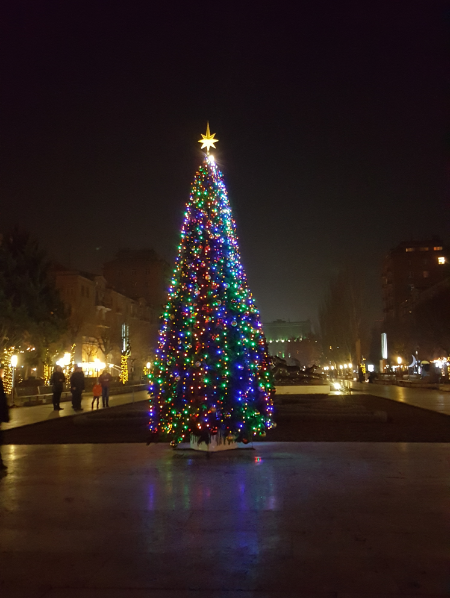
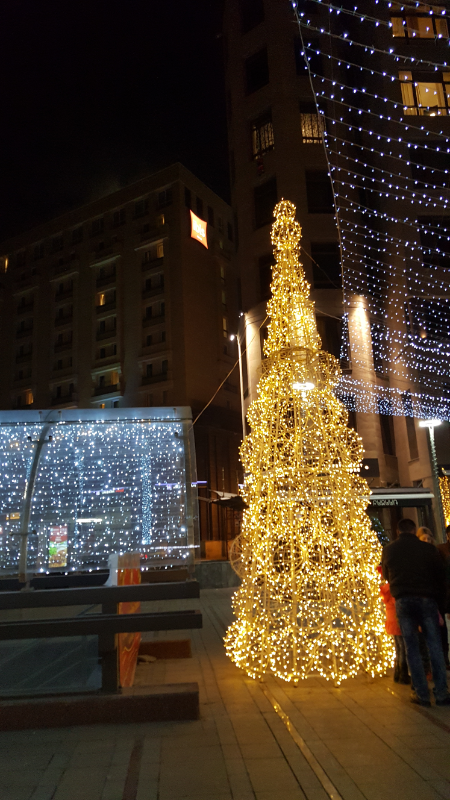
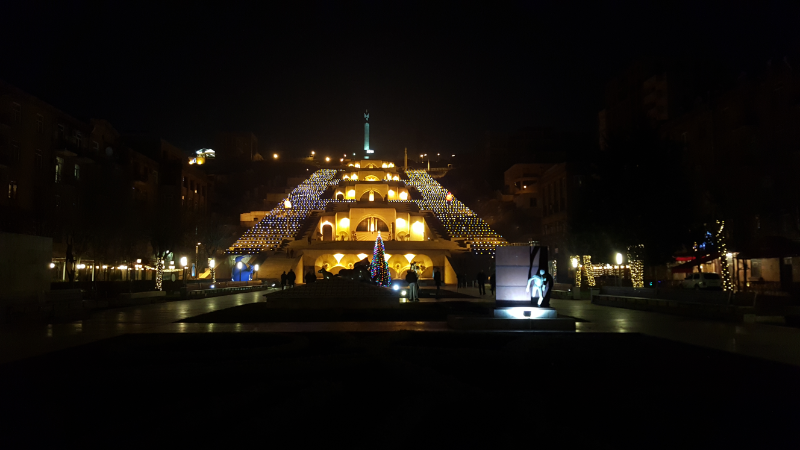
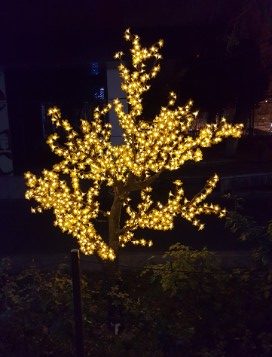
Tree at the base of Cascade

I’m used to New Year’s being a sort of “friends’ holiday”. You spend Thanksgiving and Christmas with family, and on New Year’s, you spend time with your friends. Here, that is NOT the case. New Year’s is a massive family holiday, and it launches a celebration that lasts an entire week, until Armenian Christmas on January 6th.

Like everything else here, there’s a lot of history behind New Year’s. Throughout the years, it’s been celebrated on multiple different days. “Kaghand” new year was celebrated on March 21st, coinciding with the spring equinox and the awakening of nature. “Navasard” new year was celebrated on August 11th, the day that the Armenian patriarch Hayk defeated the Babylonian King Bel, a tyrant seeking to extend his power over the whole earth. That day, Hayk killed Bel in battle with a long arrow, guaranteeing the freedom of his people and establishing Armenia in the year 2492 BC. (Hayk apparently had a pretty busy life because he also helped to build the Tower of Babel. That’s the tower in the Bible that people were trying to build up to heaven, and God disrupted its construction by making the people speak different languages.)

Ridiculous light tree

Next, according to the Julian calendar, the new year falls on January 14th. This is now called “Old New Year” and is still celebrated, though to a lesser degree than “New New Year” on January 1st, recognized on that date after switching to the Gregorian calendar in the 18th century. Does your head hurt yet? Yeah, same. During the Soviet years, the new year was celebrated three times each year: at midnight the night of December 31st, at 1AM (midnight in Moscow), and again the night of January 13th.

New Year’s is when Dzmer Papik (Santa Claus/Grandfather Winter) comes and brings presents. Families gather and eat a big meal at midnight after spending the entire day cooking enough food for a week. No matter the economic status of the family, significant money and effort are put into the table for New Year’s. People do what they need to do to create a spectacular feast.

The rest of the week is national holidays, and they’re spent going from relative’s house to relative’s house, visiting and eating more. Apparently, there’s a proper order to do your visits in. You would visit your parents, for example, first and move through the relatives and close friends from there. The most important people should be visited in the first couple days. I don’t completely understand how you’re supposed to know if the people you’re visiting are home considering everyone is going around doing visits… who knows. But even if you’ve been visited at your home by someone, that doesn’t mean that you’re not going to go later and visit them at home too. Of course, each visit includes eating. It’s amazing that everyone in this country isn’t as big as a whale.

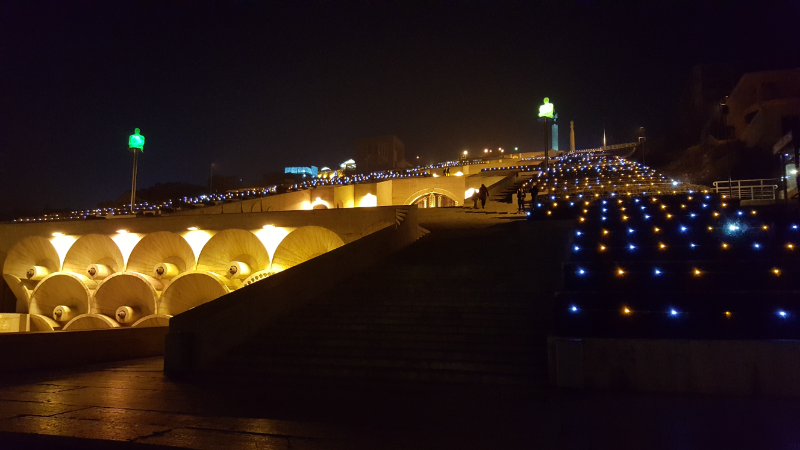
I didn’t know about these lights until last night! There are lights going allllll the way up Cascade, and they look awesome! There are some twinkle lights too.

More lights
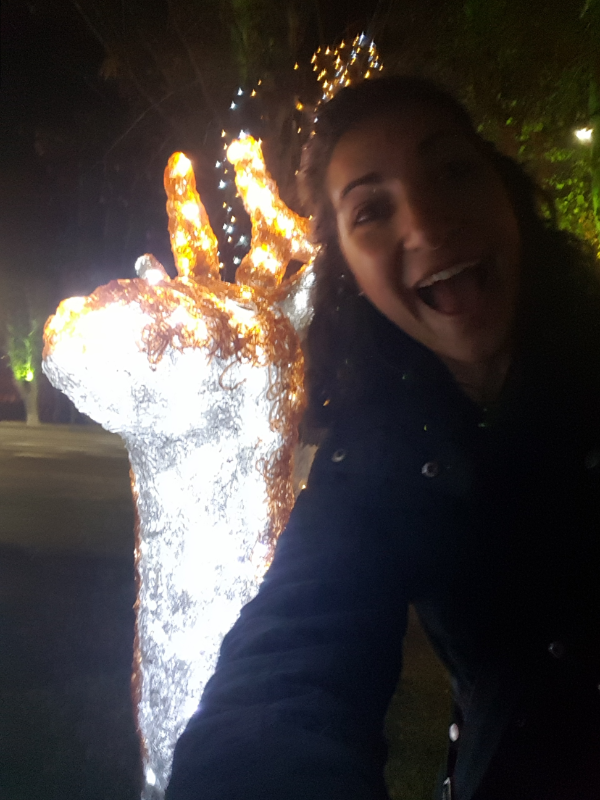
High-quality picture of me with a light-up reindeer

I didn’t have any big plans for the night until my friend Liz invited me to come over and celebrate with her host family! I was excited to get an authentic Armenian New Year’s experience. The walk over to their apartment was super eerie. I have never seen the street so deserted! It was especially startling considering how crowded everything was over the last couple of days as everyone did their last-minute shopping. At that point, the shopping was finished, and everyone was inside getting ready to commence the eating! I got to the apartment around 11:30, and Liz’s host mom was just finishing up cooking. They live close to Republic Square, so when the clock struck midnight, we crowded around the windows to watch the fireworks.

My plan before getting invited to Liz’s was to check out the festivities in Republic Square. They had a concert and a countdown and, of course, fireworks. In hindsight, I would have been miserable there. As usual, they were setting the fireworks off terrifyingly close to the crowd. When I talked to my parents earlier in the day, my mom said, “You’re not scared of fireworks anymore, right? You used to hate them!” Welllll. I don’t know that I would use the word “scared”, but I certainly don’t prefer them. It’s much better when you’re inside, can’t hear them as well, and can still see them. Everything definitely worked out for the better.

Republic Square New Year’s concert

Besides having a great view of the official fireworks in Republic Square, we also had front row seats for the many backyard firework displays. They were everywhere. I saw some getting launched off the top of an apartment building earlier in the day, and I’m sure that’s not uncommon. Seems like a horrible idea. We saw a few flying out of Liz’s building, and it seriously looked like the people on the floor above were just launching them out of their window. I wouldn’t be surprised.

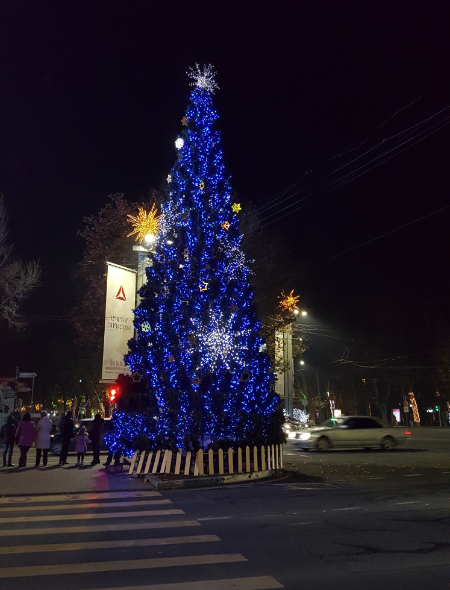
Tree at an intersection because why not

Being in Armenia has made me despise fireworks (previously I just had a strong aversion). At home, I only have to deal with them a couple times each year. Here, it’s practically every night. There isn’t like a 15-minute fireworks show, but there are at least a few because every celebration deserves some firepower. I think there’s something else going on right now too because some of the explosions sound more like little bombs than fireworks. They remind me of the firecrackers that the operations people would use back in university to scare the crows off campus. Is crow relocation a thing here too? I don’t know, but I’m not a fan. I’ll be happy when we’re back to the usual five fireworks per night and no terrifying firecrackers. (Side note: if you enjoy reading about crow relocation like it’s a man vs. bird war, check out THIS ARTICLE. Crow relocation was consistently one of my favorite wintertime amusements in university.)

These are fun

Anyway, after the official fireworks ended, we went to eat the incredible meal that Liz’s host mom and sister prepared. There was enough food for thirty people, and there were four of us. Of course, everything was also delicious. I ate so much that I thought I was going to burst, and then they told me that dessert was next. Uh oh. There’s always room for dessert, though.

It was nice to spend time with a family again, especially after living alone for the last four months. Both Liz’s host mom and sister speak English fantastically well, so I got to participate in the conversation and really feel like I was part of their family. It was a lot of fun! After dinner, Liz, her sister, and I watched a movie together until about 5:30AM. I have no idea how I stayed awake so late, but I more than made up for it today when I slept until 2PM and still had to drag myself out of bed.

Tomorrow, while all of the locals are doing their annual family visits, I’ll be doing a family visit all the way to Lebanon! Get ready for another trip!

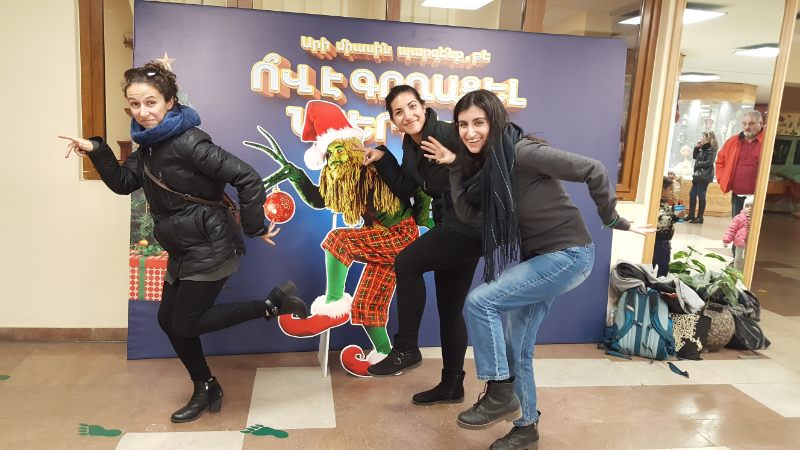
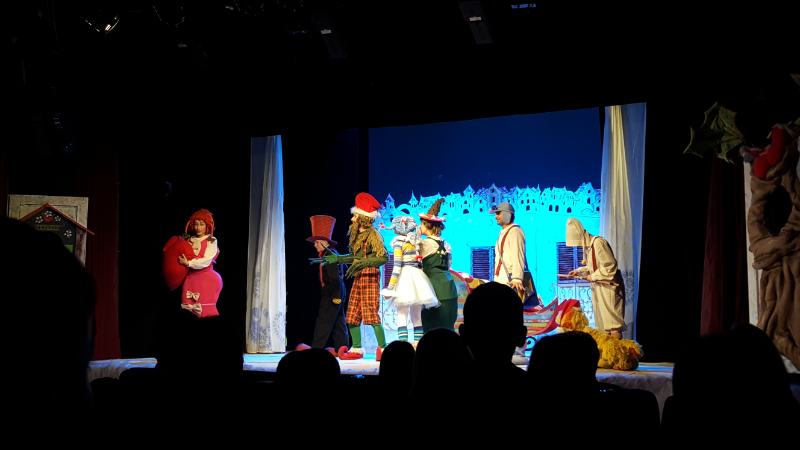
I have a new “favorite thing I’ve ever seen”. I’m sure that in the past I’ve said that something was the best thing I’ve ever seen, and whatever it was, it’s been dethroned. By what, you ask? The Grinch. The Yerevan Puppet Theatre version of the Grinch, to be specific.

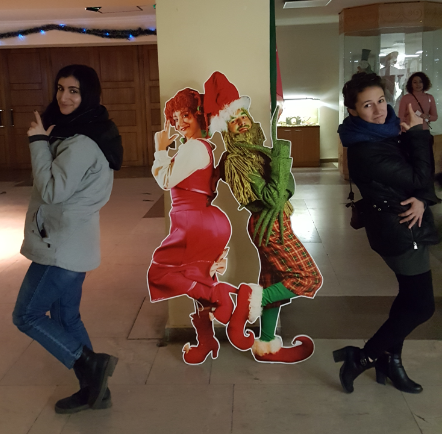
A few weeks ago, I casually walked by the puppet theatre and saw a new show poster outside. Even though I didn’t understand everything on it, the picture was really all I needed. The Grinch, in all of his green, yarn-haired glory. At that moment, I decided I had to go. Honestly, I would have gone by myself if I had to, but everything is more fun with friends. Plus going to a children’s show solo is even weirder than three grown humans going to a children’s show without bringing any children.

Because how could you not take this picture??

Finally, I got some friends to nail down plans with me. My gosh, it’s hard to get people to commit to anything! My friend Olivia from work and another friend agreed to go. Olivia bought the tickets, and we were good to go! That morning, I sent a text confirming our meeting time with the two of them, and the other friend didn’t respond… Backup plan. Liz, other friend from work, was in the office on Friday, and I re-pressured her into coming with us. She had already said no back when we were figuring out how many tickets to buy, but I told her that it wasn’t going to be long, the tickets were super cheap (only about $2 each), and she would regret not going. Sold. She was in.

This is a horrible picture, but see how some of the seats are folded up for kids and others are down for grown people?

I know that I said Liz would regret not coming with us, but that was a statement based on nothing more than my own expectations for the production. I had no idea that those were actually some of the truest words ever spoken. From the moment we walked into the building, I knew it was going to be good. They were selling popcorn, and kids were running wild. Any theatre that you can eat in is definitely my kind of place… and it was good because I had picked up some snacks for us on the way which we were obviously going to eat no matter what, but it’s nicer when you know you’re not breaking any rules. Also, the seats in the theatre are genius. You can leave them folded up if you’re a kid and need an extra boost, and you fold them down if you’re a grown person.

Okay, the show. How do I even begin to describe the show? We really didn’t know what to expect going in. Since it was at the puppet theatre, did that mean it was going to be all puppets? No. No it did not. A girl with blue yarn hair came running into the theatre to start off the show, and it was nonstop action for 45 minutes after that. Best things about going to something intended for kids:

  • Food in the theatre
  • Audience participation is encouraged
  • Constant high energy because otherwise the kids get bored
  • Everyone speaks clearly because kids
  • The words they use are pretty basic because kids
  • Kids think everything is funny, so the acting is completely over the top
The whole crew
Hehehehe

I’m sure I could keep going if I wanted, but basically, my major takeaway was that I should have started going to kids’ shows a loooong time ago. I even understood what was going on! The music was all the Christmas songs we know and love, translated into Armenian. The story was slightly different for cultural reasons. Here, people don’t exchange gifts on Christmas. That happens on New Year’s, and Christmas is celebrated on January 6th. I like this way much better because I’ve thought for a long time that gifts on Christmas take away from the fact that it’s about Jesus. That’s especially true for kids because as soon as presents are in the mix, they become the most memorable things. I think New Year’s presents are going to be my new approach to holiday gift-giving. Sorry, I know… I’m always getting sidetracked.

Which one am I? I’m such a good copier that I know it’s hard to tell

Anyway, since Christmas presents aren’t a thing, “How the Grinch Stole Christmas” doesn’t make much sense. They decided to go with the much more direct “Who Stole the Gifts?” for the title. The town is obsessed with the new year. They do not live in Whoville. Cindy Lou Who is Dzyun Anushik, aka sweet snow (kind of weird no matter what, but slightly less weird because Anush/Anushik is an actual name). Santa Claus is Dzmer Papik, aka Grandfather Winter. The Grinch hates the new year because he was born green (GREEN! *gasp*) and therefore had no friends, was loved by no one, and never got any presents.

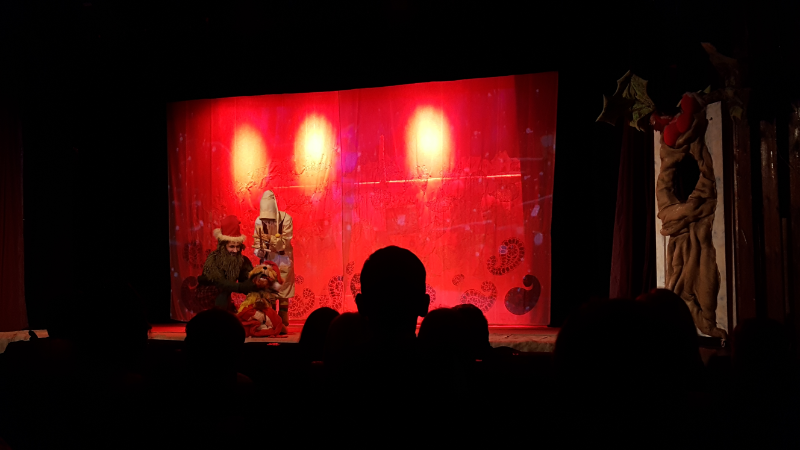
The first song of the show was crazy and energy-filled, and I didn’t even care that they were people and not puppets. Then… song #2… PUPPETS. No clue why they were necessary (they really weren’t), but I’m never going to complain about something like that. The dog, Max, was also a puppet, handled by a puppeteer in a white jumpsuit and hood.

The Grinch, Max, and the puppeteer

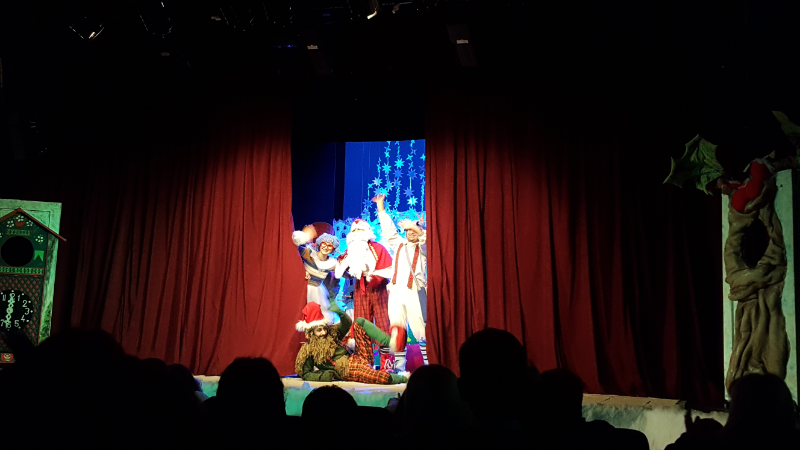
It had everything I hoped for and more: stupid humor that the kids LOVED, audience participation, puppets, bad lip syncing, hilariously translated Christmas songs, PUPPETS, dancing, and a feel-good ending. And I understood most of it!

Curtain closing. Encore, encore!
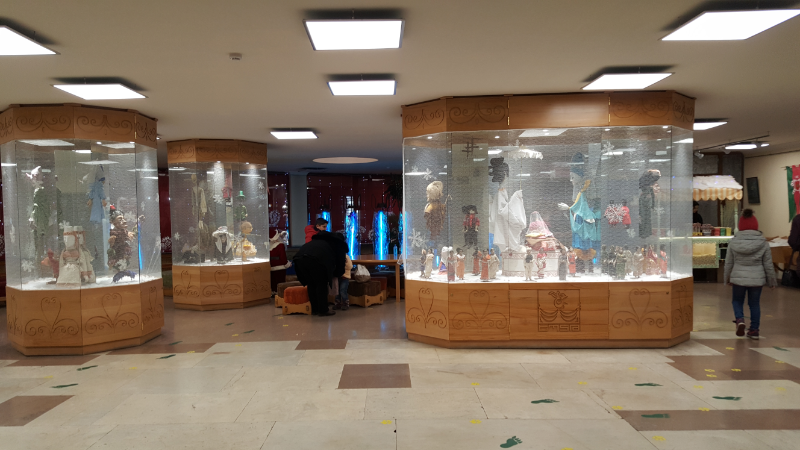
Puppet displays
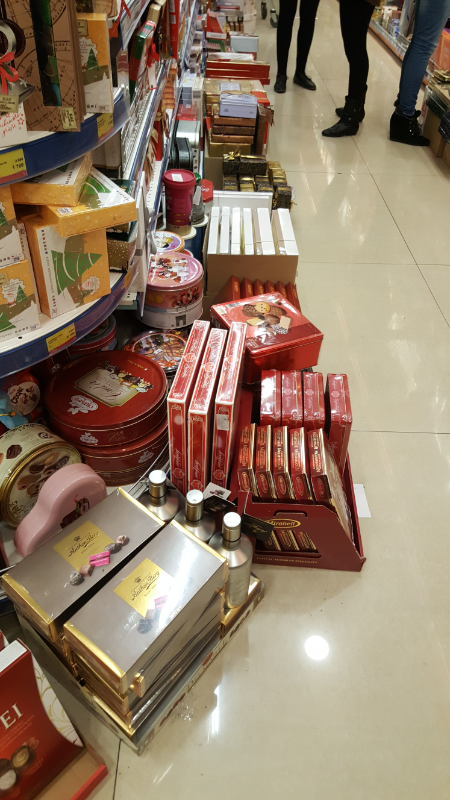
Like I said, the supermarkets are completely swamped. At this one, they had extra stock piled in front of all of the shelves so that they wouldn’t run out of things. One part hilarious, one part brilliant. And also much harder to navigate your way through the store because you simultaneously have more people and less aisle space.

When we left, we all agreed that it was valid to say that missing out on the show was something to be regretted. Thank goodness because I was just making that up to convince Liz to come. It was the perfect way to kick off the holiday season and holiday VACATION!

I’m so excited to have some time off work and to go to Lebanon! Work has been chaotic, and I can tell that I need a break. The construction project is coming along, and they think it should mostly be finished by the beginning of February! I can’t believe I’m going to get to see the finished product! Everyone takes off during the first week of the year between New Year’s and Christmas, so luckily that means I’m only going to miss a week of work for my trip which isn’t a big deal.

Otherwise, the city has been crazy with everyone getting ready for the holidays. All of the supermarkets are swamped, traffic is insane, and there are just people everywhere. I’m excited to experience the New Year’s festivities!

More light pictures! LOOK AT THIS
I think this is my favorite one so far
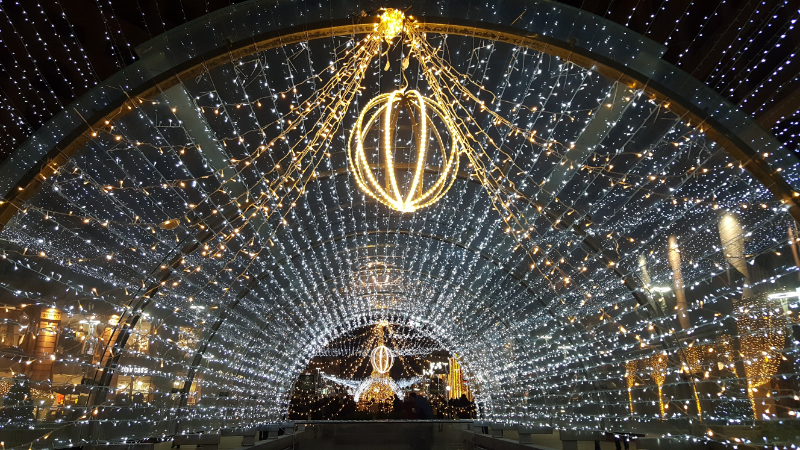
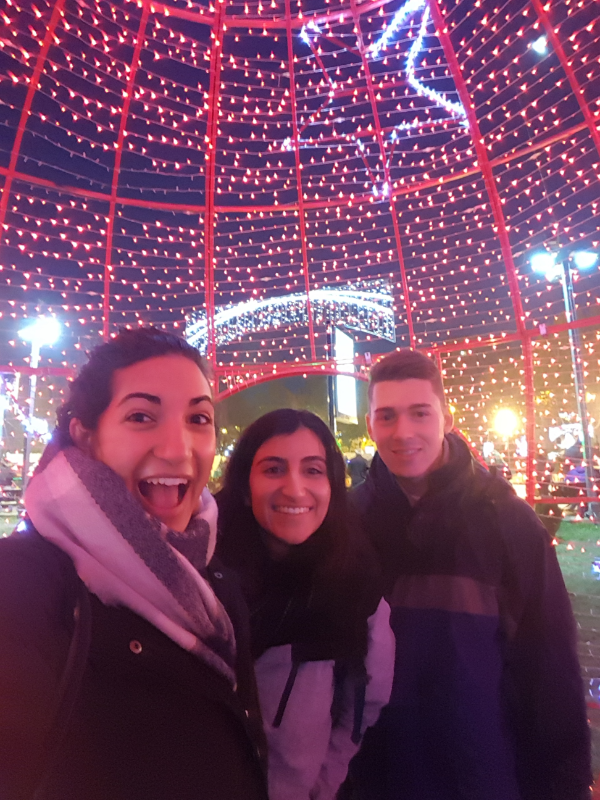
Inside a light ornament with Liz and Daniel, a guy from my language class

I’ve been trying not to fall into the trap of feeling like I have so much longer to spend in Armenia and getting less aggressive with the sightseeing. I definitely have been failing a little bit, and we’re going to put some of the blame on the cold weather. That’s not much of an excuse though because there are so many things to see within Yerevan that I barely have to go anywhere to see or do something new.

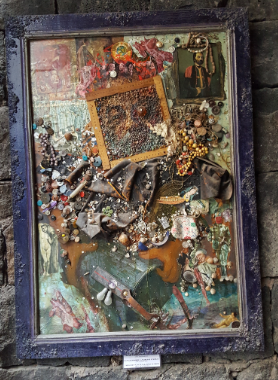
The museum also has collages and artwork made by Parajanov’s friends or just made by people to honor him. The one is called “Parajanov in Prison”.

One Saturday, one of my friends, Tara, asked me if I wanted to go with her to the Sergei Parajanov museum. I didn’t know much about him or about the museum, but I knew that some of my friends had been there before and enjoyed it, so why not? We got there close to closing time but had just enough time to do a tour, and that ended up being a fantastic decision. It seems like that’s kind of a theme here. In a lot of places, I think that you can do just fine in a museum without a tour guide, but there are so many museums that I’ve been to here where your experience is made at least 50x better by going on a tour. Maybe it’s a language thing because there aren’t as many English descriptions of things, but I also think they just do a good job with the tours in general.

Sergei Parajanov was an Armenian director and artist who was alive during the Soviet years. He was born in Georgia to Armenian parents, so if anyone tries to tell you he’s Georgian, ignore them! HE’S ARMENIAN. His given name was Sarkis Parajanyants, and what could be more Armenian than that??

Parajanov was born in 1924 and studied a variety of creative arts including voice, violin, and ballet before finally going to film school. His life was filled with plenty of struggles. In 1948, he was imprisoned for 7 months on homosexual charges. In 1951, he married a Muslim Tatar girl who was murdered within the year by her relatives for marrying outside of her religion. He married again in 1955, at age 31, to a 17-year-old, and they had one child in 1958 before divorcing in 1962.

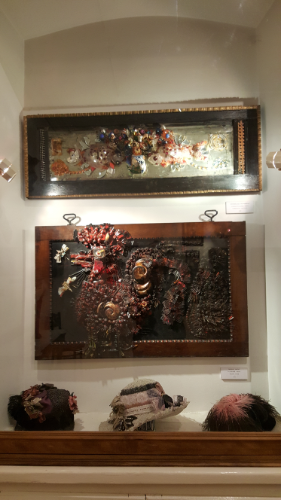
A rooster made of hair pins

Since he was working during Soviet years, everything he did had to be approved by the authorities. In order for him to create a film, he had to get funding from the government. He started directing films in 1954 and released his first film that achieved worldwide fame in 1964, Shadows of Forgotten Ancestors.  After its release, he was blacklisted by the government for “supporting Ukrainian nationalists”. This put his other projects in jeopardy. His next influential film, The Color of Pomegranates, was released in 1969 and tells the story of Sayat Nova. This film was re-cut by the authorities before its release, and he was punished for speaking out and criticizing Soviet cinema. After that, his projects were all rejected.

In 1973, he was arrested again and sentenced to five years in a Ukrainian prison. People protested internationally, and despite the dangers associated with protesting within the Soviet Union, some people spoke out there as well. He was released after four years and wasn’t allowed to create more films, so he used his creative energy to make collages which he called compressed films. In 1982, he was imprisoned AGAIN, this time for 10 months on bribery charges.

Finally, in 1984, he was allowed to create another film. He was even allowed to leave the Soviet Union, and he attended an international film festival in the Netherlands where he won an award. He was in the middle of working on an autobiographical project when he was diagnosed with lung cancer and died in 1990, right around the collapse of the Soviet Union and at the age of 66. He is considered a genius, and it is unfortunate that he was never able to create free from the constraints of the Soviet system.

The Yerevan museum is in a house that was intended for him, but he passed away before ever living there. It’s filled with a ton of his collages, and they are hilarious. He was one of those people who, if you ever left anything at his house or unattended for a second, you could expect to come back and find it irreversibly altered. He wouldn’t apologize but rather would tell you that he improved it.

There was one collage that the base was a piece of art that was given to him by a friend. Parajanov, of course, thought that it could be better, and so he took it upon himself to improve it. Can you imagine giving someone a painting as a gift and then coming back and seeing that they glued stuff all over it? Or there was another one where he took a cane (that someone left at his house maybe?) and integrated it into a collage.

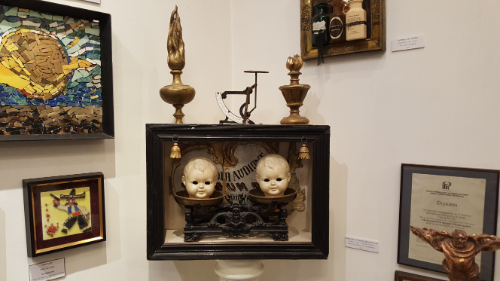
He also used an incredible quantity of baby doll heads. Pretty much all of his art is made from things that he found, but Tara and I were amused anyway at the thought of him going to a toy store, looking at the dolls, and picking one out, thinking, “Ah, yes! This is precisely the type of doll head I need for my next work!” Sometimes things don’t have to be true for them to be funny.

This collage is of Romulus and Remus, the twins from Roman mythology whose story led to the founding of the city of Rome. Romulus is the one with the full torch and Remus is the one with the torch cut off, symbolizing Remus’s death, supposedly at the hands of his brother.
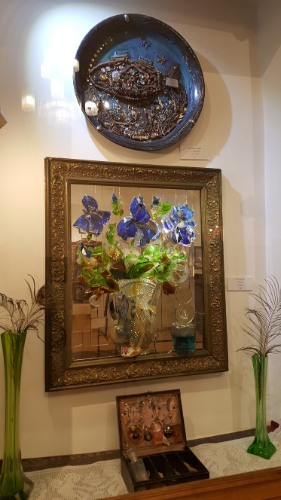
The flower collage with the perfume bottle in the bottom right corner.

I think Tara and I laughed through about 90% of the tour. Parajanov was a funny dude, and our tour guide was also awesome. Sometimes, our guide would explain something, and we would both just look at him like, “You have to be kidding…” For example, there was a glass collage in the shape of a flower, and he said that since flowers are smell good, Parajanov stuck a perfume bottle in the corner of the collage. Almost painfully literal.

There is a bunch of stuff that he created while he was in prison, including dolls, collages, and sketches. Even with incredibly limited resources and resistance from the prison guards, he still kept making things. It’s actually pretty amazing that so many of his creations survived.

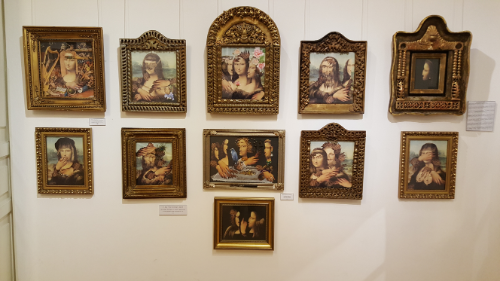
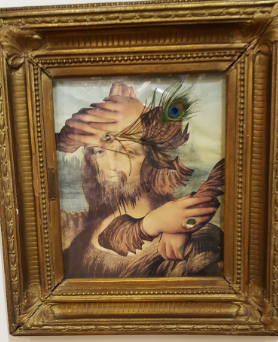
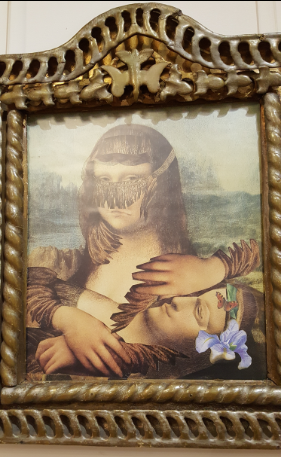
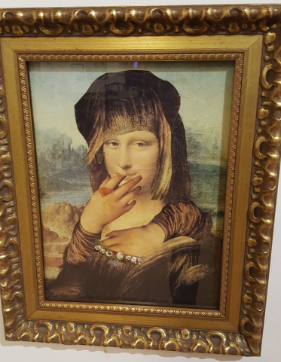
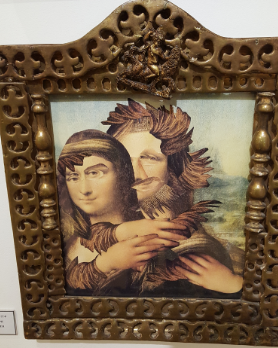
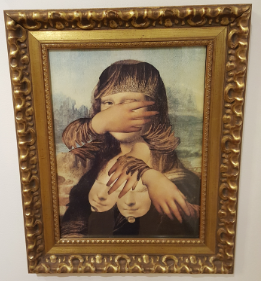
The best part of the whole museum is his Mona Lisa collages. The actual Mona Lisa is, in the opinion of some people, kind of overrated. I don’t know what Parajanov thought of it, but I do know at least that he thought he could make it better. In my opinion, he definitely did. He made a whole series of different Mona Lisas, and they’re all beyond awesome. When we walked into the room with them, Tara called my name and just pointed at the wall… and the second I looked, I completely lost it. They are hilarious. Like this guy was a total genius. Imagine looking at one of the most celebrated works of art and thinking, “That’s nice, I could make it even nicer.” And then he did. Eleven times.

The Mona Lisas
I’ll just let these speak for themselves.

His work is wacky and weird and ego-filled, and I loved it. Tara had a cool story about him too. Her parents got married in Armenia, and afterwards, they went to Georgia for part of their honeymoon. When they were in Tbilisi, they just asked around until they found where he lived, and they MET him! They were with another couple who had also just gotten married, and Parajanov quickly whipped up some earrings for the two women as wedding presents. How cool is that?!?!

If you’re ever in Yerevan and you have the time, you MUST go to this museum. Seriously, it’s one of the best ones I’ve been to in Armenia. I think you can also watch his films on Youtube if you’re interested. I haven’t gotten around to watching any of them yet, but they’re on my list.

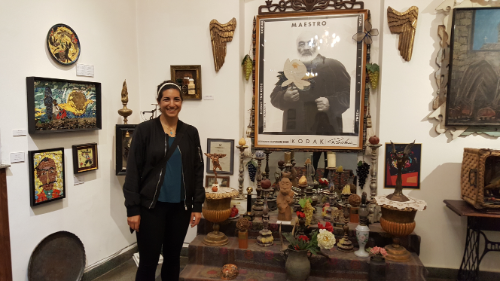
Me and Tara with our favorite wall in the museum
Outside of the museum

I have one word for you, folks: LIGHTS. That’s right, it happened. Today was the official “lighting of the city” ceremony (I just made that name up, but that’s what it was). My coworker and I were talking about the lights just yesterday, and when I got in this morning, she said that she read they were going to have an event in Republic Square at 7PM to turn everything on. YES.

Me with my coworker, Yelena

From that point on, the day was kind of perfect simply because of the anticipation of the lighting ceremony. That was my go-to topic of conversation with every single person I encountered, and I’ll just say that none of the Armenians were nearly excited enough. They were all like, “Yeah, they do this every year.” SO?? That doesn’t make it any less crazy! Though I guess it’s like anything else where you can become immune to the awesomeness if you let yourself get used to it.

Can we all agree to try harder to live each day with our eyes open? Okay, that sounds stupid if you take me literally. What I mean is that it’s way too easy to get used to the cool things that surround us, and we eventually start walking around without seeing them anymore. It’s even happened to me throughout this year, and sometimes I have to take a second to be like, “HEY! Lara! Wake up! You’re in ARMENIA (/India/Peru/Ghana/fill in the blank) right now. Take a look around, appreciate the awesomeness, and stop being such a goober!” I know, harsh words. No one likes to be called a goober, and the best way to avoid it is to not act like a goober.

Light trees! I don’t think the picture does them justice

Anyway, I need to go on a nighttime city walk now so that I can take a million pictures of all the crazy, ridiculous, insane, out of control, etc etc etc decorations and lights. This place is truly a winter wonderland. Recently, while I was in the middle of some rant about how many lights there are, the person I was talking to said something to the effect of, “But isn’t it like this in the US too?” HAHAHAHA. I mean, yes, there are plenty of excessive holiday decorations, but I have NEVER seen anything on the level of Yerevan. It’s the whole entire city! It’s not just one square or one street or one area. It’s everywhere.

I can’t tell you much of anything about the actual ceremony. Here’s the best summary you’re going to get out of me: It was supposed to start at 7. It didn’t start until at least 7:20. There were some dances and songs that I completely missed because I was too busy yelling at them to just turn the lights on already. Someone sang an Armenian version of the classic “All I Want for Christmas”, though apparently the translation wasn’t even close and ended up being a bit of a love song to the city (shocking… because all we need is another song about Yerevan. If you missed my post about Yerevan’s birthday, just know that there are more songs about Yerevan than about every other city in the world combined). There were people in weird, multicolored animal costumes dancing around.

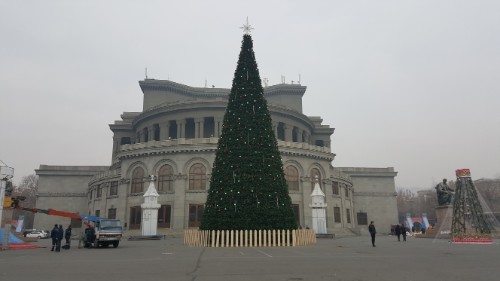
HUGE tree in front of Opera that is still smaller than the Republic Square tree
With crazy lighting comes crazy wire splices. Can you spot the incredibly safe and waterproof connections?
Walking away from Opera. This is from last night, so all of the lights weren’t even on yet!

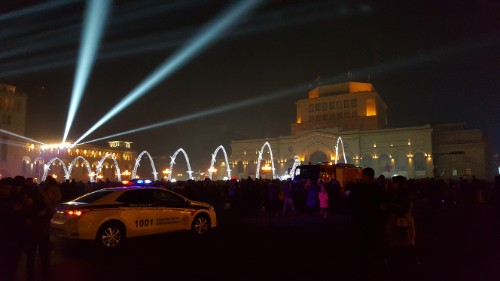
Finally, the mayor and his family got up on stage and started the countdown from 10. I was jumping up and down from the excitement of the whole thing. I definitely win the award for most excited person over the age of 8. Maybe even just most excited person. The tree lights were not as cool as I wanted them to be, but THE FOUNTAINS. The fountains are the greatest things I’ve ever seen. I need to do a full post of photos of the fountain sculptures because they’re phenomenal. I didn’t get any good pictures tonight because there were too many people, but I promise I will!

You can kind of see a smidge of the fountain lighting
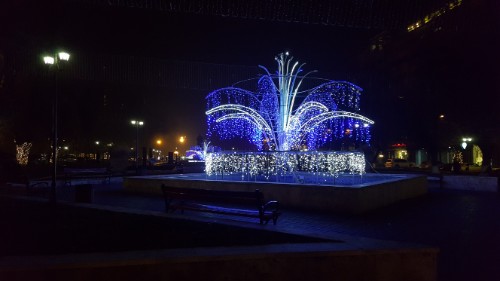
Some of the fountains. Try to tell me that this isn’t awesome? And they twinkle a little bit in real life. Kind of mesmerizing.

After the tree lit up, the fireworks started. WHY. Why does every event need fireworks? I hate fireworks, mostly because they’re loud and make me want to hide under a blanket. I only used to tolerate 4th of July fireworks because those came along with licorice laces and other candy that gets permanently stuck in your teeth. To make things worse, here they always set them off WAY too close to people. I spent the entire time with my fingers in my ears and my eyes peeled for potential flying firework debris while simultaneously trying to check out all of the newly lit decorations. Why do you need fireworks when the whole point of the event was turning lights on? It’s basically the same things as fireworks except that nothing is exploding.

Anyway, in summary: today was wonderful, fireworks are the worst, and lights lights lights!!!!! I hope you’re not sick of me talking about them yet because I can promise this won’t be the last you hear of them.

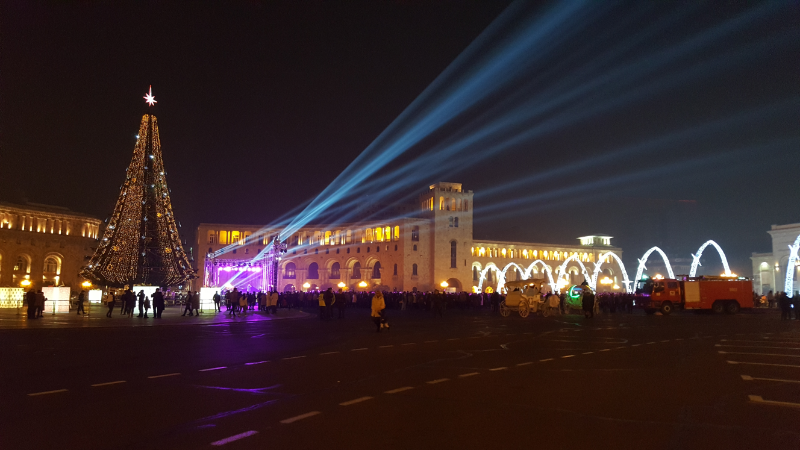
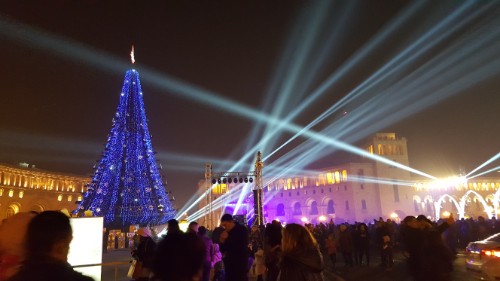
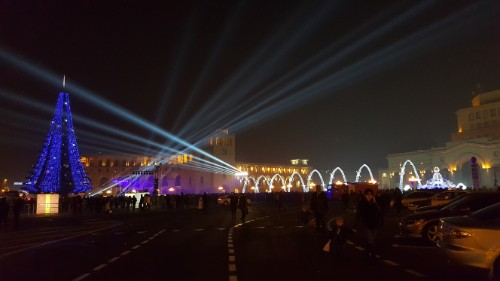
The tree! Take note of how well those spotlight beams are showing up… That’s because of the worse-than-usual smog in the city. Hooray, pollution! We were joking that the city worked hard to get pollution levels up just so that the lights would look good for this event. “Okay, everyone. We’re all going to save our trash burning until Tuesday morning so that we can get a nice smog hovering over the city. Those lights are going to look GREAT!”
Republic Square. It was closed off to car traffic again which was so fun! I love walking in the middle of the street.

My resume at the end of this year is going to be a total hodgepodge. In Ghana, I was a farmer, math and English teacher, tutor, computer repairwoman, carpenter, mason, and hole digger. In Peru, I was an engineering teacher, lighting consultant, and electrical surveyor. In India, I was an architect, dance choreographer, Bible storyteller, and English literature teacher. Here, I’ve been an AutoCAD teacher, archaeology laborer (aka bucket carrier), architect, kitchen designer, and content editor… and now, you can add amateur graphic designer and marketing consultant to that list.

Winter wonderland!

With the construction underway on the project at work, I’ve been dabbling in some other tasks. One of the other volunteers and I are determined to broaden the reach of the organization so that they can get more donations. They’re doing awesome work, but it’s not well publicized. If you want people to donate to support your work, you need to show what exactly it is that you’re doing. You need to promote your activities so that more people hear about your organization and are motivated to help. You also need to have a way for people to donate… ideally one that’s functional.

Disclaimer: I’m not a marketing expert. I didn’t study business. I don’t have experience specifically in this field. However, I do have experience with selling things… it started with Girl Scout cookies and led me to every merchandise committee in existence in university. Selling merchandise is all about making products that people will want and then alerting people to their existence. This isn’t so different. We already have products that people want (aka an organization that’s doing good, effective work). Now, we just need to spread the word. Maybe it sounds stupid to equate selling t-shirts with fundraising for an NGO, but seriously, there’s plenty of overlap in skills and thought processes.

Isn’t it just the perfect amount?

Our first project is the website. There’s a lot of information there already, but some things about the way it’s organized are confusing. We’re going to try to reorganize a bit, plus add more information that will hopefully answer some of the questions a potential donor would have about the logistics of the different programs. Anyway, I’ll let you know when it’s finished so that you can critique our work and offer suggestions (because what could be better than crowd-feedbacking? It’s like crowdfunding for ideas).

I also got placed in charge of designing the Christmas card that they send out to all the donors, so that resulted in a full day of me squinting at my computer screen and trying to come up with an idea that wouldn’t be too stupid. I don’t know, I think it turned out okay. I also didn’t have all of the graphic design resources that I would ideally have for a project like this, so I had to get creative with powerpoint and free editing software. It was a fun adventure… and by fun I mean that if I could afford photoshop, I could have finished the whole thing with about 10% of the effort.

The card…. Shh! It still hasn’t been sent out yet, so feel honored to be one of the first crew to see it.

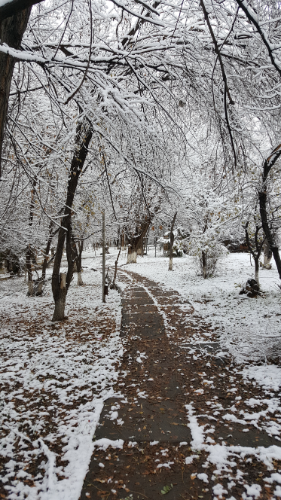
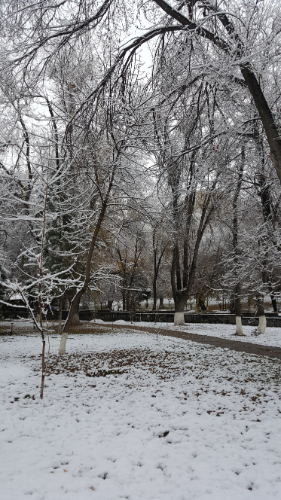
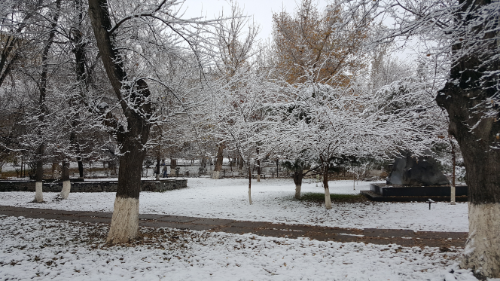
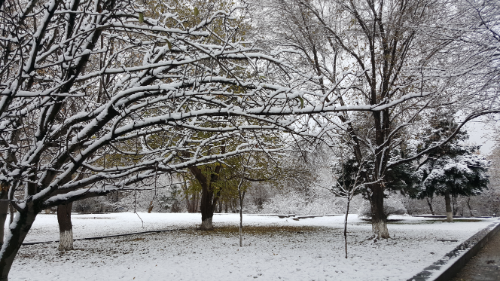
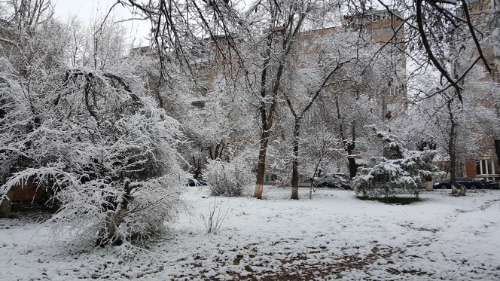
In other exciting news, it snowed here!! It was about a week and a half ago, and it was the best kind of snow… it happened overnight, there was only about an inch, and it was all melted by the time I was walking home from work. You get all the beauty of snow with none of the annoyance! If only the whole winter could go like this… I know that’s not going to happen, though. It’s okay. I’ll enjoy the mild weather while it lasts!
Everything is so pretty under a layer of snow
Just enough to hide the litter on the ground and make the world look clean
I was on my way to work when I took this, but if I hadn’t been, I think I would have insisted on taking a quick frolic through the snow.

The city is getting even more out of control with the lights. I’m sure you’re probably sick of hearing my rants about the insanity of this city, but you’re going to have to put up with them a bit longer, sorry. They are STILL putting up new decorations. They started when I was home for Thanksgiving, and every time I think they must be out of places to put more lights, I’m proven wrong. There are lights everywhere. Everywhere. EVERYWHERE. Do you understand yet? No. You couldn’t possibly.

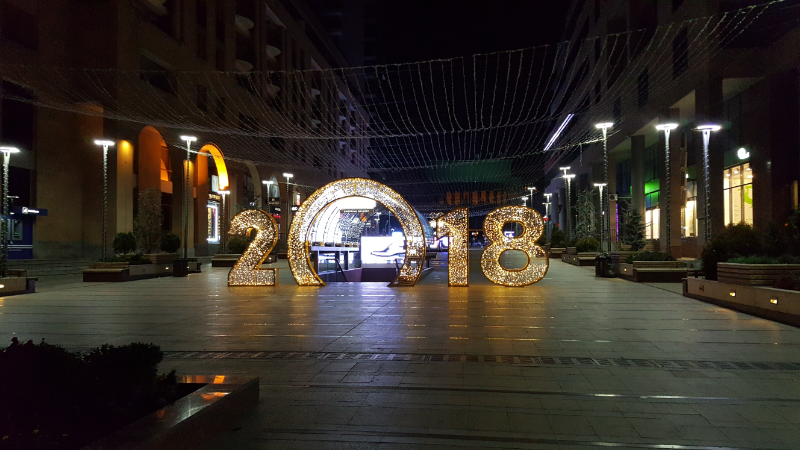
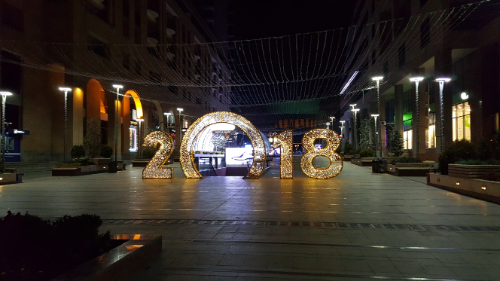
2018! Almost!

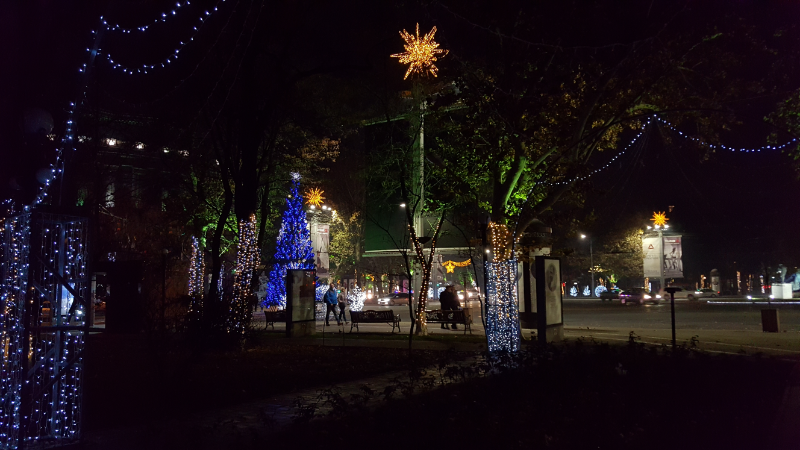
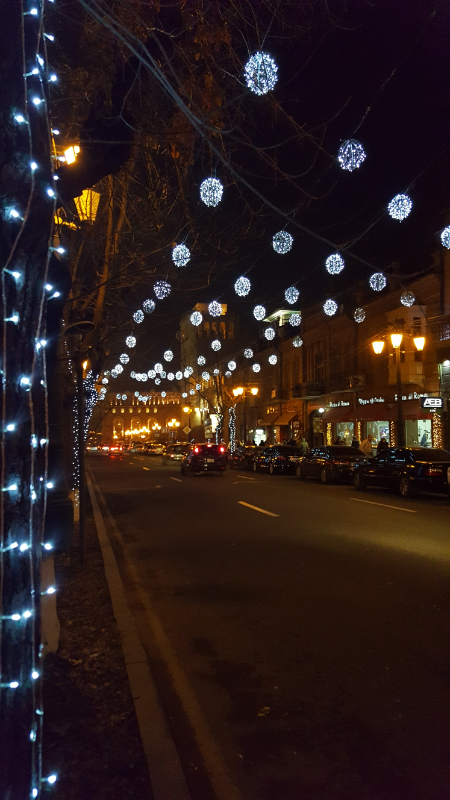
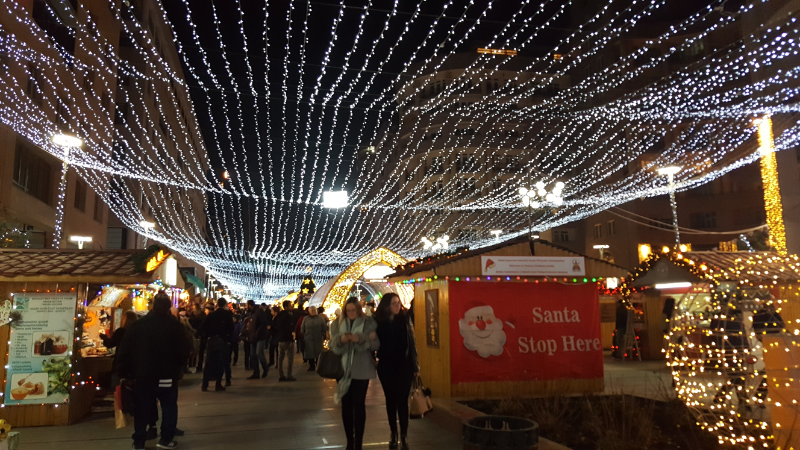
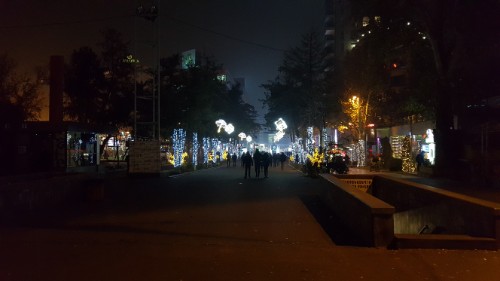
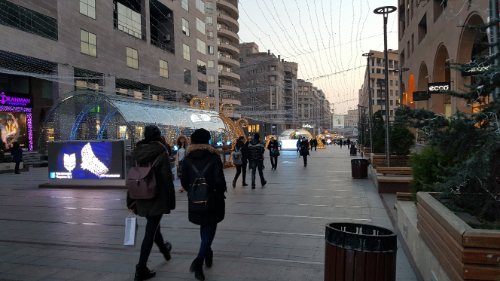
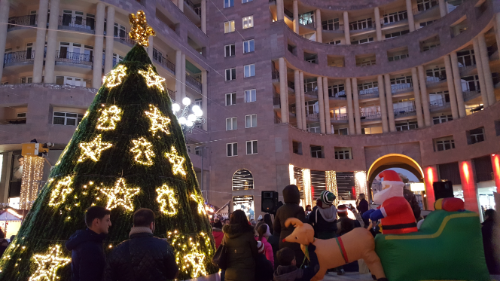
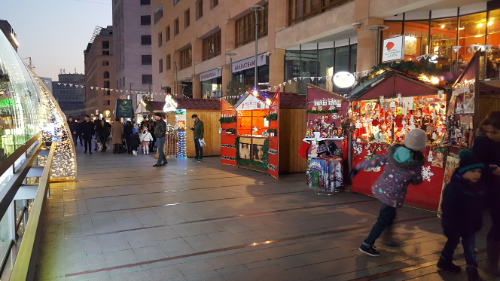
There are at least two ginormous Christmas trees, one in Republic Square and the other in front of Opera. Northern Avenue has lights strung up over the entire street like a light canopy. There are light sculptures in every fountain. There’s a Christmas Village on Northern. There’s a light tunnel in Republic Square. There are these massive light arches there too. In front of Opera, besides the huge tree, they have a giant light ornament that you can walk inside, plus big, light-up castles. There are light shapes hanging from the trees, and lights and lights and lights to the point where you think that if they ever turn them all on, all of the villages in the rest of the country are going to have to have their power cut in order to accommodate them (that’s a depressing joke, but it’s also one of those things that unfortunately wouldn’t be surprising).

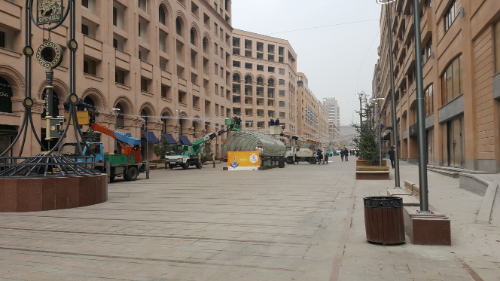
Using a bucket truck to string the lights over Northern Ave
Northern Avenue with only some of the lights turned on… It’s going to be crazy once they get the overhead lights going.
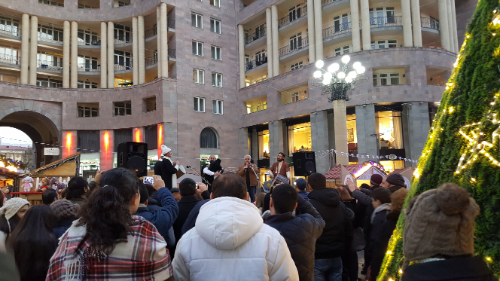
Random concert on Northern!
More decorations

I still can’t figure out when all of the lights will get turned on, but I am the MOST excited. It’s another one of those situations (like Yerevan’s birthday party) where I think the whole thing is completely ridiculous and beyond crazy, but it’s happening no matter what I think, so why not enjoy it? I have some pictures, but I promise that as soon as more things get turned on, I’ll take so many that your eyes will be permanently damaged from all of the lights shining in them. Okay, maybe not your eyes but DEFINITELY mine. Even with the limited number operating so far, I think I’m permanently seeing spots.

Christmas Village on Northern
Lights lights lights!