A trip to Tbilisi isn’t complete without a trip to the famous Tbilisi sulfur baths. According to legend, the sulfur hot springs are the reason why a settlement was started in that location in the first place. “Tbilisi” comes from the Georgian word for “warm”, tbili. The sulfur baths are still going strong today, and there are a few different bathhouses to choose from, ranging from super shady looking to super expensive looking. Supposedly, the water is great for your skin, and you can get a body scrub and massage to go along with it. There are public baths (separated by gender) or private, and I’m guessing most tourists go with the private option. There are stories about mothers going to the public baths to scope out wives for their sons because that’s not weird at all (everyone is naked, in case you didn’t catch that). I personally don’t understand why I would want to soak in questionable rotten egg water for an hour, but maybe if I go back I’ll have to check it out as one of those “try it once” experiences. Eh. Or maybe not.
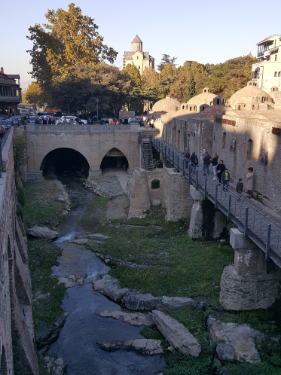
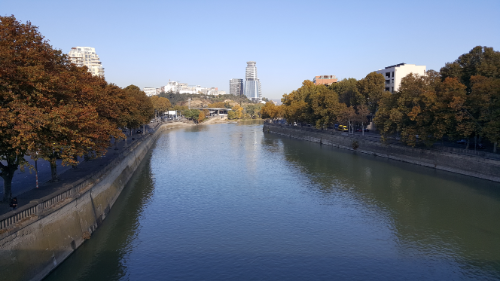
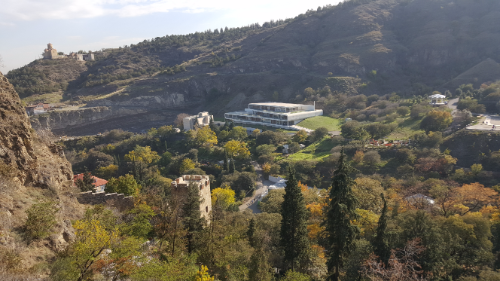
Sulfur stream. You can see the baths to the right side of the picture.
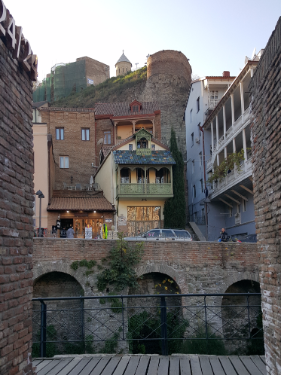
Doesn’t this look like something out of a fantasy movie? Elves. Definitely elves in this movie.

Do you remember Mike’s friend Hovsep who showed us around Vanadzor? If not, Mike (my brother) has a friend, Hovsep, who he met about 4 years ago when he was in Armenia doing a service project. When my family went to Vanadzor, where Hovsep lives, he showed us around.

While we were loitering by the sulfur baths, plotting our next move, I saw a guy who looked vaguely familiar walking up the sidewalk. I was 80% sure that it was Mike’s friend, but I couldn’t for the life of me remember his name (there are too many Armenian “H” names – Harout, Hagop, Hrant, Hovsep, Hovhannes, I could go on). I wasn’t willing to commit to a hello on the 20% chance that I didn’t actually know him, so I instead stood there, stared at him, and gave the world’s least awkward wave when he looked at me. I could practically see the gears turning in his head and the face of recognition once he remembered how we knew each other. The whole thing was incredibly weird. I don’t even see people I know in Armenia… How on earth did I manage to see someone I know in GEORGIA? He gave us a few recommendations of things to check out, and we parted ways. I think both of us were still baffled by the time we said goodbye. Talk about random.
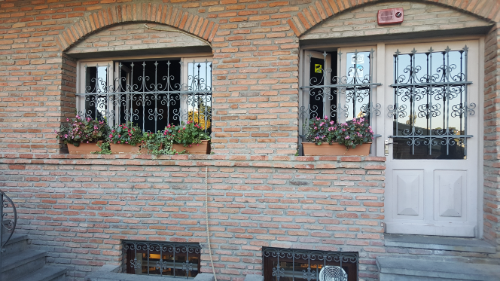
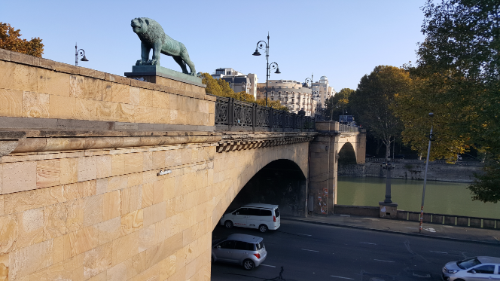
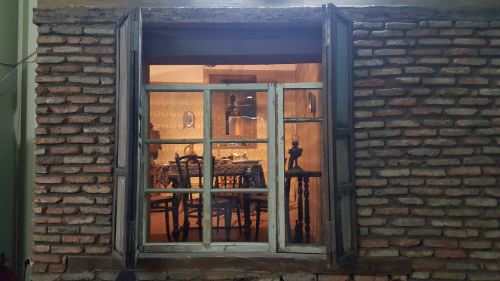
Windows of Tbilisi

Still obsessed with the river

Once I recovered, we realized we were starving and went to grab lunch/rest our aching feet. It was way after normal lunchtime, so by the time we finished and hit the road again, it was starting to get dark. No matter though, we still had things to do and places to see! We were close to the former “Armenian quarter” in the city and decided to head there next. On our way, we saw a sign for Queen Darejan Palace and figured we might as well check it out. We had no clue what we were headed for, but isn’t that half the fun of exploring?

On our way there, we passed a church playing beautiful music on its speakers outside. I thought it was just some mood music, but nope! There was a service going on, and the singing alternated between the priests and a group of five women. I don’t know if it was the night, the church acoustics, the lighting in the church, or just the harmonization, but it was magical. Every time the five women sang, I got chills. I’ve never heard anything so awesome. I know that’s a bold statement, but seriously, they were incredible. I’m sure the ambiance didn’t hurt… I was getting a little lightheaded from breathing the air in there (based on the excessive incensing, I assume it was a Georgian Orthodox church).

When I was about ready to pass out from the fumes, we went outside, looked out over the city, and tried to process everything. My friend Tara said it was the most magical thing she’s ever experienced, so there’s some proof that it wasn’t just me! There was something awesome happening in that tiny church, and we got to be part of it because of a last-minute detour.
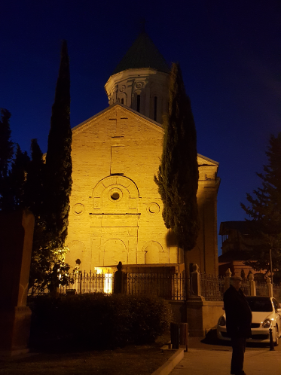
Etchmiadzin Cathedral
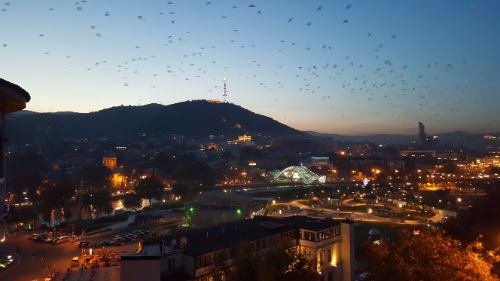
View of the city from the palace/magical church… plus a terrifying number of birds (bats??) that happened to be flying by

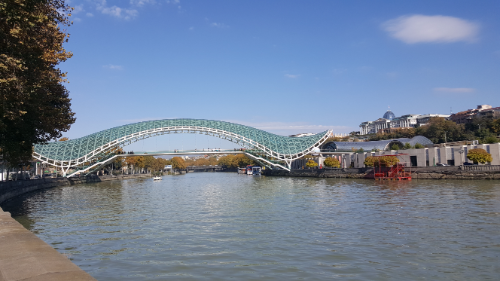
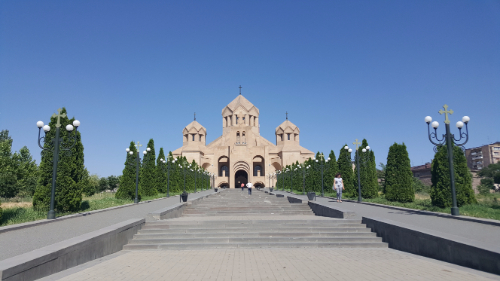
The palace is right next to the church and was closed, but it didn’t even matter. We peered at it over the fence and then kept moving. We decided to make a new rule for our exploring – no backtracking. That means that if you make a wrong turn, you can’t just turn around. You have to keep going and figure out a new way. If you’re trying to get somewhere on a schedule, I strongly discourage this approach. If you’re in it for the adventure, strong recommend. We wandered past the other Armenian church, Etchmiadzin (creative name, right?), and the Presidential Palace (it has a glass dome!), made a few less-than-ideal street crossings, and eventually made our way to the most futuristic-looking bridge in the city, The Bridge of Peace.
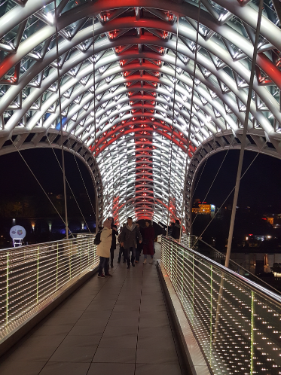
The Bridge of Peace, fully illuminated

Okay, when I said that Narikala Fortress is my favorite thing we saw in Tbilisi, I forgot about the bridge. We can let them share the #1 spot, but seriously… This. Bridge. Is. So. Cool. It’s a pedestrian bridge over the Kura River (the one that runs through the middle of Tbilisi), and I’m sure it’s one of those things that everyone complained about when it was built because it’s modern and doesn’t match anything in the city. I don’t care about any of that. All I care about is the lighting. THE LIGHTING. I was losing my mind and no one else seemed even remotely excited or impressed. Apparently, there are four different lighting programs that change hourly, and if I had been there by myself, I might have stayed for four hours to see them all. There are lights in the canopy over the bridge AND in the glass handrail panels. I’ve never seen anything like those panels before… the LEDs were in a grid between two sheets of glass and looked totally seamless. It was like magic.

The program running when we were there was mesmerizing. The canopy was lit in white and red, making the Georgian flag, and the lights brightened and dimmed in waves. That was coordinated with the handrail lights which turned on and off in waves, so when you walk across, a wave of light shoots past you and fades into the distance. It was like something out of the future. Like I said, no one else’s excitement level was even close to mine. Bummer. I need to go back so I can stare at the lights again, this time unburdened by guilt from making people wait for me while I nerd out.

Our intended destination after the bridge was a restaurant, but our “no backtracking” rule had us going in all sorts of wrong directions (also because I wasn’t trying very hard at navigating. We’ve already talked about this – going the right way takes the fun out of everything). We popped into another church that we happened to pass (because why not?) and then made a last-minute turn into the Tbilisi History Museum. You usually have to pay to go in, but there happened to be a temporary modern art exhibition opening that night. We walked right in and got to experience the joys of modern art including amusing ourselves by pretending that normal things in the room were part of the exhibition. Tara and I spent a good five minutes scrutinizing an air conditioner and were thrilled when a woman came over and gave it a second look. Otherwise, it was pretty much par for the course on modern art. Some of it looked cool, some of it looked unfinished, and most of it looked weird.

By the time we made it to the restaurant, everyone was ready for a good nap. My feet wanted to fall off. I consider that the sign of an exploration day done right, so hooray for us! I slept VERY well that night.
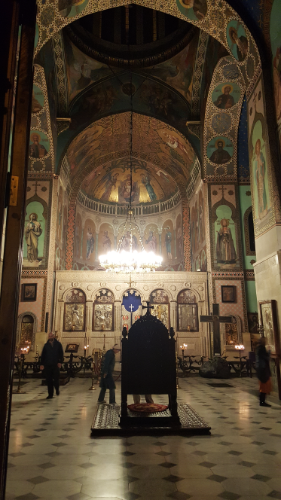
 

Sioni Cathedral of the Dormition… quite the mouthful, huh?
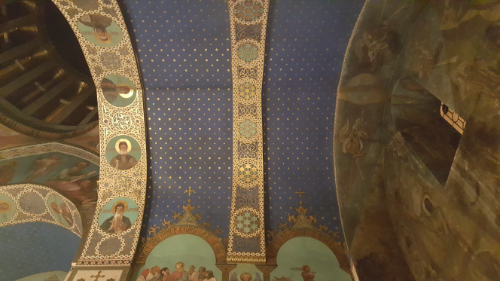
The ceiling in Sioni Cathedral of the Dormition
Cool part of the modern art exhibit. Don’t ask me what the point is because I don’t know. I just like how it looks.
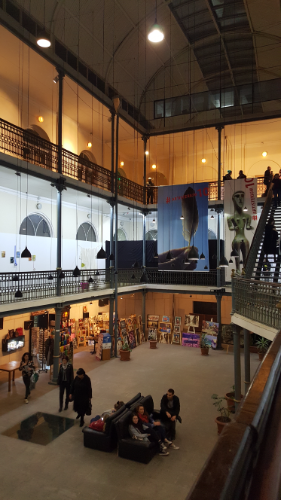
The main atrium in the Tbilisi History Museum. I love that so many buildings actually have lighting that someone put effort into. What a concept.

Welcome to Tbilisi! I know it probably felt like we were never going to make it, but here we are! Despite our late-night arrival, I was determined not to waste any time! I woke up at 8 on Saturday, took a shower, got dressed, and returned to the room to find everyone else still passed out. It didn’t look like they were getting up anytime soon, so I sent them messages saying I was out for a walk and to text me when they were awake. After getting a map from the front desk, I set off with no plans beyond walking generally south where I knew I’d eventually hit a river.

First reaction: It was weird being in a foreign country that wasn’t Armenia. It made me realize how comfortable I’ve gotten here! Yes, I can’t have an in-depth conversation in Armenian (or even a non-in-depth conversation about anything besides where I’m from, what foods I ate today, or whether or not I’m married), but I can at least say enough to find my way around, say hello and thank you, and feel like I’m not a mute. I hate having to rely on other people being able to speak English because it makes me feel like a bum… I guess, though, that’s mostly because English is my first language. If my first language was Spanish and I knew English to help me when I travelled, I wouldn’t feel like I was just expecting everyone to cater to me. I would feel like we were speaking the international language of travel. But alas, English is my native language, and it doesn’t matter how many other languages I learn if I’m not in a country that speaks one of them.

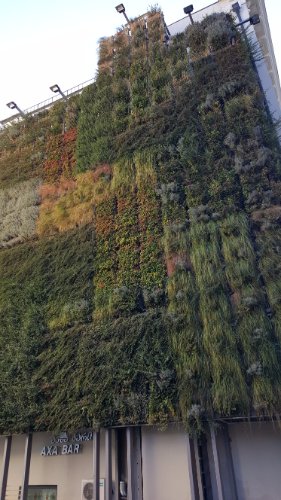
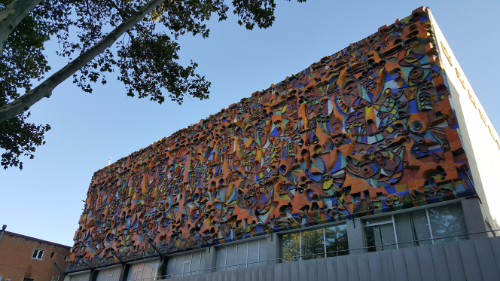
Green wall! On the outside of a building! Whose colors are changing for fall! Cool.
I think this is an office building. I was sure it had to be something artsy to deserve such a cool facade, but I don’t think so. How about that!?

I tried to learn a few basic Georgian phrases, but I forgot how hard it is to remember things when you’re not used to the sounds. It’s almost better to not know how to say “hello” in the local language because then people know immediately that they need to speak to you in English. I guess after that you can say, “Do you speak English?” but I only like to do that if I can say it in the language. Too many words, so I focused my efforts on “thank you” and “excuse me”. It never really clicked… my default now when I hear other people speaking a non-English language is to start speaking Armenian, and I had to fight against that reflex the whole weekend.

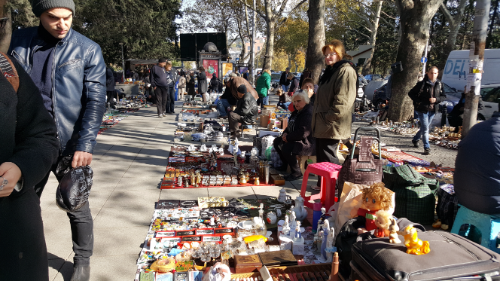
Flea market

Anyway, my first impression of Tbilisi was that it’s not so different from Armenia. Maybe that’s because, if you remember from my Armenian Inventions post, Armenians built Tbilisi. It is true that there was a significant Armenian population in Tbilisi at some points in history (in the early 1800s the city was almost 75% Armenian), but who knows how much the Armenians can factually take credit for. I mean, practically, they’re happy to take credit for all of it. Factually, I’m not sure.

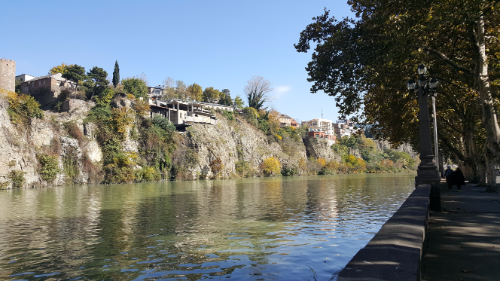
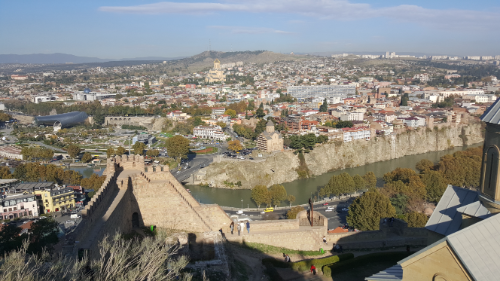
One big difference between Tbilisi and Yerevan is the river. The Kura River runs right through the center of the city, and it makes everything look a thousand times cooler. It’s also not super flat there, so the city is naturally more visually interesting. There are some skyscrapers and a few examples of weird modern architecture, making it feel more western. What’s a modern city without weird, modern buildings, right?

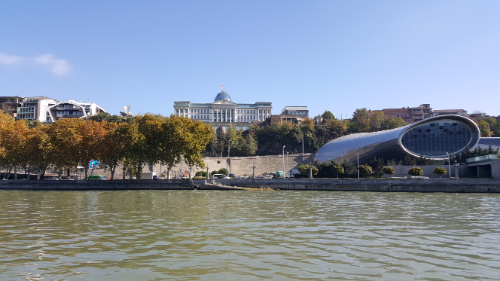
The Presidential Palace, complete with a glass dome, and a weird modern building that I called the macaroni building but that someone else more accurately described as a blood vessel building.
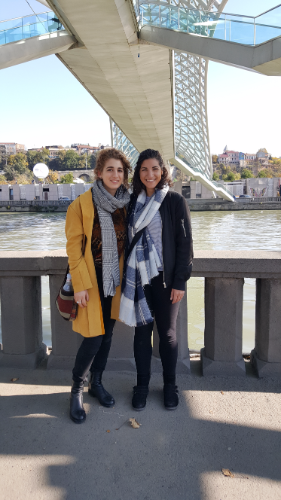
The river and the Bridge of Peace
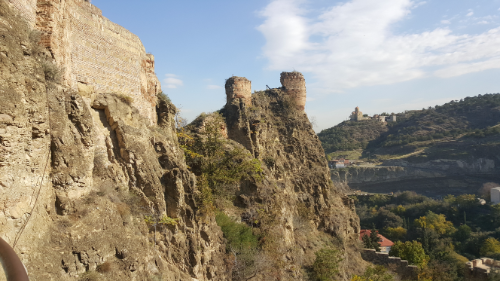
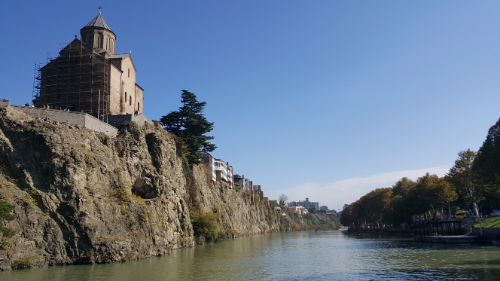
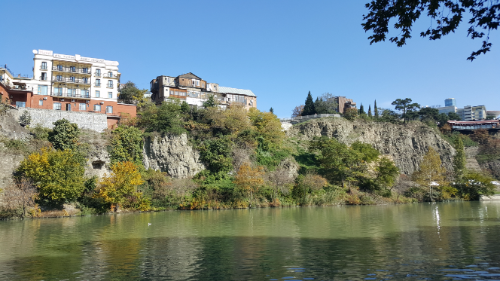
Cliffs in the middle of a city… See how cool rivers are??
Cliffs cliffs cliffs
The coolest

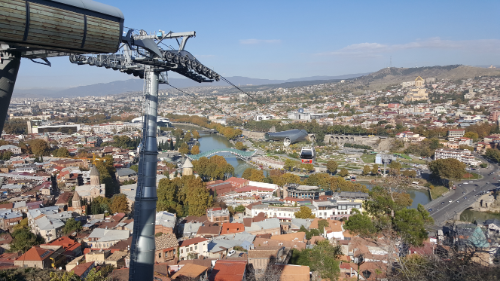
After wandering around for almost an hour, I made my way back to the hostel to check on my friends. They were just about ready for breakfast, and after eating, we headed back out onto the streets. Since I basically knew my way around the whole city by then, I was in charge of sightseeing destinations and navigation (though the latter is mostly because I had functional maps on my phone). We walked around a bit just to get a feel for the city before taking a cable car up Sololaki Hill to see Kartlis Deda, Narikala Fortress, and the National Botanical Garden.

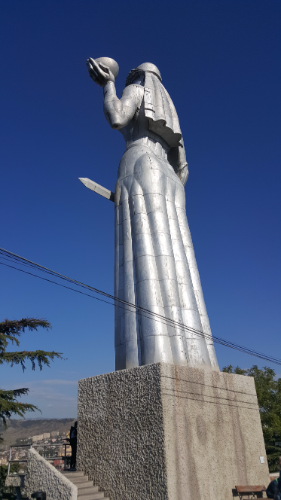
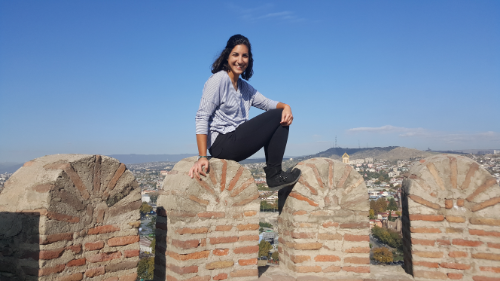
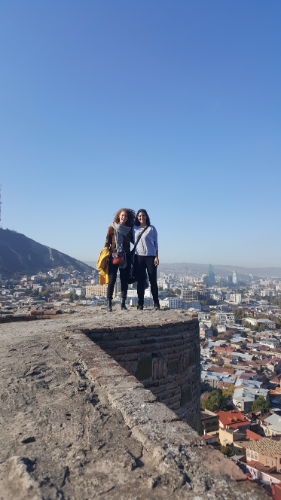
Kartlis Deda is basically Georgia’s “Mother Armenia” equivalent (so… Mother Georgia). She was erected to celebrate Tbilisi’s 1500th birthday, and she has a bowl of wine in one hand for those who come as friends and a sword in the other for those who come as enemies. There’s also a fantastic view of the city from there, and after taking a million of the same picture, we headed to the fortress.

Me and Tara
Kartlis Deda! Well, from behind. You really can’t get a good picture of her from up on the hill
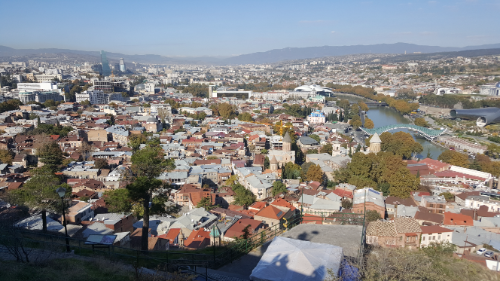
The view from the top of the hill!
You can see the cable car and the park where we started our ride
The botanical garden plus a coolio building with a partial green roof/underground portion

Narikala Fortress was established in the 4th century by the Persians. Since then, it was expanded and repaired in the 7th and 8th centuries, the 11th, and the 16th and 17th, all by different people… you know, whoever had control of Georgia at the moment. So basically, who knows what the heck it looked like in the 4th century, but it sure didn’t look like it does now.

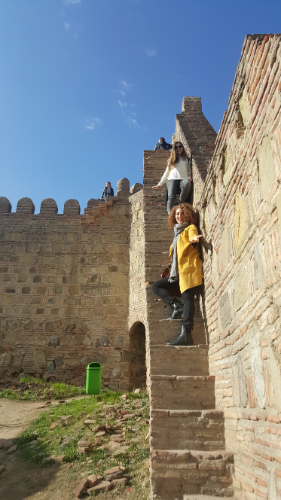
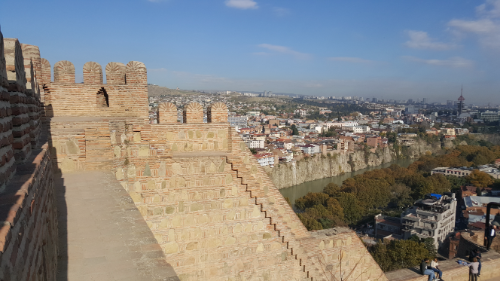
The fortress is awesome!! It’s probably one of my favorite things that we saw all weekend. We should have just waited until we got there for our view of the city! I love the places where you can go and climb around on things and no one’s yelling at you or telling you not to go somewhere, and this was one of those. No entrance fee, no security people. Just the expectation that you’re not going to do anything stupid. Ah, the expectation of common sense is so rare these days.

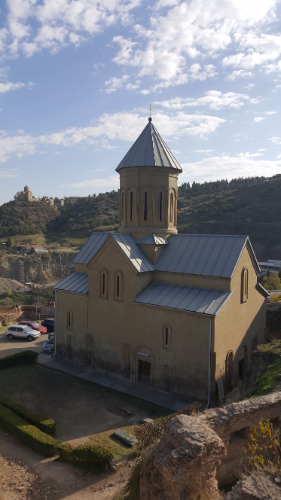
We took our time wandering around and investigating as many nooks and crannies as we could find. There’s also a church in the center that was built in the 1990s to replace the previous one which burned down. It was beautiful on the inside (paintings galore!), but I don’t know what they were thinking when they picked the stone for the outside. It kind of looks like it was made of plywood. Ick.

World’s steepest steps, Noravank style
Plywood Church
Narikala Fortress. Doesn’t it look like it’s just growing out of the top of the hill?
Have I mentioned that I want to live in a castle someday?
This was completely safe.
*insert emoji with heart eyes*
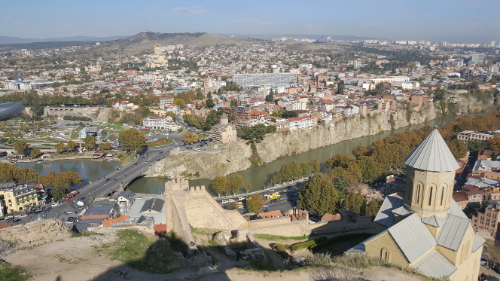
See the cliffs by the river?

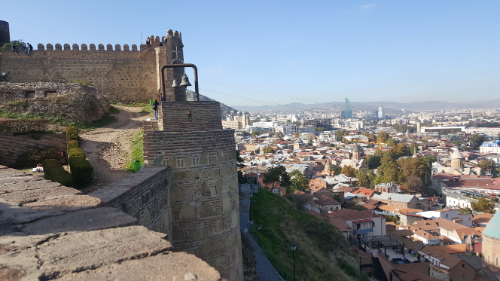
Okay so every picture is practically the same, but the view is so cool that you feel like you need to keep taking them
Outside of St. George’s

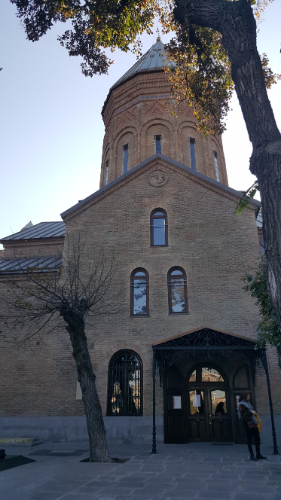
From there, we walked down the hill with nothing more than a general direction to guide us (probably everyone else thought that I was actually leading the group based on the map or some plan, but they say ignorance is bliss, so sometimes there’s no reason to burst that bubble). By chance, we stumbled upon one of the two functional Armenian churches left in the city, St. George’s Cathedral.

There’s some disagreement about when St. George’s was built, so we’ll say it was maybe built in the 13th century and that maybe there was a 7th-century church there before that. It’s also the seat of the Georgian Diocese of the Armenian Apostolic Church and, which in my opinion should be the church’s biggest claim to fame, the burial location of Sayat Nova! He’s the namesake of about 50% of the streets in Armenia and was a poet and musician who, though he lived in Georgia, was Armenian. And don’t you ever forget it! HE WAS ARMENIAN.

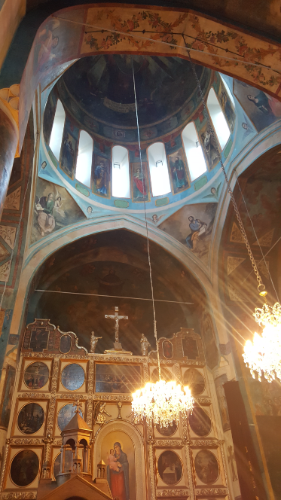
I know, I got distracted again. Back to the church. It has a brick/stucco exterior, common to churches in Georgia, and the inside is covered in murals. It was interesting to see how different it is from churches in Armenia. Everything is way more ornate than in most churches here, and the murals are extensive. I could tell that all of us felt at ease there, maybe because we felt like we were among people with whom we could actually communicate. Oh, the luxury.

After our brief taste of home, we were off again, trekking through the streets in a semi-planned direction. Our next stop was Juma Mosque… which may or may not have been the mosque I was aiming for, but no one has to know that. I actually don’t even know. There are two mosques on the map, and we made it to one, so that’s called a success. (I want to clarify the fact I CAN read a map. The issue, which I can refer to you my university cartography professor to hear about in more detail if you’re interested, is these darn tourist maps that try to be all artsy and end up making a map that’s barely usable because things don’t actually show in the right places. Isn’t the whole POINT of a map to show things in the right places??)

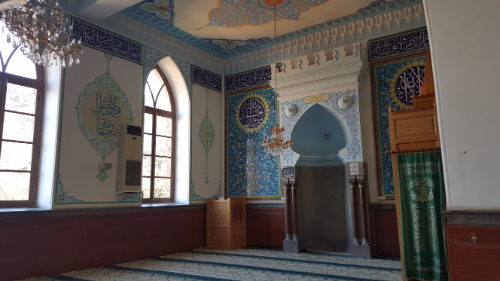
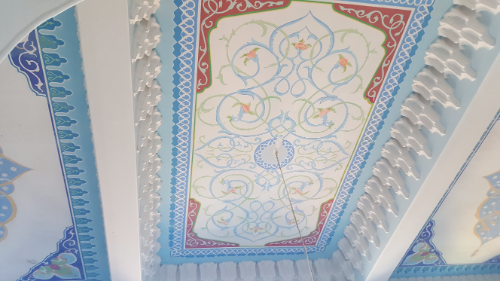
The mosque is plain looking from the outside, just a simple brick building, and we would have completely missed it if the doors weren’t open. The inside, on the other hand, is spectacular. The ceilings, the walls, the everythings were beautiful. I’m a big fan of blue, and it seems like that’s a popular color when it comes to mosque decorations. I was curious about the reason behind that, so I looked it up. It doesn’t look like there’s any connection between Islam and blue, but in the Middle East, blue represents safety and protection as well as immortality, spirituality, and heaven. Those seem like some pretty good reasons to pick blue for the primary color in a religious building! I don’t usually think much about it, but the psychology of colors is interesting. Blue does suggest a kind of peacefulness that seems appropriate in the worship context. Hm.

Inside St. George’s
I didn’t take a picture of the outside of the mosque, but just picture a nondescript brick building and you’ve got it. The inside though… definitely not nondescript
The ceiling

I’m going to give you some time to ponder color psychology, mostly so that I don’t include a full novel in one post. If you’re busy, you can go do your busy person things. If not, look up the meanings of colors in different cultures. It’s interesting, I promise. If you’re into that kind of thing.

Adventures on adventures! One of my friends asked a few weeks ago if I wanted to go to Georgia for a weekend, and of course I said yes! That’s Georgia the country, to be clear. It only takes about 5 hours (theoretically) to get to the capital, Tbilisi, by car from Yerevan, and most people go there when they need to renew their passport stamps because it’s the easiest open border to get to.

Someone knew a driver and got in touch with him to organize rides to Tbilisi on Friday after work and back to Yerevan Sunday night. He asked if we could also take a woman to a village along the way, we agreed, and he subtracted her fare from our total. The drive started out okay. I mean, traffic was terrible getting out of Yerevan, but what do you expect when you leave at rush hour?
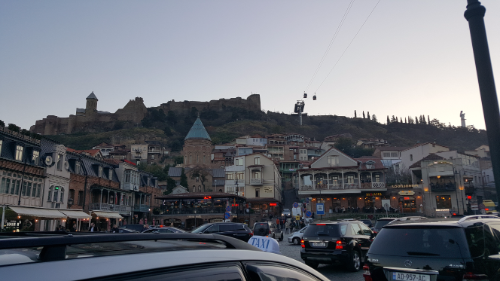
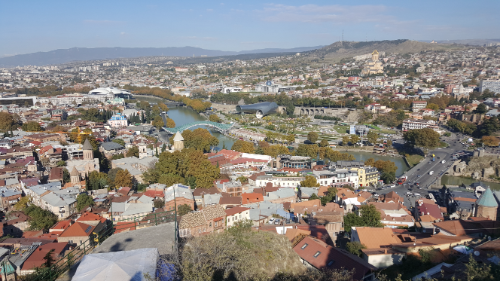
Here are some random Tbilisi views for your enjoyment. This is from one of the hills that overlooks the city.

This also was my first experience getting a gas refill in a car that runs on natural gas. I guess I never had to think about it before because I rarely even go to gas stations here. In hindsight, I realize that I’ve been in taxis with huge gas tanks in the trunk, and while I didn’t think twice about it at the time, those were probably natural gas-powered cars as well.

Armenia is apparently one of the biggest users in the world of natural gas-powered vehicles. I think it’s mostly just because it’s cheaper than gasoline, but it’s also kind of a pain. When you stop to fill the car, everyone has to get out and wait in a “safe zone” in case the car blows up. No big deal. As they say, as long as everything is installed correctly, it’s not dangerous… which is exactly my concern. I had a conversation with someone about this who said, “Oh they’re very safe. I’ve only seen a car blow up once.” Oh, well then! You’re right. No big deal. Know how many times I’ve seen a car blow up? Zero, and it would be nice to keep it that way.
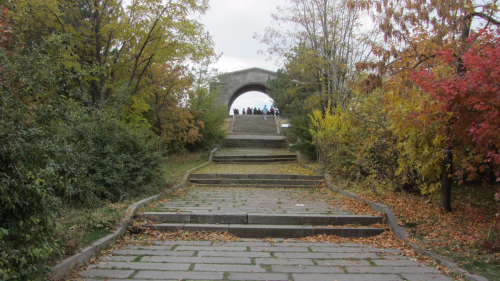
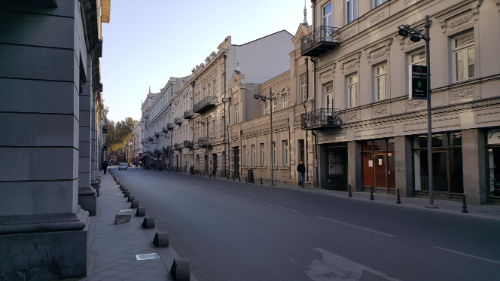
A Tbilisi street

Anyway, the stops to get gas took a bit longer than anticipated, and then, just as we dropped the extra woman off, we got a flat tire. Wonderful. As the woman is hopping out of the car (knowing full well that we have a flat), she gives a jolly, “Bari djanapar!” (have a good journey) and shuts the door behind her. My jaw dropped, and I literally gave a laugh of disbelief and a “she’s joking, right???” Who does that? “Oh, that’s too bad that you all have a flat, but here I am at my destination! How wonderful! Have a great journey!” Thanks a lot, lady.

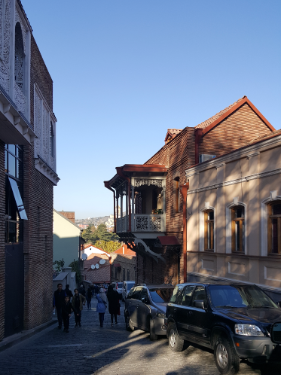
I don’t know if the picture properly communicates the feeling, but this place looked like something out of a movie with elves in it. Something about the styles of the buildings and the colors and the way they’re all arranged on the hill… I don’t know. It was like something out of a fantasy movie.

The joke was on her though because in classic Armenia fashion, despite the fact that it was the middle of the night, we were invited to wait inside her friend’s house until the tire was changed. I guess it was someone’s birthday because cake was involved, plus the usual offers of coffee, tea, water, or anything else you could possibly want.

Finally, we set off again on the final stretch before the border. There’s nothing more fun than an 11PM border crossing! First, we got to the Armenian border. We all had to pile out of the car and walk through passport control while the driver went across with the car. Then, we piled back in, drove through what I assume is some sort of no-man’s land, and piled back out again at the Georgia border. We walked through passport control with our bags and met the driver again on the other side. Now I have passport stamps galore! From there, it was maybe an hour before we got to Tbilisi.

You know how long the whole thing took us? SEVEN HOURS. Instead of five. SEVEN. We got in after midnight, and I immediately passed out. I figured the sooner I slept, the earlier I could wake up and start exploring!

I think this is going to turn into a little Georgia weekend mini-series… I’m cutting part one off here because I don’t want to make your head explode. We’ll take it in small pieces instead, so stay tuned for a mini-Georgian/Armenian parallel history lesson.

These balconies used to be popular in Armenia as well, but they’re kind of a dying breed (mostly because of the destruction of historic Yerevan and the lack of maintenance).

Okay, here we finally are… Day 7! The week with my family was simultaneously the longest and shortest week ever. Each day was a jam-packed experience, but when the week was over, it felt like they had just arrived. I think that’s just the way life goes. It feels long when you’re living through it, but looking back, it seems like it all passed in a second.

Charents Arch

In the last few years, I’ve been trying to really savor the good moments and those times when I have that feeling of inner peace like everything is as it should be. For me, that’s just making an active effort to recognize when things are great and memorizing everything about those moments. It’s almost like I take a second to step outside of myself, look at the scene around me, see the people, remember the feeling, and then go back into experiencing it. I don’t know if that makes any sense, but since I’ve started thinking that way, it’s made it easier for me to access those times and that peaceful feeling in my memory. Wow okay, bit of a sidetrack, sorry!

View from Charents Arch

Like I was saying, Day 7! Our final day’s schedule was to visit Garni Temple and Geghard Monastery with a stop at Charents Arch along the way. Another one of my brother Mike’s requests (besides the hiking one) was to go somewhere with a good view of Mount Ararat. As far as I know, the two best places to see Ararat from Armenia are Khor Virap and Charents Arch. Unfortunately, my family was here during an incredibly hazy/cloudy/foggy week, and despite scheduling Khor Virap and Charents Arch 5 days apart, the visibility was equally horrible on both days.

Hey, Ararat! Oh, you can’t see it? Yeah, exactly.

The arch was built in 1957, named after Armenian poet Yeghishe Charents, and features words from one of his poems, For My Sweet Armenia, talking about how the beauty of Ararat is unrivaled in all the world. I’m sure we would have agreed if we had seen it, but mostly it just looked like someone pulled off an amazing magic trick and made the mountain disappear. I can’t complain though. If the worst part of the trip is the fact that we never got a good view of Ararat, I can live with that.

The fam with Ararat (supposedly)
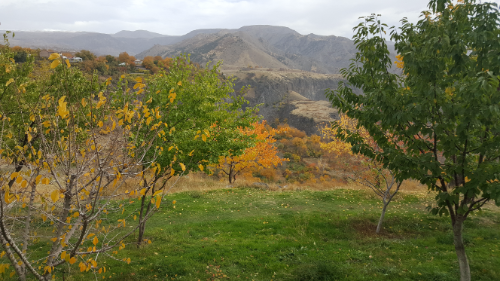
Pretty tree

Charents Arch was a new stop for me, but I had already visited Garni and Geghard with Sarah. You can read more background information about those sites HERE.

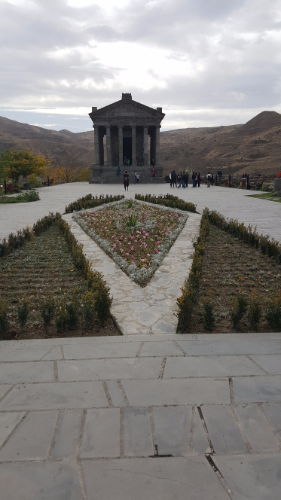
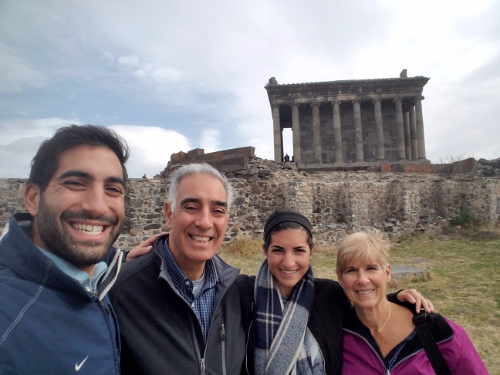
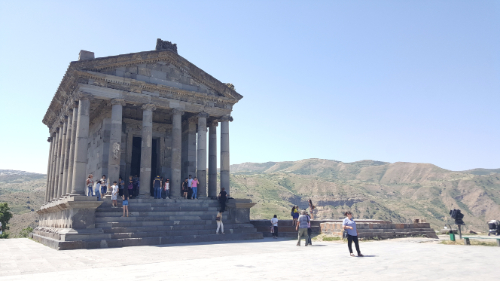
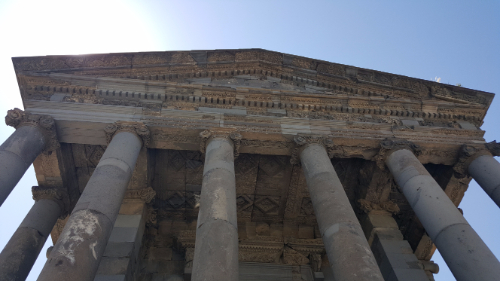
Garni Temple
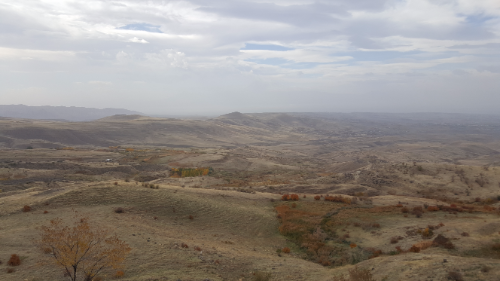
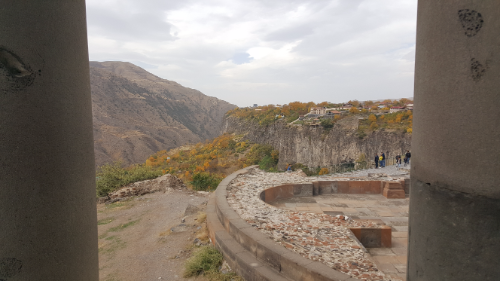
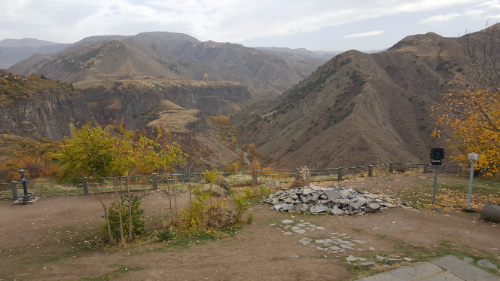
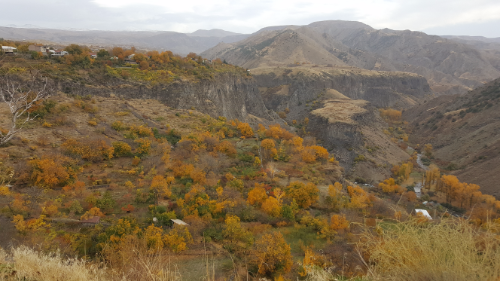
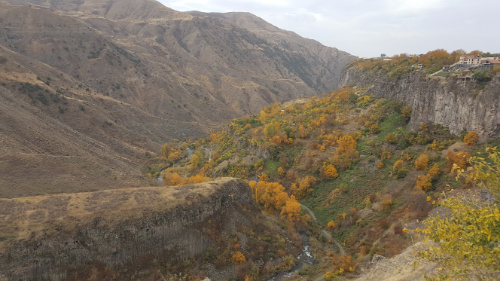
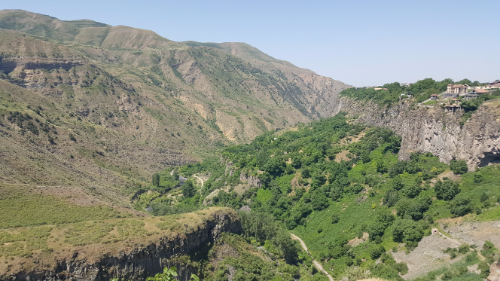
Views from Garni
So pretty!
Fall!
<3 <3 <3
Garni selfie

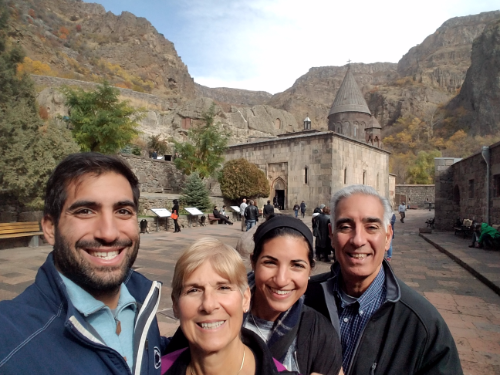
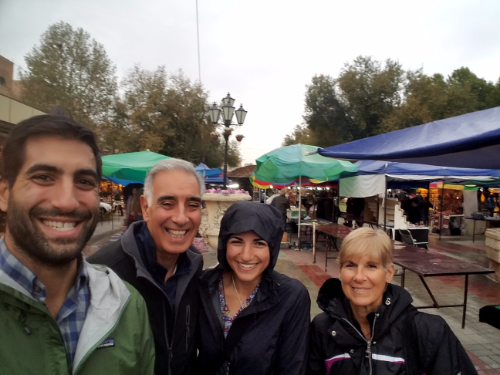
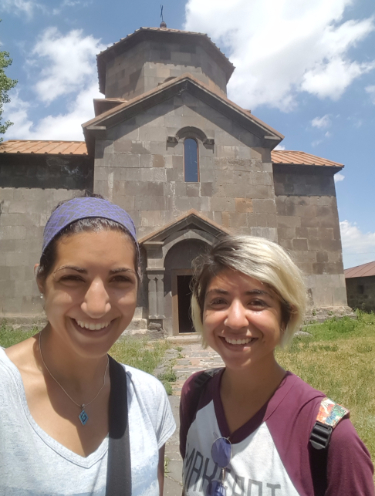
Geghard selfie

I did see some new things at Geghard, though. When I went with Sarah, we went with a taxi and had an hour to explore. This time, we had as much time as we wanted, and Mike and I did a little extra exploring. After we finished checking out the monastery and crawling into every nook and cranny we could find, we started heading back to the parking lot. Mike spotted a path going up the mountain and asked if I wanted to check it out with him. Hmm… random, semi-overgrown path leading to who knows where? Did he even have to ask? That practically screams “Lara!”

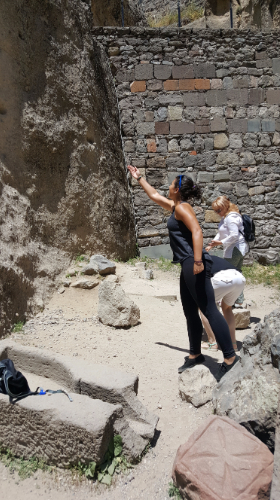
Tossing for wishes
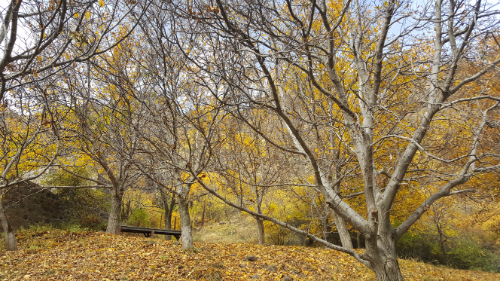
Fall! Fall! Fall!
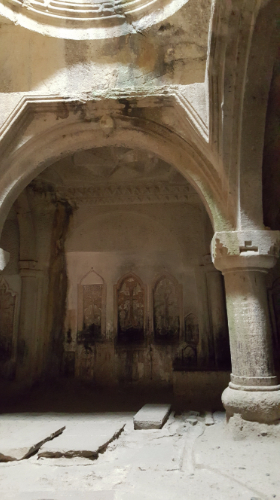
Inside Geghard with Mom and me peeking in from a hole at the top

Fancy khatchkar wall
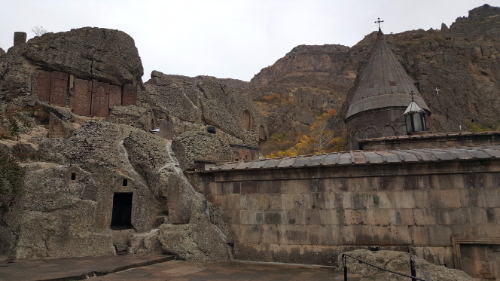
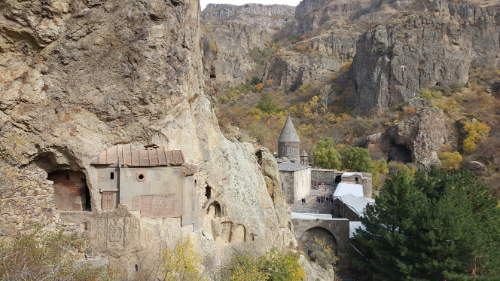
Some cave holes and the cave chapel, including an itty bitty me and an itty bitty Mike hiding in the chapel (don’t even bother trying to see us because you don’t have a chance. Just trust me. You can see my mom though! Hey, purple jacket!)

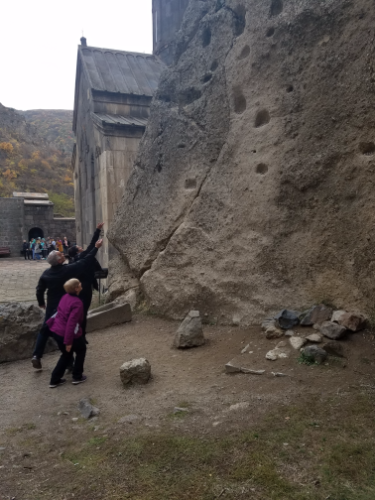
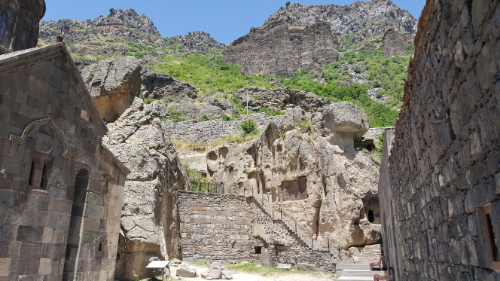
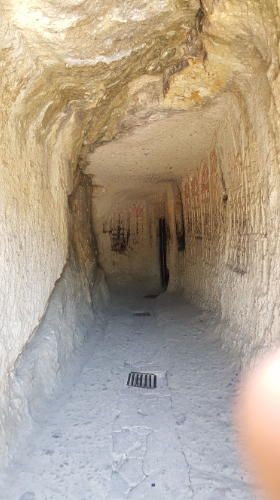
I wasn’t exactly dressed for a side excursion (black pants = dirt everywhere, boots with no traction = possible death), but you can’t let small details like that get in the way of adventure! Mom had read about how the Geghard monks used to live in caves surrounding the monastery, so we were hoping that’s what we were about to find. There were a bunch of caves, plus another little cave chapel popping out of the side of the mountain. I’m not completely sure how they managed to build some of these things…

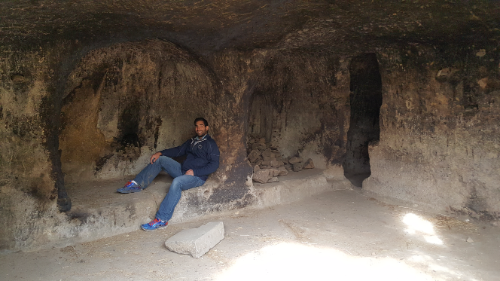
We went into a few different caves that were definitely monks’ quarters. In one of them, Mike tested out what looked like a bed nook, or a “monk bunk” as we decided they should be called. Very comfortable, I’m sure. The Geghard monks were known for their simple, minimalistic, and hermit-y lifestyle, and what better way to live that life than in a remote cave with a stone bed?

A lot of the cave homes have been destroyed by earthquakes, so there isn’t a definitive number for how many there were. Some estimates are in the hundreds, and they weren’t all as accessible as the ones we saw. Supposedly there are/were some that can only be accessed by ropes or ladders! I guess I’ll have to take my ropes and grappling hook with me next time I go.

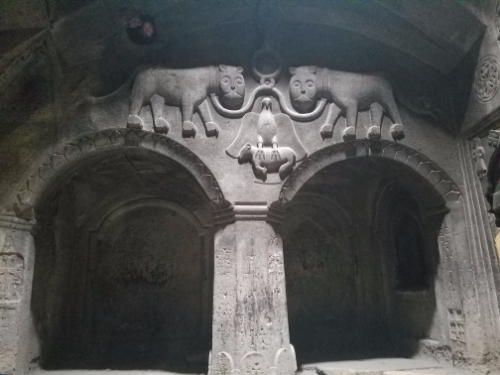
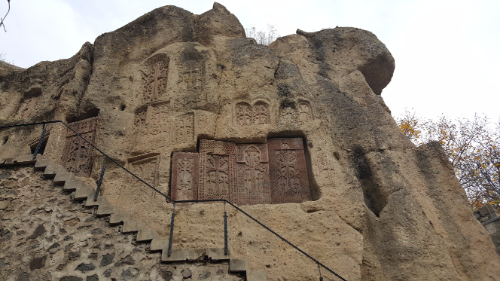
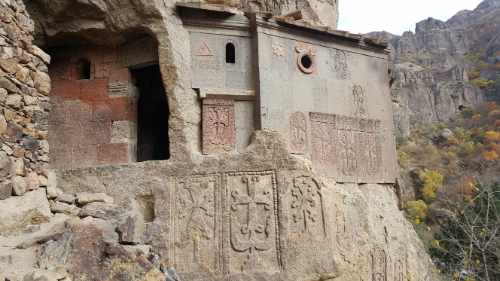
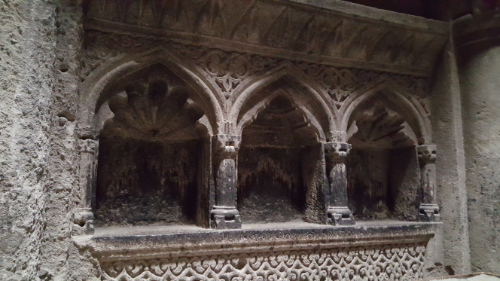
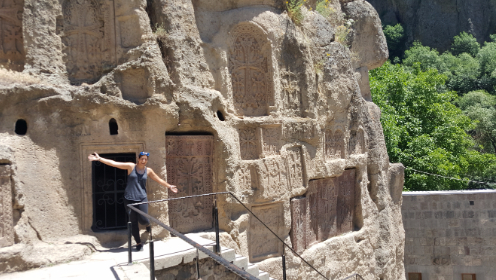
Cave chapel with awesome carvings

The cave chapel we saw is named after St. Gregory, and it’s said that he lived in one of the cave dwellings back in the 4th century when he was preaching in the region. I personally am just amazed at the fact that St. Gregory managed to do something at practically every place in the entire country. “This is where St. Gregory was imprisoned in a pit.” “This is where St. Gregory lived in a cave while he preached in the surrounding area.” “This church was built on a rock where St. Gregory once sat to rest on a long journey.” “This monument displays the grain of sand that touched the actual foot of St. Gregory when he vacationed briefly at Lake Sevan to regain his tan after being imprisoned in a pit.” “St. Gregory had a vision that this field was filled with flowers and when he came here and sneezed, flowers immediately grew.” “This village is where St. Gregory once got a flat tire and had to stay the night until it was fixed.” It seems like no matter where you go, St. Gregory did SOMETHING there. (Okay, yes, I made some of those up, but they could just as easily be real claims.)

I know, I let myself get sidetracked again. Sorry. In summary: there are caves at Geghard where monks used to live. St. Gregory maybe lived there. Cave chapel. Monk bunk.

St. Gregory’s cave chapel
Mike on a monk bunk!
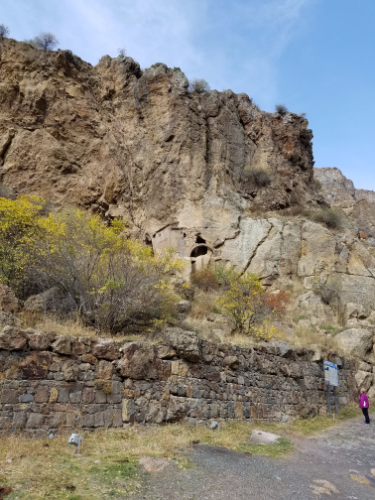
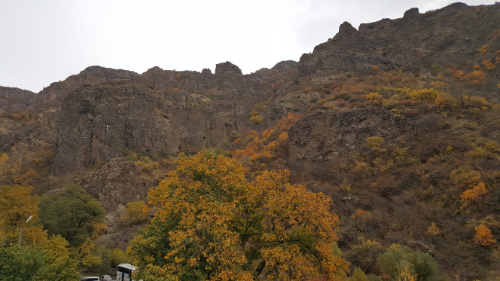
Cliffs and cave holes

After finishing up at Geghard, we headed back to Yerevan to wander around until dinnertime. I took my parents to see the office bunker where I work (it’s underground and has no windows), and we did some last-minute perusing at Vernissage.

Even though the planning for my family’s trip was a LOT of work, and I was semi-stressed the entire time because I wanted everything to go perfectly, it was so much fun to have them here. I certainly didn’t feel physically refreshed after they left (honestly, I could have used a vacation after the vacation), but I was emotionally refreshed.

Can you believe that practically everything went exactly according to plan? And the one thing I couldn’t control, the weather, was fantastic! I’m calling it a success! If you need an Armenia vacation planner, I’m basically a professional now.

The week is just flying by, isn’t it?? Day 5 was our Yerevan Day. We spent the morning at the Genocide Memorial and Museum, and it was just as exhausting as when I went with Sarah. Since I had already been, I perused a bunch of the photos and other materials that I skipped before. I think you would need to go back 10 times to see everything without your brain turning to mush.

At Vernissage. It kind of looks like we’re just at a football tailgate…

After that, we had a low-key rest of the day and went to Vernissage. Before coming, Mike told me that I needed to “speak Armenian like a local” so that he could get the best prices there. Thanks, Mike. No pressure or anything. I certainly didn’t pass as a local, but I think I at least projected the illusion of knowing what I was talking about. Hopefully.

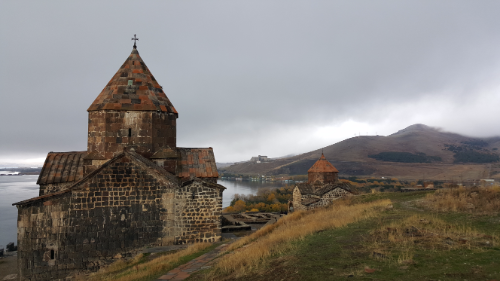
Sevanavank, looking a bit eerie

Day 6 was another crazy, hectic, “what were you thinking when you planned this?” kind of day. I wanted to go to Lake Sevan and Dilijan, and the only way we were going to have time for both was if we did them in the same day. So what choice did I have? No choice, that’s right.
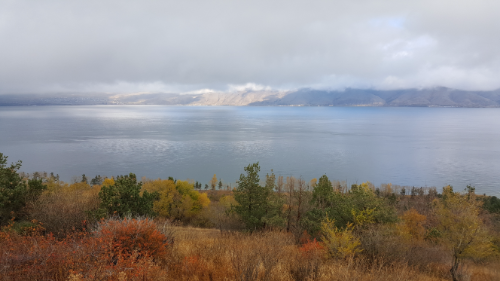
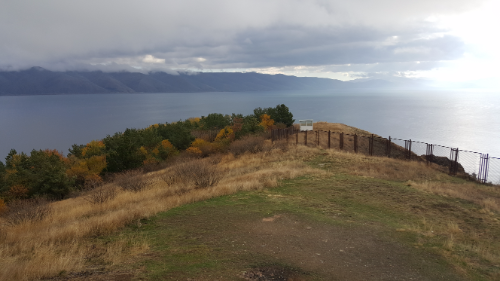
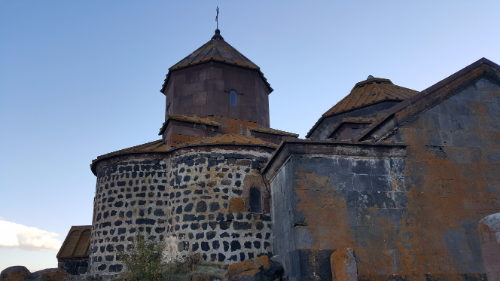
We made our way to Sevanavank first, the monastery on a peninsula that used to be an island until the water level of the lake dropped from overusing it for irrigation. The water in the lake is a beautiful, brilliant blue color when the sun strikes it, but we were there early in the morning and it was cloudy, so instead, it looked a bit spooky.

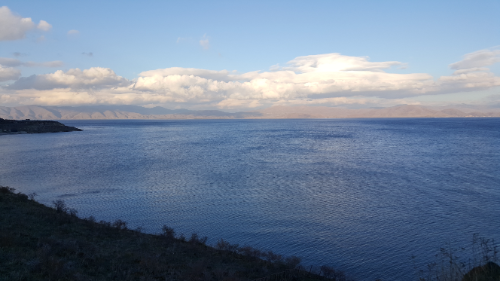
Hi, pretty lake.
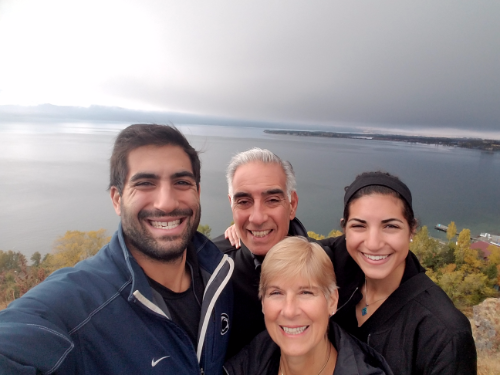
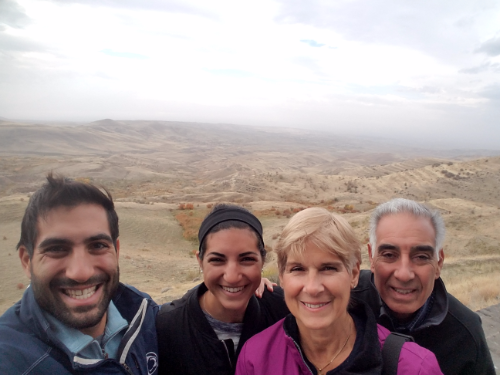
Family selfie at Sevanavank

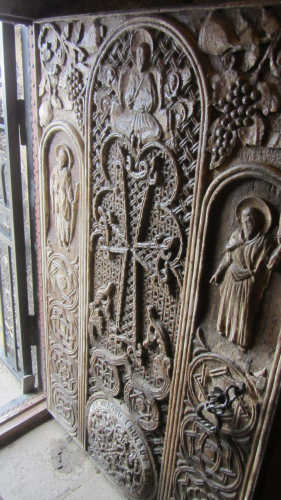
The door into Sevanavank.

From there, we headed to Dilijan. Back before I made the schedule for the trip, I asked everyone to send me anything that they definitely wanted to see or do. One of Mike’s requests was for us to go on a hike together. The best place for that is Dilijan, so I was left with the task of figuring out where Mike and I could hike that Mom and Dad could be entertained for the time it took us to complete our hike. Then, a stroke of brilliance!

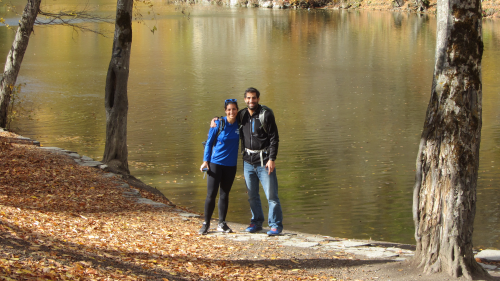
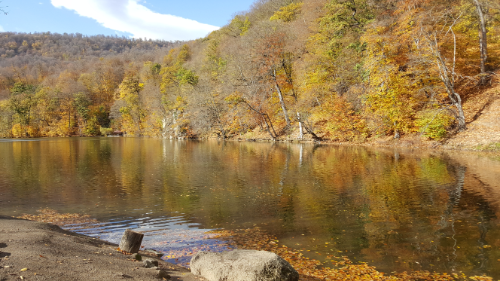
Pre-hike by Parz Lich

There’s a hike in Dilijan that goes from Parz Lich (lake) to Goshavank, a church in the town of Gosh. I also knew that there’s another monastery in Dilijan that’s supposed to be very nice. I Google mapped it out, and my suspicions were confirmed. We could make it work out perfectly! Mike and I got dropped off at Parz Lich which is a beautiful place anyway and especially in the fall. Mom and Dad hung out there for a little and drank some coffee while Mike and I started the hike. After leaving the lake, they went to Haghartsin Monastery and then met us at Goshavank. Our hike was supposed to take 2.5 hours which we decided meant 2 hours for us, and the timing was spot on!

How cool is this???

Okay so I’m literally obsessed with fall right now. Just brace yourself for a whole lot of hiking through the pretty, fall-colored woods pictures.

I know, I’m getting ahead of myself again. Mike and I had an interesting hike. It had rained the night before, so the ground was super muddy in some spots. To make things worse, it’s that clayey soil, so by the time we were 10 steps in, our shoes were about 10 pounds heavier from all of the mud stuck to them. Luckily, the beginning was the worst part, and we were fine after Mike fashioned us some walking sticks.

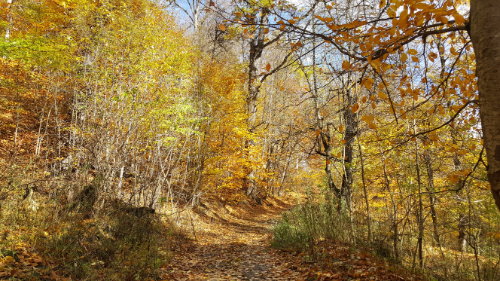
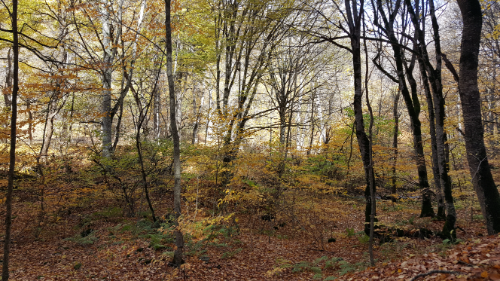
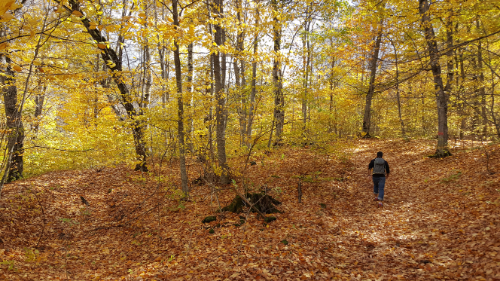
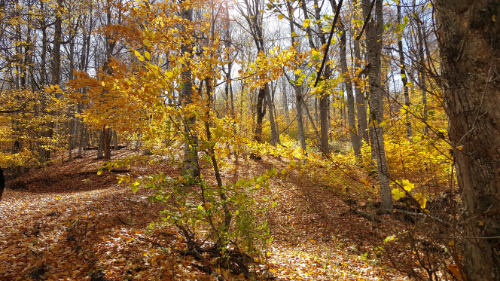
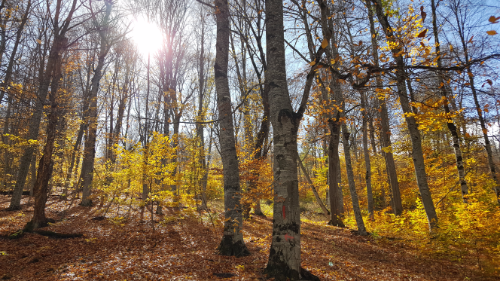
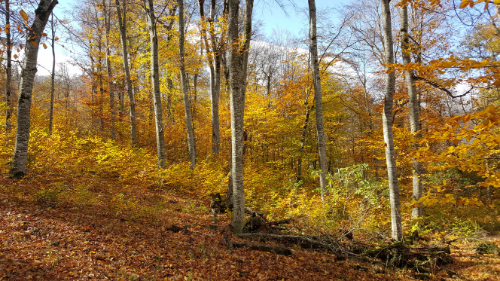
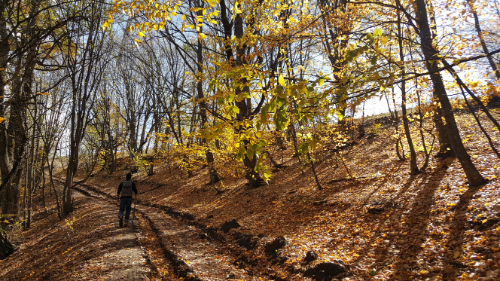
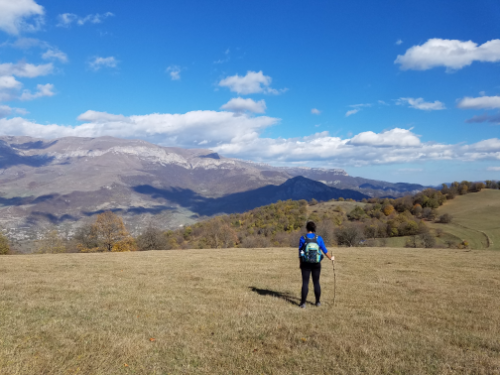
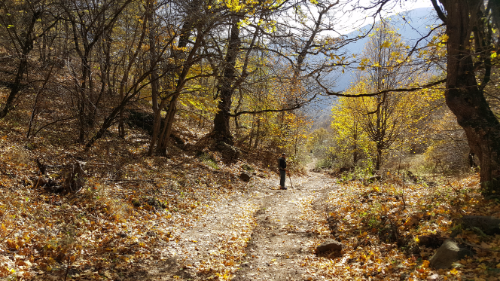
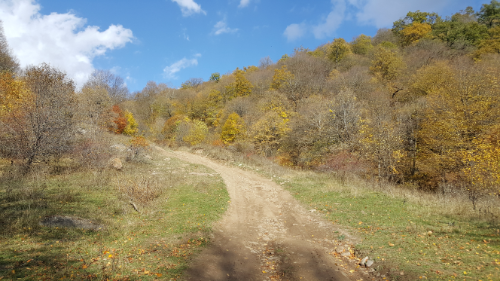
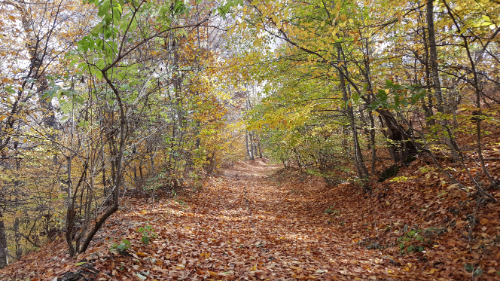
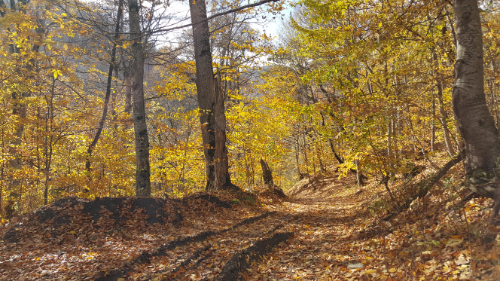
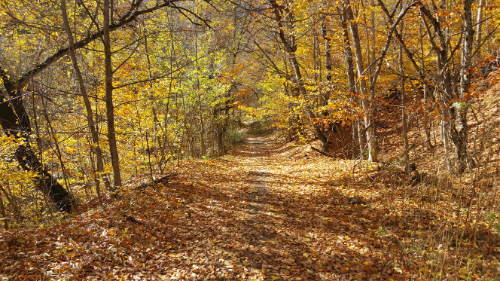
The hike itself was fabulous. The trees were at that perfect point in the fall when they’re all yellow and there are still enough leaves on them that it looks beautiful instead of depressing. The sun was shining through the trees, making the leaves look golden and the forest look mystical. At the peak of the hike, you have an amazing view of the valley and the mountains in the distance. It seriously looked like something out of a stock photo. It was also nice to have some time with Mike. Hikes are great times for good conversations! (Brace yourself for  photo explosion but I seriously couldn’t pick just a few.)

Fork in the road

Quite the view, huh?
Headed down to Goshavank

We beat our parents to Goshavank by a few minutes and spent that time eating Cheetos (gotta love that good ‘ole American snack food) and cleaning the mud off of our shoes. When they caught up with us, we all went to check out Goshavank together.

It’s kind of castle-like, right?

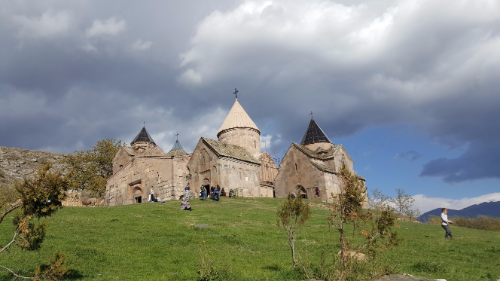
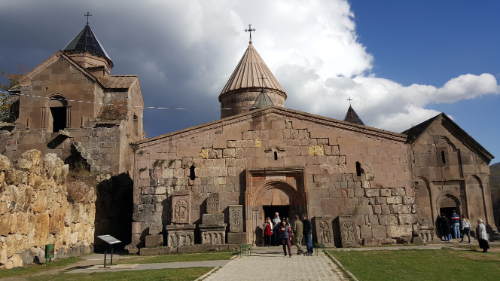
Goshavank is a monastic complex whose main church was built in 1191. There are way more buildings than I anticipated, and while the whole thing is quite nice, the coolest part is the bell tower and book depository. The book depository is a big, boring room, but on top of it is a chapel/bell tower, and you can see it through a hole in the ceiling! I wanted so badly to go inside the chapel, but the only way in is by using these cantilevered stairs that are currently unusable. Maybe that’s why I think that was the coolest part, because I couldn’t actually go inside, and I SO wanted to.

Goshavank! See the book depository and bell tower to the left.
After Goshavank, despite the fact that Mike and I ate a bag of Cheetos, a granola bar, and a pack of M&Ms while waiting for our parents, we were starving. We went to a restaurant in Dilijan, Kchuch, that has the best pizza in Armenia (the competition, to be fair, is nearly nonexistent because I haven’t eaten many things here that could even realistically be called pizza, but it’s also good by real standards too). We had one of those stuff-your-face-and-then-wonder-why-you-ate-so-much-but-it-was-so-good meals before piling into the car to head back towards Lake Sevan.
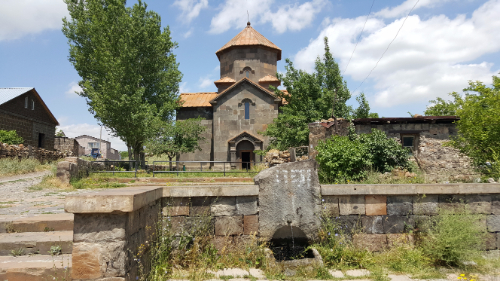
Hayravank

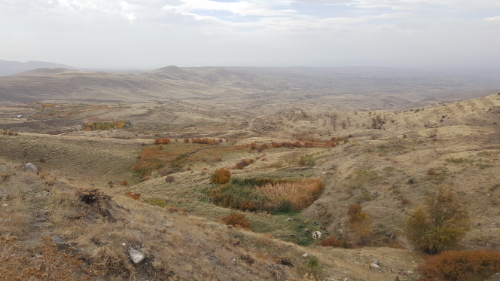
We had two more stops on our list: Hayravank (another church, of course) and Noratus Cemetery. Both have some weird legends/stories associated with them, so brace yourself. Before I get into that though, let me just say that the drive from the town of Sevan to Hayravank is probably one of the best drives I’ve been on in Armenia. The road runs along the water, and the views are absolutely incredible. Even if there was nothing to see down there, I would still say that it’s worth the drive.

Lake Sevan from Hayravank

Hayravank itself wasn’t anything too spectacular, but the lake is awesome and so was the sky when we were there. The church is small and was built in the 9th century. Ready for the legend? Once upon a time, the Armenians were in a war (it seems like this is a common theme throughout history here). Some mean dude (that’s an understatement) named Timur was conquering his way across Armenia, killing everyone and destroying everything. When he went to Hayravank to kill the priest and destroy the church, the priest flung himself into the lake, and instead of dying, ran on the water.

Timur was amazed and told the priest he could have one wish (he was like a stingy genie – only ONE wish??). The priest asked him to spare the church and as many people as could fit inside. As more and more people piled in, Timur got suspicious and stepped inside just in time to see the priest turning the last person into a dove and releasing it out the window. The End.

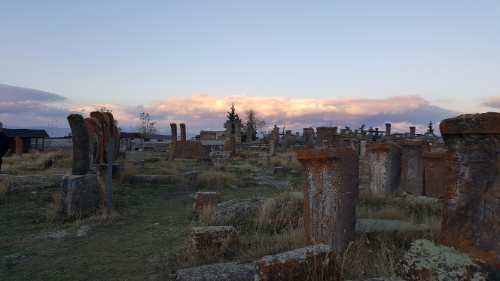
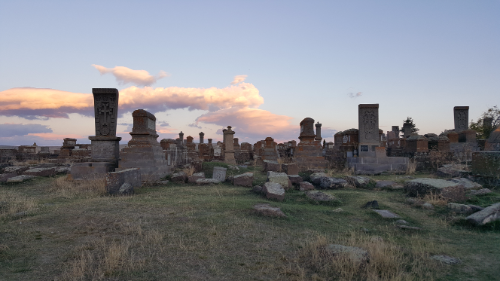
Noratus. Don’t be weirded out by how awesome the gravestones and the sky look together. Okay, it’s a little strange to have a cemetery as a tourist destination, but somehow still so cool.

Baffling, right? And I’m left with so many unanswered questions. Did the people get changed back from being doves? Did they remember the time they spent as birds? Did they know that was going to happen to them when they stepped into that church? When they changed back into people (assuming they did), did they have their same clothes on? Why was Timur such a jerk? I’m afraid that I’m going to go through life never knowing the answers to these questions.

Finally, we went to Noratus. Noratus Cemetery is the largest collection of khatchkars. It used to be the second largest with the largest one in Nakhichevan, the territory to the southwest of Armenia that is currently controlled by Azerbaijan. That cemetery was destroyed by Azerbaijan between 1998 and 2005, and now Noratus takes the title.
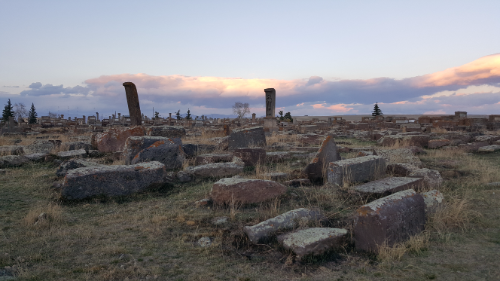
The popular story about Noratus takes place during another time when Armenia was in a war. This time, an army approached from across the lake, and it vastly outnumbered the villagers. To make it look like they had more soldiers than they actually did, they dressed up the khatchkars in the cemetery with swords and helments. The army was fooled, and they retreated.

Okay, once again, SO MANY QUESTIONS. Who on earth had this idea in the first place? Where did they get so many extra helmets and swords? How dumb/blind was the army that they couldn’t tell that the “soldiers” they were seeing were a bit rectangular? I could keep going, but I’ll spare you.
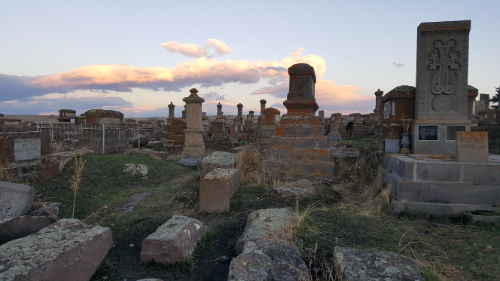
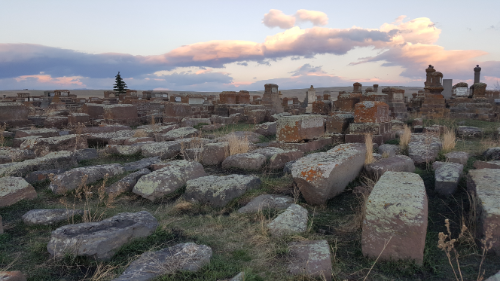
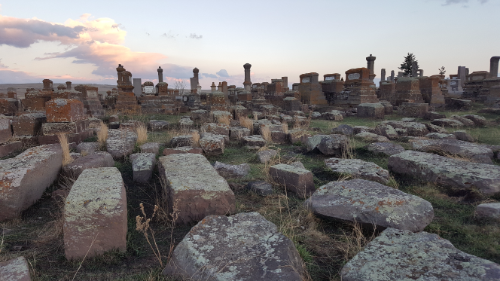
It probably would have been interesting to go to Noratus with a guide who knew something about what we were seeing, but honestly, all I wanted was to go to sleep by the time we got there. It was another long day, and just stopping in and getting to check out the sunset was enough for me.
After the Day 3 marathon, I think everyone was happy with our shorter Day 4 plans. At the very least, everyone was happy about the later departure time – 10AM instead of 8. The schedule for the day was Sardarabad and Etchmidazin/the Vagharshapat churches. I was looking forward to Sardarabad because I hadn’t been there yet, and I was looking forward to the rest of the day because I actually know something about the churches we were visiting and could be a better tour guide than some of the other days.

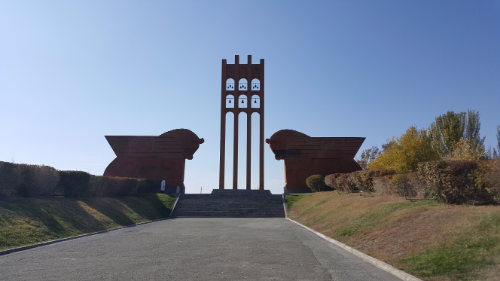
The approach…

Sardarabad, an Armenian town west of Yerevan, is often considered to be the site of the most important battle in Armenian history. In January of 1918, the new Bolshevik Russian government ordered the withdrawal of Russian troops from the Caucasus. Ottoman Turkey saw this as an opportunity to not only complete their seizure of Western Armenia but to take over Eastern Armenia as well. This would have meant the complete the destruction of the Armenian nation.

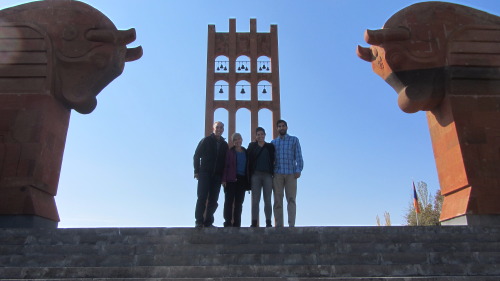
Not a great pictures, but this is the only one we have of all of us from this day.

The Armenian army rushed to deploy forces to hold the positions formerly defended by the Russians. Only a fraction of the historical Armenian homeland remained unconquered by the Ottoman Empire, and hundreds of thousands of Western Armenian refugees had fled to safety there. In May, Ottoman forces marched into Armenia and attacked modern-day Gyumri. After Gyumri (then called Alexandropol) fell, the army turned towards Yerevan. They launched three simultaneous attacks in Sardarabad, Karaklisa (now Vanadzor), and Bash Abaran.

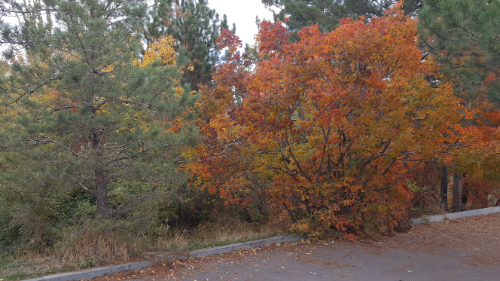
Fall. Is. The. Best.

The Armenian forces were vastly outnumbered, and a massive civilian recruiting effort was organized. There’s a story about the Catholicos at the time refusing to leave Etchmiadzin when people wanted to relocate him to safety. He said that he would fight if it came to that, and he ordered all of the church bells in the valley to ring for six days to recruit more people. People, regardless of age or occupation, volunteered to fight and were organized into civilian units. Women and children helped in various capacities as well, and I have no doubt that many even ended up in combat.

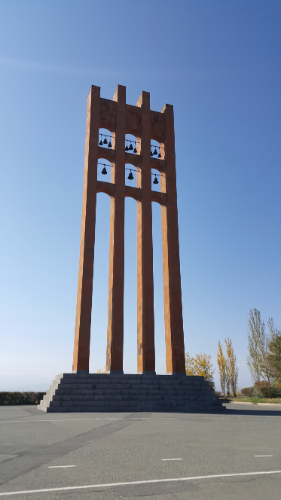
The belfry

Against all odds, the three battles resulted in Armenian victories, halting the advance of the Ottoman army and preserving the last bit of Armenia. They (once again, the mysterious “they” who have an opinion about everything) say that what the Armenian volunteers lacked in training, they made up for in determination and passion. For them, it was personal. They were fighting to protect their families and for the survival of Armenia.

The thing about war is that even when you win, you still lose. Thousands of lives were lost during the battles, and I’m sure that the families of those people didn’t much feel like celebrating. However, due to the courage and sacrifice of the army and those volunteers, Armenia exists today.

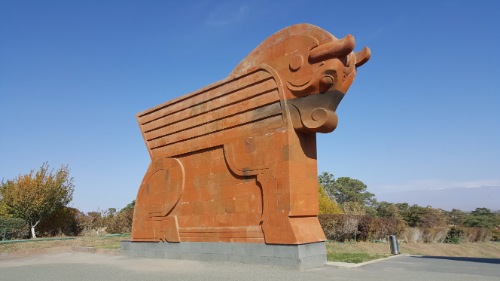
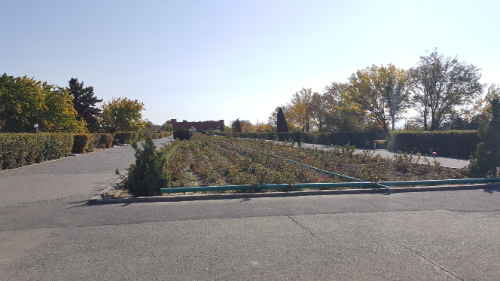
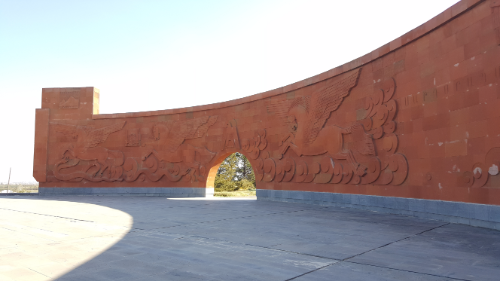
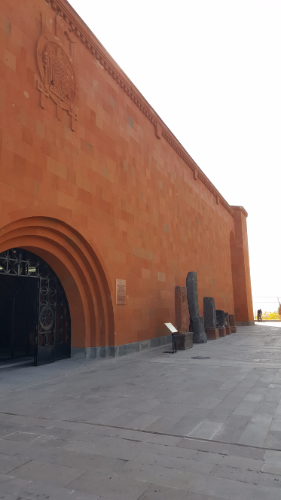
The memorial complex was built for the 50th anniversary of the battle, in 1968, and it’s kind of amazing. You drive straight at it on your way there and have an epic view of the bulls and the belfry. The bulls represent the united strength and persistence of the Armenian people. The bells are a shrine to those who were killed in battle and now represent victory bells. The eagles lining the path to the memorial wall are standing guard over the future of the Armenian people. The memorial wall depicts the battle (very symbolically I think because we totally didn’t get it) and the rebirth of the Armenian people. Finally, the museum is designed like an Armenian medieval fortress. All of the windows face interior courtyards except for two – one facing Aragats and the other facing Ararat. Everything is made from red tuff and is gigantic. On days when the sky is blue, the contrast between the red stone and the blue sky is pretty awesome.

One of the bulls
The eagle walk
The memorial wall
The fortress-like museum

The museum was built later and has two parts: the majority of the museum is filled with various historical and cultural objects (ethnography museum), similar to the Armenian History Museum in Yerevan, and the other part is dedicated to the battle. We went on a tour of the Ethnography Museum, and it was exhaustingly long but also very well done. It’s one of those places that’s almost not even worth visiting without doing the tour because you can walk around and completely miss the important things without realizing it.

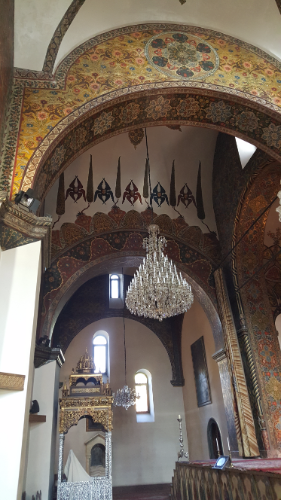
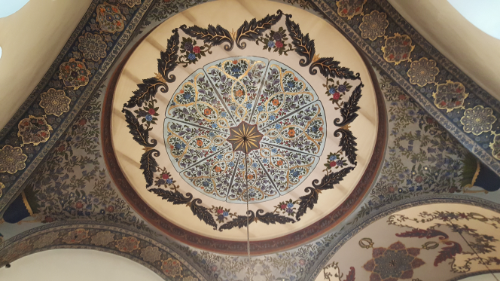
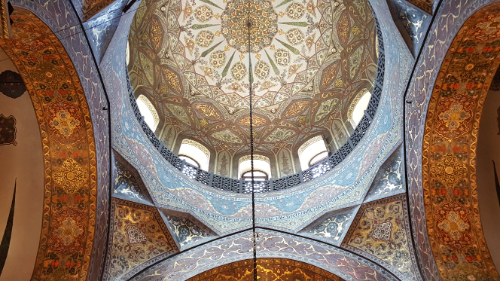
I can never get enough of the painted ceilings at Etchmiadzin.

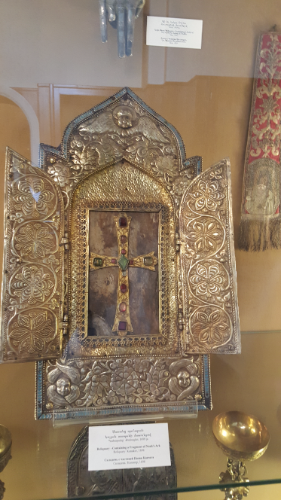
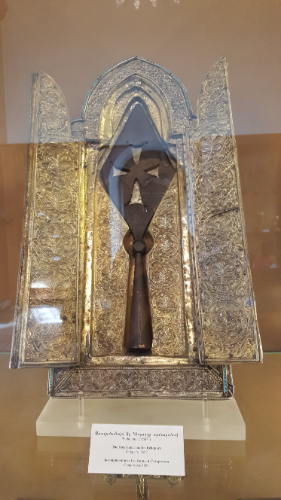
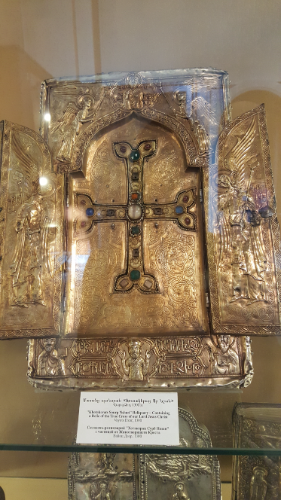
By the time we left the museum, I think everyone was ready for a nap, but we had more things to do! We drove to Etchmiadzin, and I walked everyone around my favorite parts of the complex. We also went to the museum inside Etchmiadzin which I was excited about because they have (supposedly) a piece of the cross, a piece of Noah’s Ark, and the spear that pierced Jesus’s side when he was on the cross. Each of these relics is one of many in the world with similar claims attached. The cross and Noah’s Ark could at least physically have multiple pieces in different places, but the spear is another matter. There can be only one. Obviously, all of the others are fakes and the Armenia one is real. It’s said to have been brought by the Apostle Thaddeus to Armenia and was housed in Geghard Monastery for a long time before ending up in Etchmiadzin.

The rest of the museum was less exciting. Lots of fancy Catholicos clothing and other reliquaries that didn’t have much information about what was inside them. Honestly, the museum could use a good labeling. I thought it was cool anyway and the rooms were beautiful, but I also wouldn’t have minded actually knowing what we were looking at.

Like seriously… is this not awesome??
Piece of Noah’s Ark. We were a little confused about this but think that maybe the brown stuff you can see behind the cross is the piece? Maybe?
The spear. The only real spear.
Here’s another confusing one. I guess the piece of the cross is inside, but you can’t see anything. For all we know, it could be empty. Or filled with cotton balls. Or Hello Kitty erasers. Or M&Ms. My point is, it could be anything. Or nothing.
Not a fantastic picture, but this is inside one of my favorite chapels at Etchmiadzin. When the sun is in the right positions, the light coming through the windows makes crosses on the ground or the walls. It’s cool!

From there, we walked to Saint Gayane Church and later drove to Saint Hripsime. There were weddings happening at both churches, so we pretended we were invisible and tried to stay out of everyone’s way. It was only semi-successful because at Saint Hripsime, if you want to see the tomb and the stones that supposedly stoned her, you need to get all the way to the front of the church. Not easy to do without being noticed. Anyway, I’ve written in great detail about the stories of Saint Gayane and Saint Hripsime and the origins of Etchmiadzin, so if you want a refresher, you can check out those old posts HERE.

We were planning on stopping by the ruins of Zvartnots Cathedral on the way back to Yerevan and decided to skip it because everyone was about ready to pass out. I think we made the right choice in the moment, but it’s still on my list. Maybe I’ll manage to get there one of these days!

Victoria and I decided that we wanted to go on a Saturday adventure, so we planned a mini-excursion to visit Havuts Tar Monastery. It was on my list of places to go because I read that the view is great and it’s worth a visit even though it’s in ruins. The location was also very convenient… It’s just a short hike away from the town of Garni, and the marshrutka ride from Yerevan to Garni takes less than an hour.

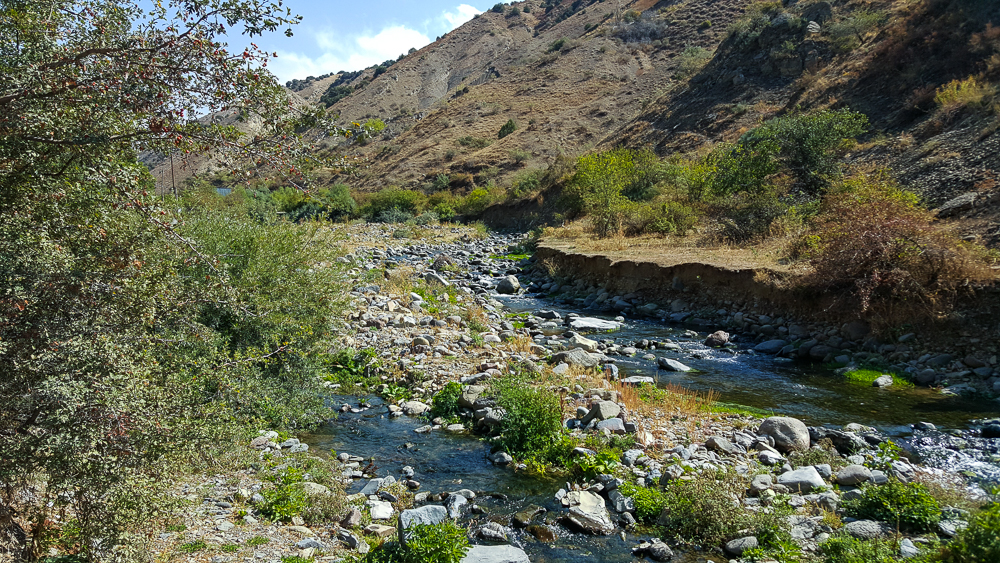
Azat River! Along our walk to the reserve from Garni

I wasn’t so sure about the logistics of hiking there because it’s located inside of Khosrov Forest State Reserve. It’s one of the oldest protected areas in the world, supposedly established by King Khosrov in the 330s. I think he just wanted something to name after himself. It was re-established in its current form in 1958. There are four different landscapes within the park, ranging from desert to alpine meadow, and a ton of different plant and animal species. There are 41 mammal species!

The Khosrov website makes it seem like coordinating a visit to the park is a huge pain. It says that you have to hire a guide and get a permit if you want to hike in the park, and it’s a bit expensive. In all of the reviews I read about Havuts Tar, no one said anything about a guide. Who the heck knows which one is right? The best way to figure anything out is to just show up, so that’s what we planned. We figured we would go, try to visit, and be prepared for a last-minute change of plans if we weren’t allowed into the park.

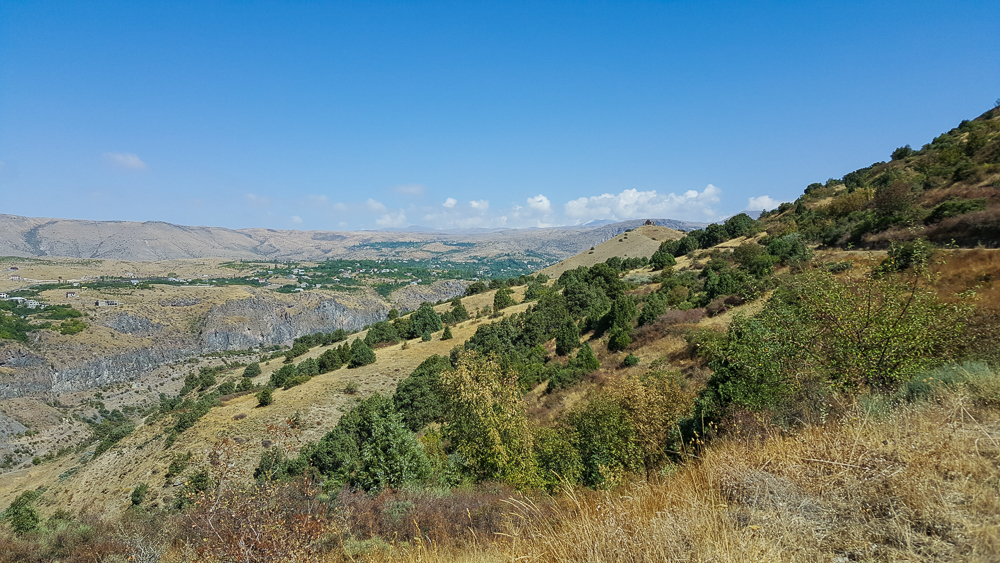
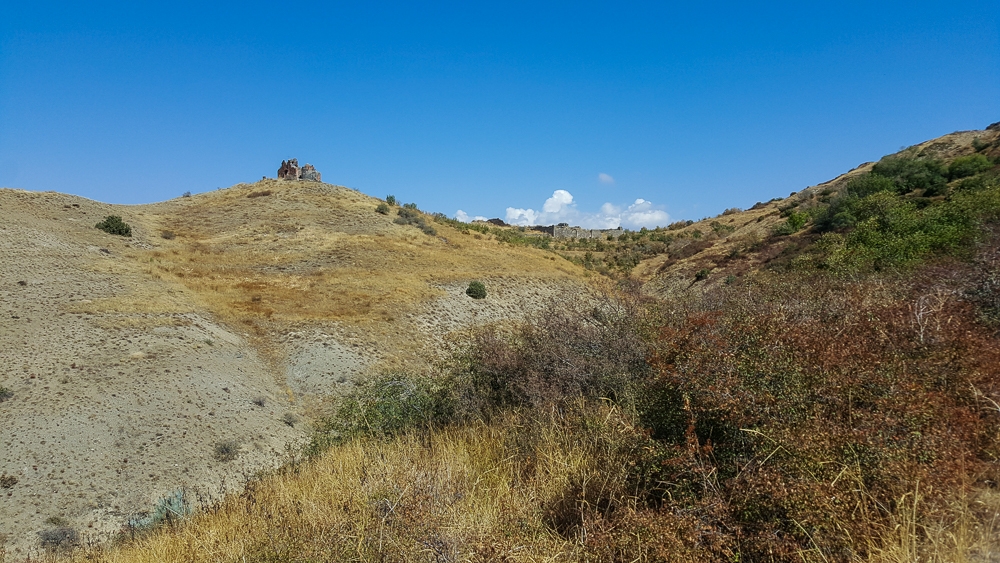
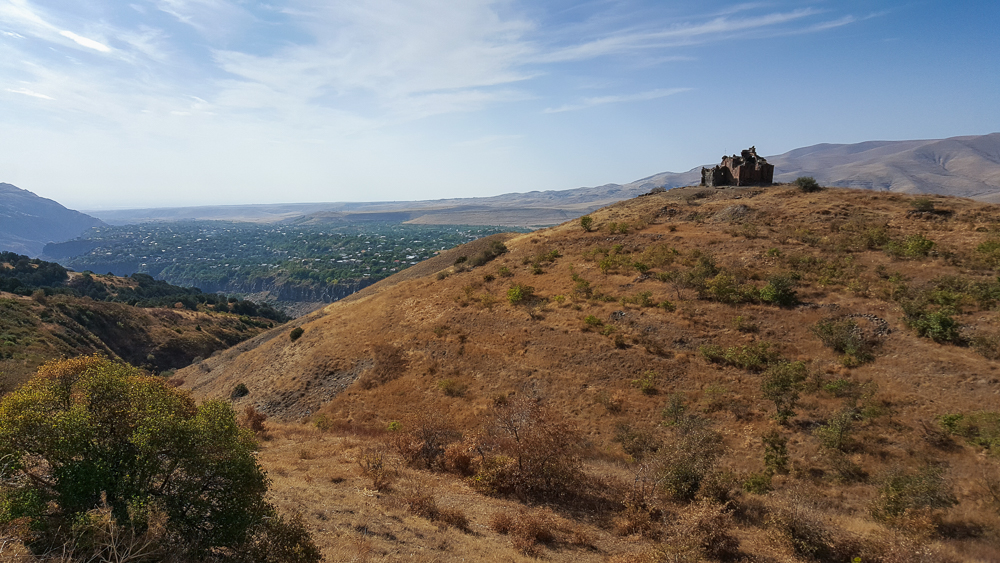
You can see a little speck on top of the mountain in the background, right side… that’s Amenaprkich Church

Our marshrutka dropped us in the center of Garni, and from there, we started walking in the general direction of the park. Oh yeah, we also weren’t exactly sure about how to get there… but hey, it’s all part of the adventure, right? It took a few near-wrong turns and some helpful directions from locals, but we eventually found what looked like a trail and started hiking. Thank goodness for GPS because otherwise, who knows where we would have ended up? It seemed for a while like we weren’t going to encounter anyone… until we turned a corner and saw a huge gate with a Khosrov seal on it. Okay, showtime. Worst case, we’d get turned away and have to find something else to do. No big deal.

There was a park ranger sitting at the gate, and we said hello and told him that we wanted to see Havuts Tar. (We had practiced saying this in Armenian on the walk so that we would sound like we knew what we were talking about.) He didn’t seem thrown off by our presence or our request and asked where we were from. We said Yerevan, and he told us that it’s 1000 dram to hike there if you’re from Yerevan and 2000 dram if you’re a foreigner, so lucky for us that we’re not foreigners because we get a better price. I think he winked at us when he said that, but I have no idea why because we definitely were passing as locals.

We went into the little visitor’s center to pay, and they had a sign with pricing for all of the different sites within the park. To me, that seems to mean you don’t need a guide… Oh, who knows. Maybe it’s like some local secret that you can just walk in, but they try to trick the internet users into getting a guide? Anyway, I was surprised by how nice the visitor’s center was. They had posters about the different sites in the park, information about environmental preservation, a creepily impressive beetle collection, and best of all, a bathroom.

Khatchkar along the path to the monastery

Victoria and I paid our 1000 dram each and headed up the trail to the monastery. The hike wasn’t bad at all. There were some steep parts, but we were following a dirt car road, making it impossible to get lost. There were even a few shade trees along the way! That’s a rare sight on a hike here.

Imagine if it wasn’t all brown… I guess we could have picked a better time of year (aka spring). Amenaprkich Church is up on the hill, and in the low area to the right, you can see the grey walls of the monastic complex.
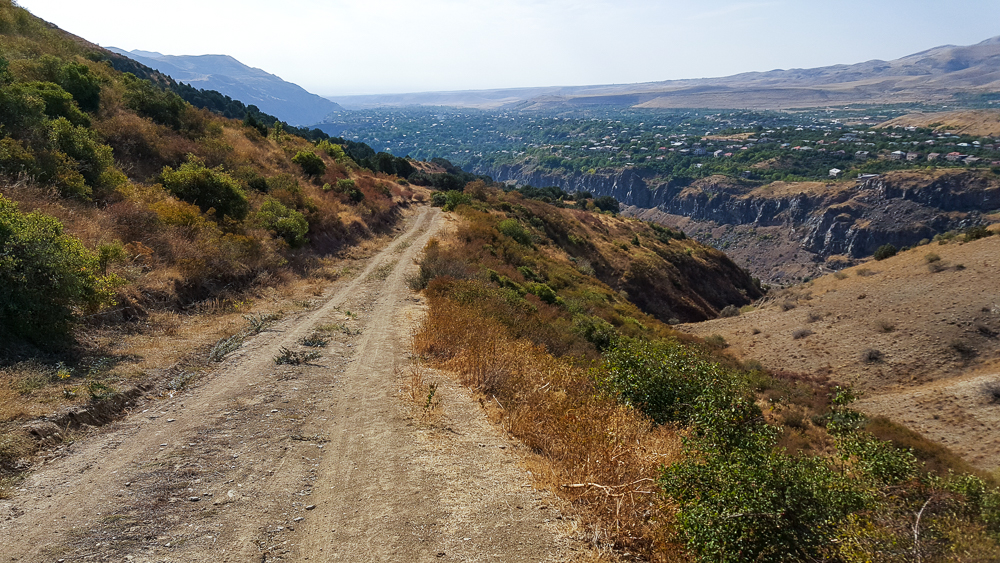
The path. Not much room for wrong turns!
Getting closer…
View of the monastery complex from the hiking trail

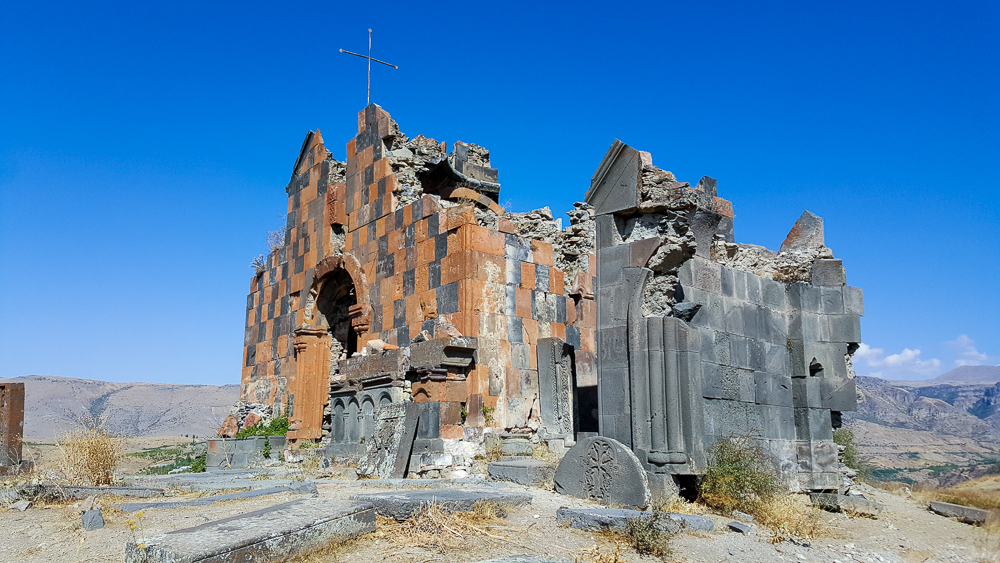
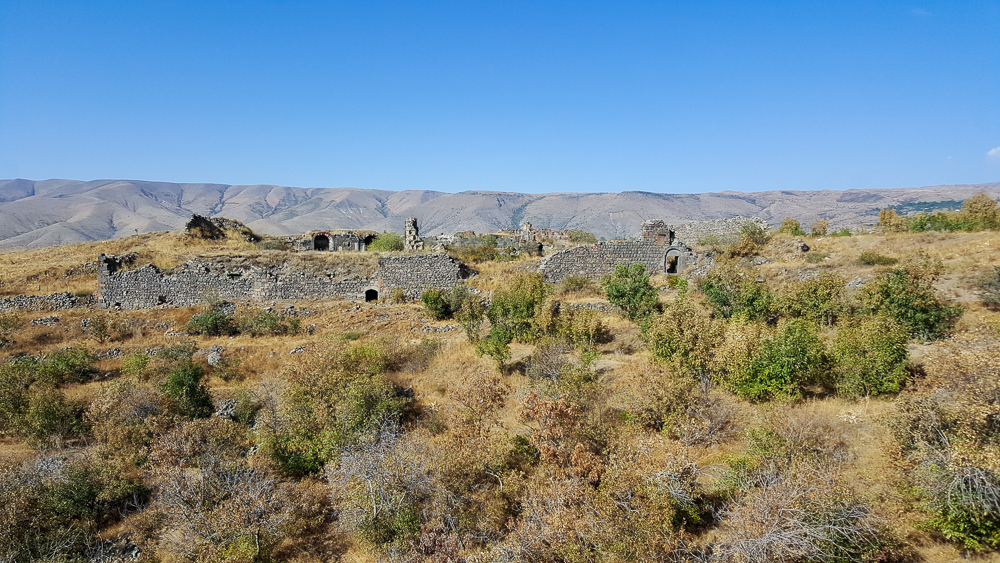
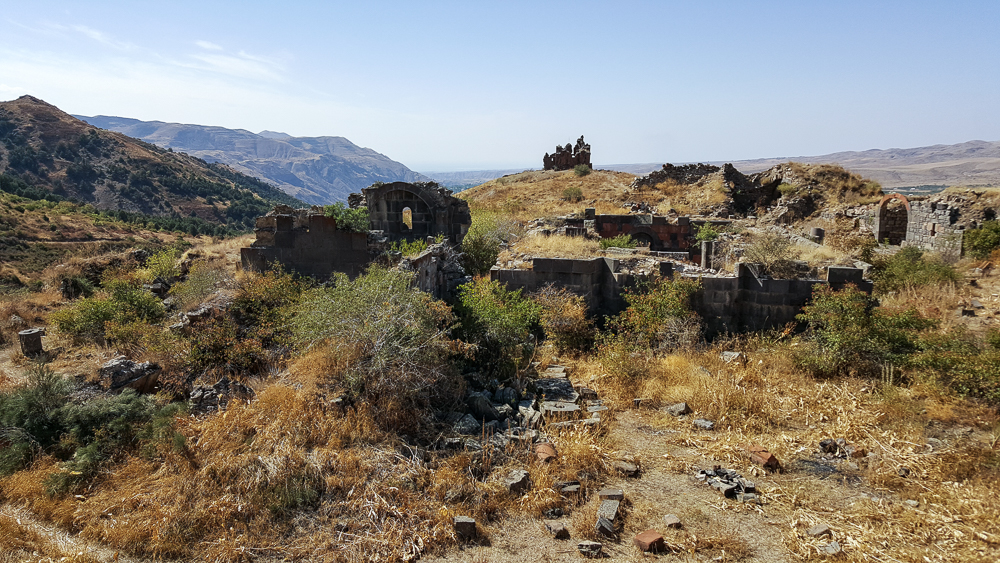
Havuts Tar Monastic Complex was built between the 11th and 13th centuries, so in Armenia time, it’s new! There was an earthquake in 1679 that destroyed much of the complex, and after that, it was basically abandoned, aside from some minor restoration efforts in the 18th and 20th centuries. There’s another church there as well, Amenaprkich Church, which is just outside of the walled complex and was originally built in the 10th century.

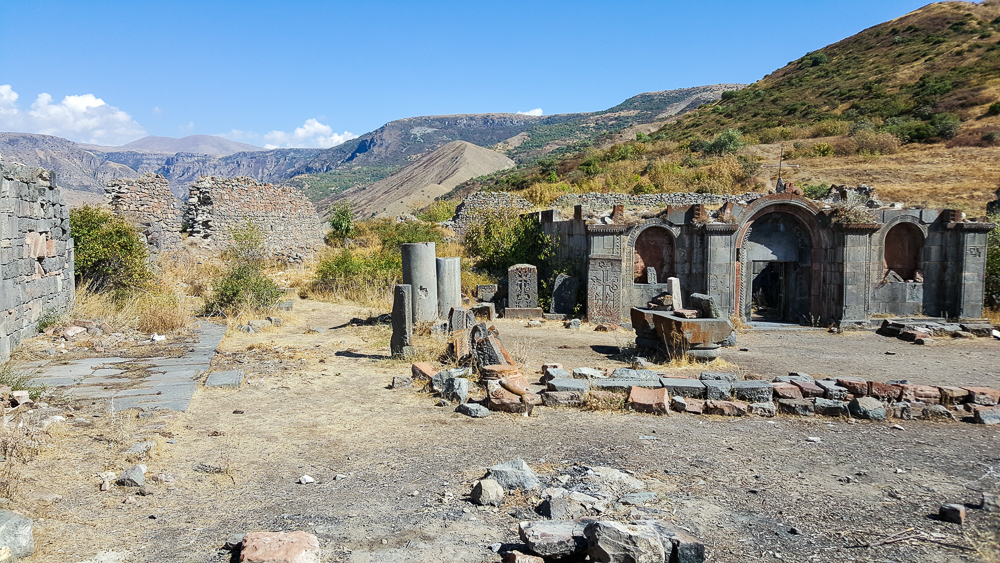
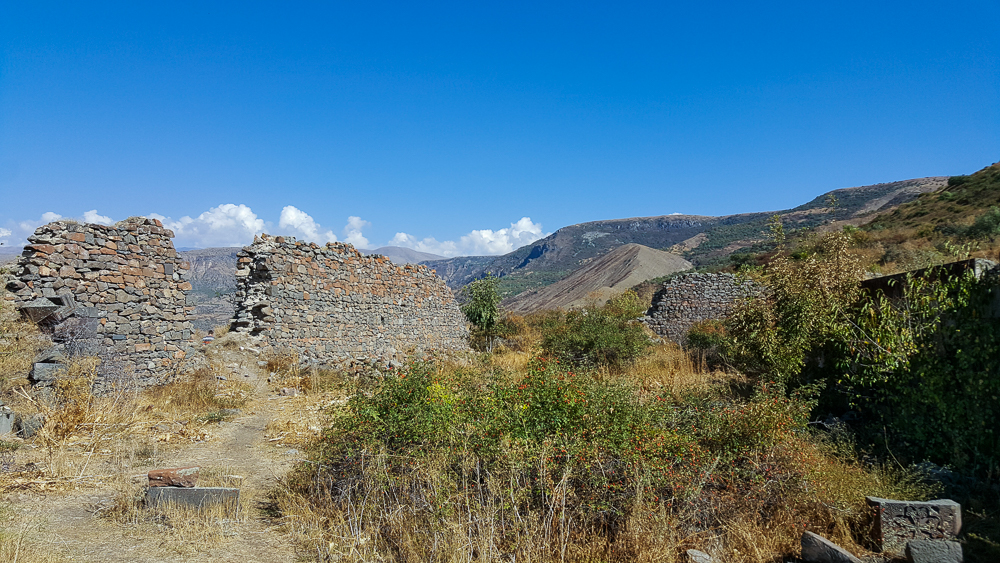
I so wish that I could have seen it in all of its glory. Just imagine! That building on the right is a church within the complex, and there are other auxiliary buildings along the perimeter walls (you can just see the edge of one on the left side of the picture).

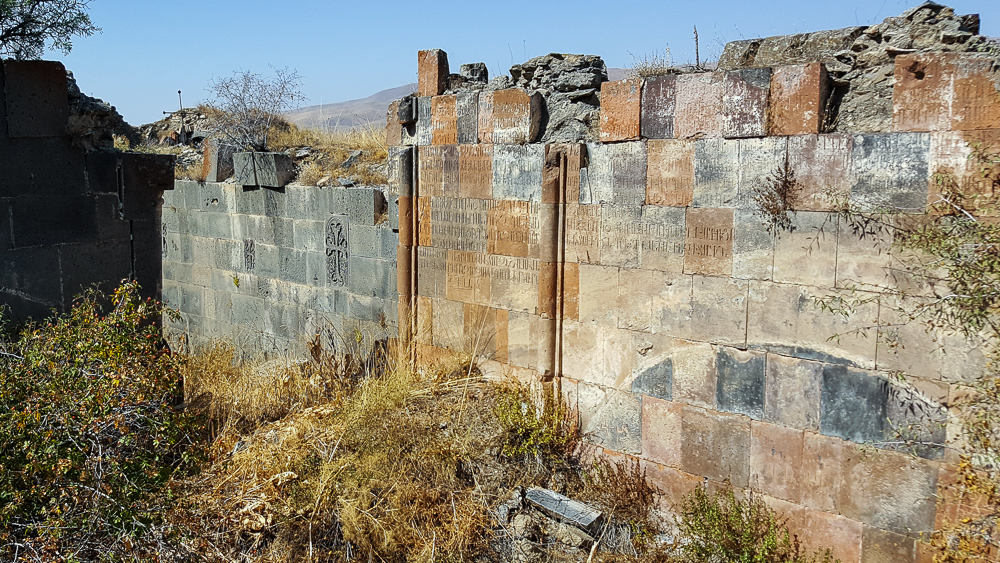
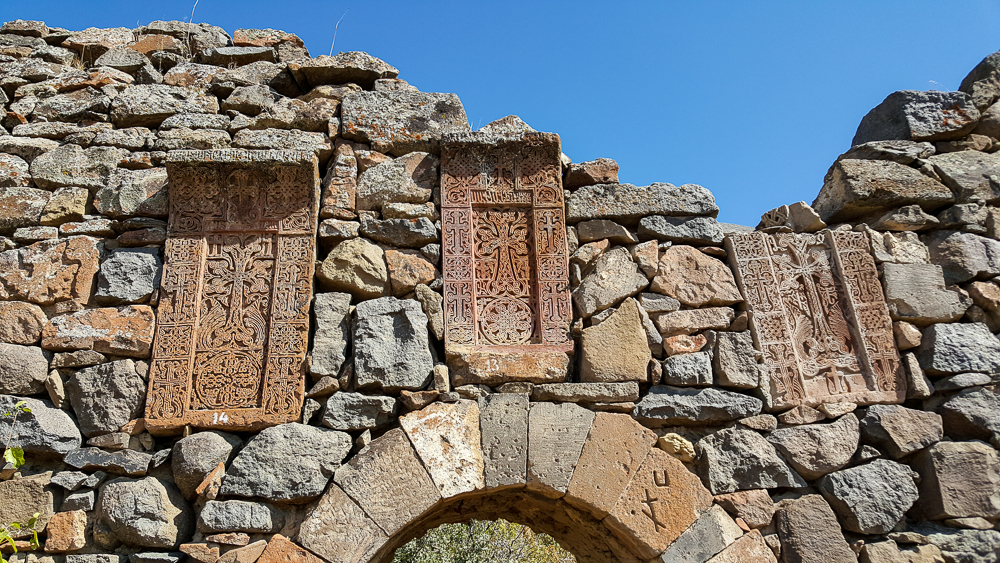
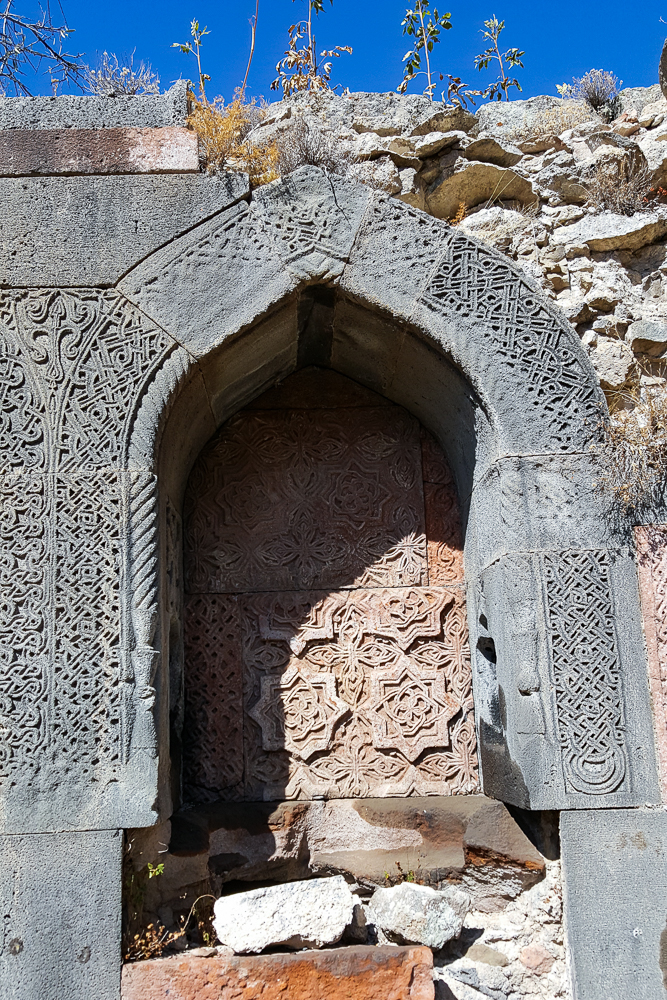
The ruins were a pleasant surprise. Everything I read basically said that the monastery is unimpressive, but the view makes the trip worth it. I completely disagree with the first statement. It was beautiful!! The ruins were way more extensive than I expected. There were fortified walls, hidden underground rooms, and some of the best stone reliefs I’ve seen in Armenia. As we wandered around, Victoria and I couldn’t help but express our disbelief at the fact that anyone would say that the monastery was anything less than awesome.

One of the church ruins with lettering on the wall that probably didn’t take one eternity to carve
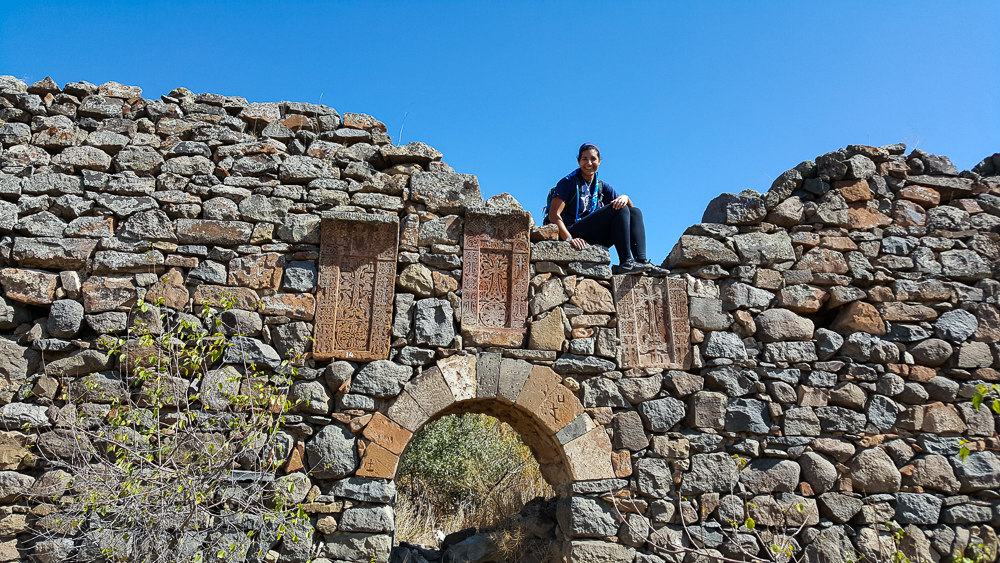
Me on a relatively stable wall…
Looking out at the ruins from the wall. The ruins of the two churches inside the complex are in the foreground, and Amenaprkich Church is on the hill in the background.
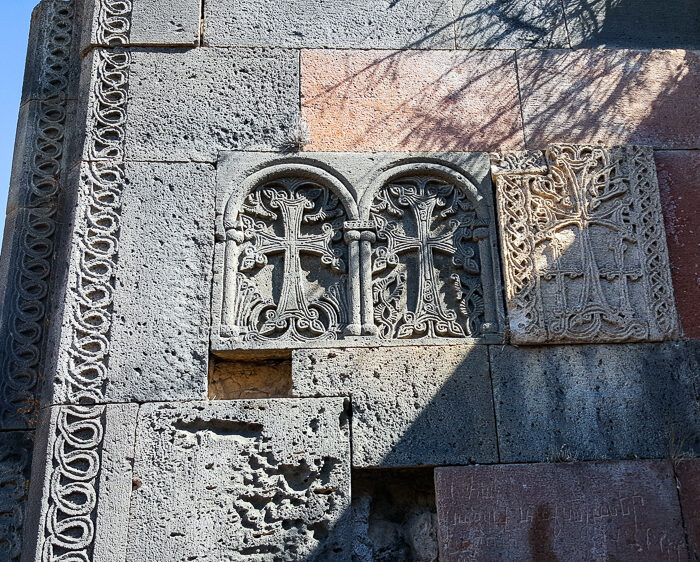
I love these khatchkars. Look at how intricate! And I also love how they integrated different decorative stones into the walls. It gives them a lot of personality.
EVERYTHING is decorated
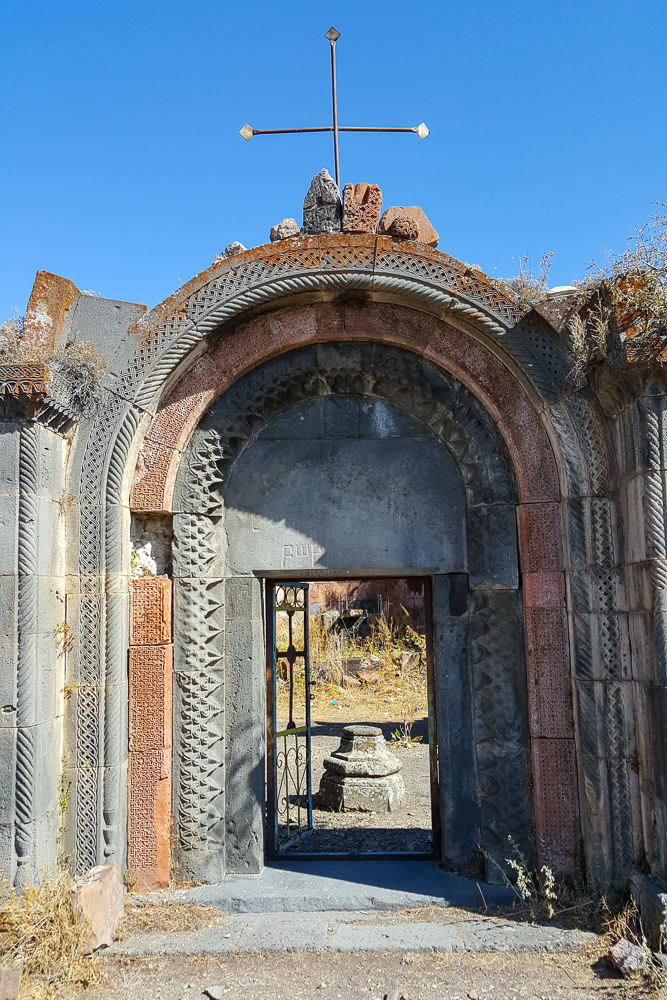
Entrance to one of the monastery complex churches. I also love how they used two different colors of tuff stone to create accents.
That view! And also I really like that wall. I think it’s pretty.
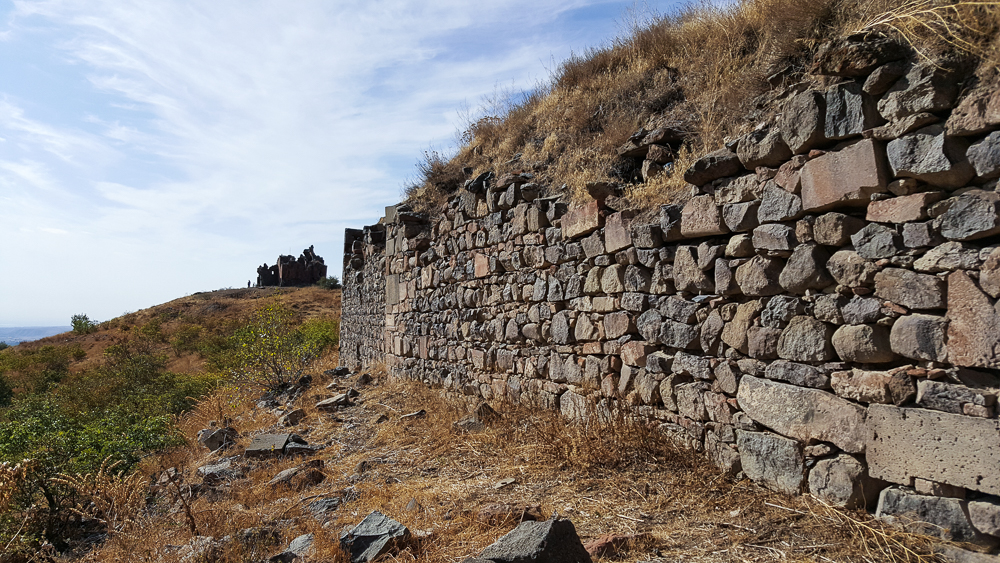
I’m sure this isn’t going to fall anytime soon… but that doesn’t mean that we didn’t sprint under it just in case
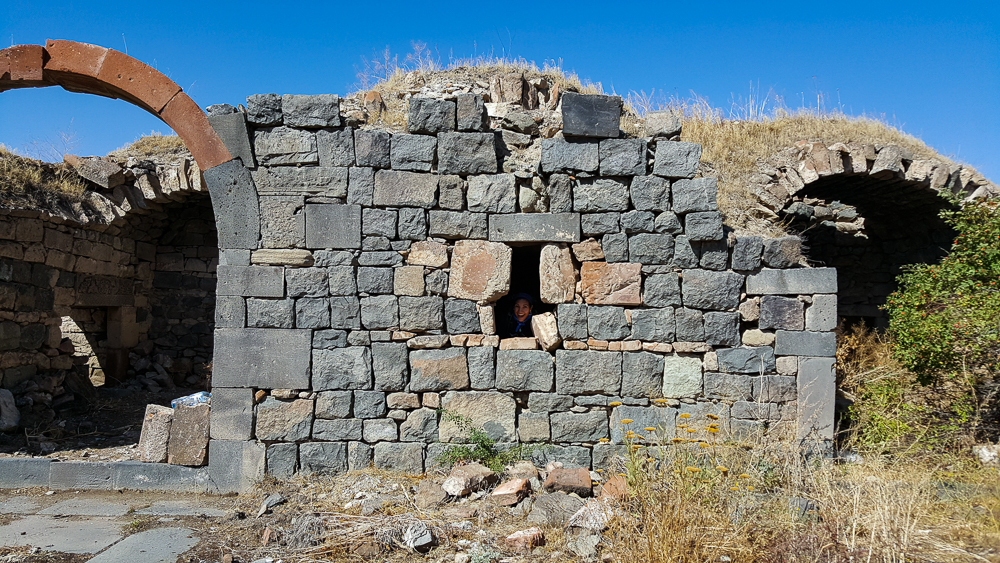
It’s not an adventure without some pictures of me in random holes. These little vaulted rooms are up against the perimeter walls, possibly used as guest chambers for the monastery.
Some of the carvings were the most intricate I’ve seen
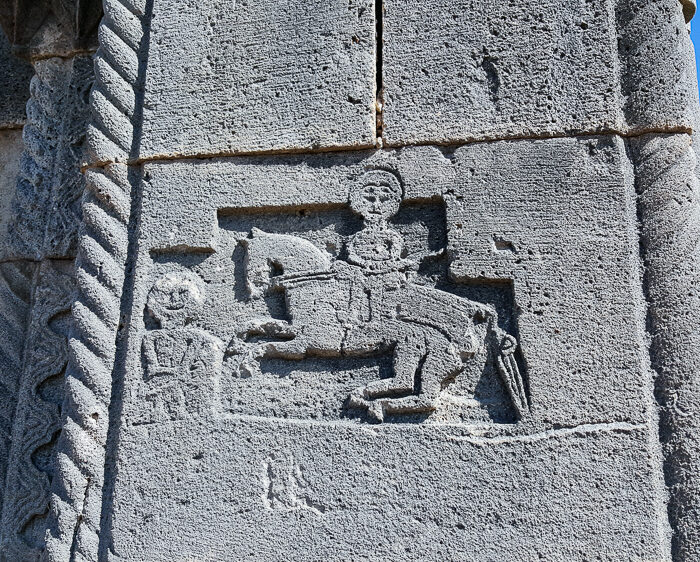
This looks like an alien on a space horse capturing another alien, but the captured alien is smiling because he knows that there are twenty of his alien soldier friends on their way to save him.

The view certainly wasn’t anything to complain about either. It overlooks the Azat River Valley, the same one that runs behind Garni Temple, and the whole thing is pretty spectacular. From Amenaprkich, you can see Garni Temple too! We found a shady spot to eat our snacks (some bread, cheese, and cookies, courtesy of Victoria), chatted, and enjoyed the scenery.

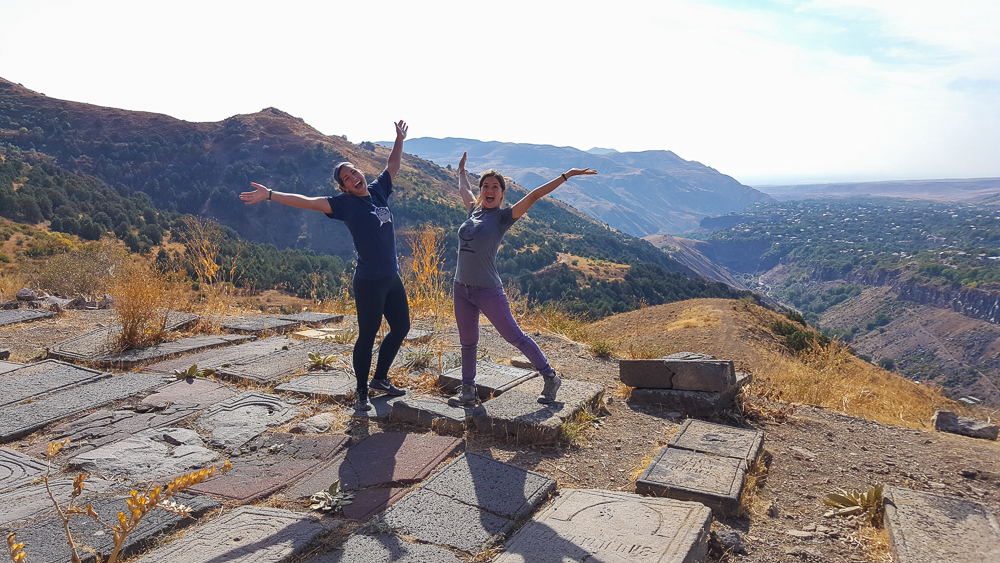
Me and Victoria! You can kind of see Garni Temple in the background, but it’s not super easy. Maybe about 1/3 of the way into the picture from the right, there’s a little grey box on top of one of the ridges sticking out into the gorge. That’s the temple.
Amenaprkich Church is the one with the orange/black tuff checkerboard front. On the right side, there’s another church that was added later, but as you can see, it’s mostly collapsed as well.
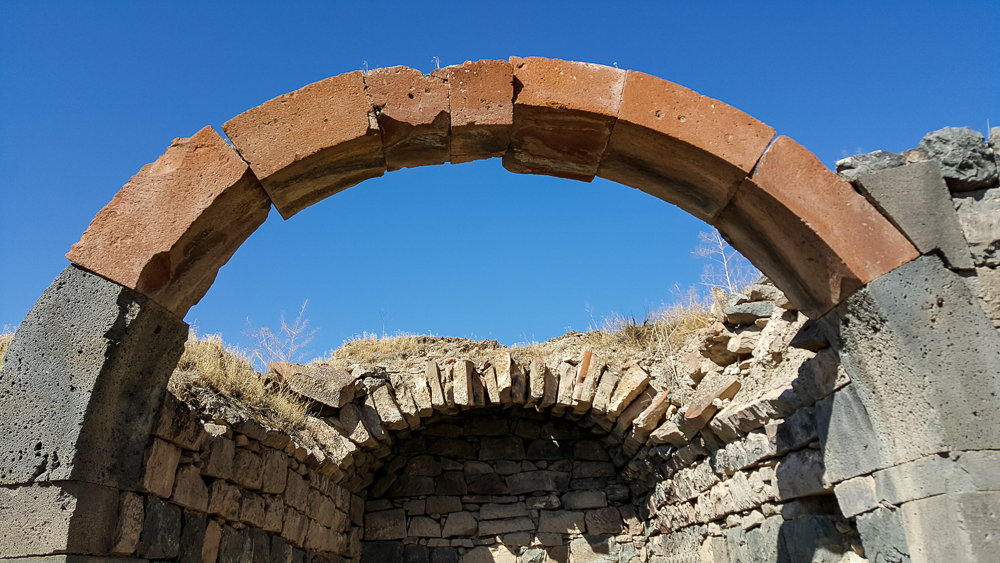
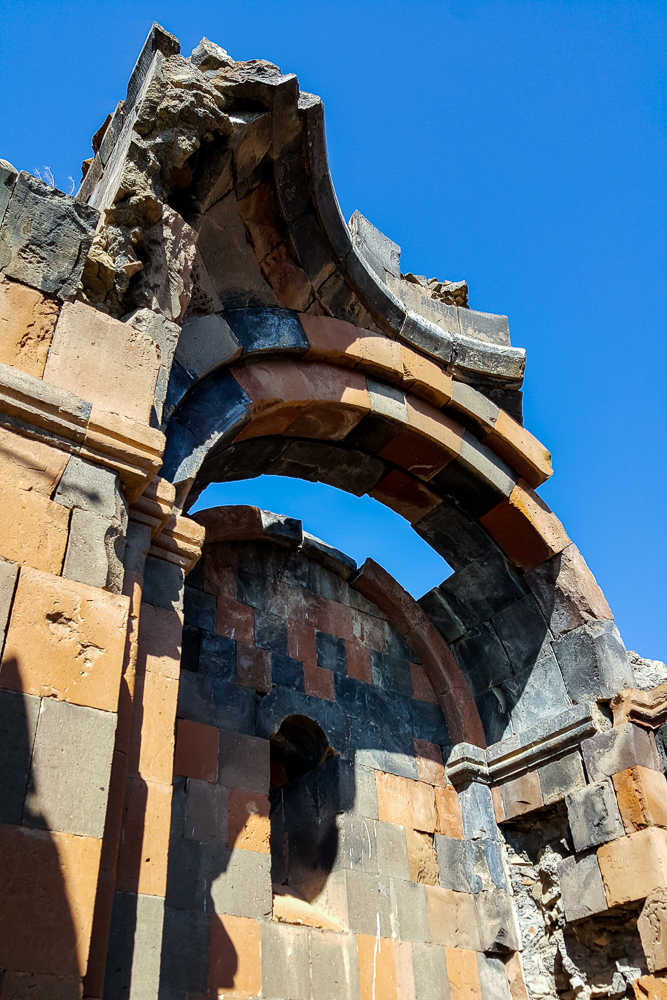
The last remaining arch inside the church. Again, I have no idea how this is still intact. And you can see part of the ring where the dome would have been.
This room is underground… they think it used to be the monastery’s manuscript library

It’s always nice when a day turns out even better than you expect. I was worried that we wouldn’t even be able to enter the park and I would have dragged Victoria out there for no reason. Far from that, we had a great time! Havuts Tar is pretty close to the top of my list of favorite places to visit in Armenia, along with Dilijan, Levon’s Divine Underground, and Smbataberd. I think my list of favorite places is slightly more obscure than most people’s…

I like this wall.

Related Posts – My Favorite Places in Armenia

Dilijan National Park – go for a hike in one of Armenia’s national parks! Or, for the autumn version, go here

Levon’s Divine Underground – explore a potato cellar turned underground wonderland (just as weird and wonderful as it sounds)

Smbataberd Fortress – soak in the breathtaking views from Smbataberd Fortress

Sergei Parajanov Museum – visit my favorite museum in all of Armenia

Erebuni Fortress – poke around the ruins of the fortress at the heart of ancient Yerevan

The excursion for the weekend was to Garni Temple and Geghard Monastery, and I decided not to go because Sarah and I were JUST there. That left me with the challenge of deciding what to do instead, and after a whole long deliberation process, I opted to stay in Gyumri for the weekend. Everyone else was either in Yerevan for the weekend or going on the excursion, so that meant I had a day all to myself. That might sound horrible to some people, but the more I thought about it, the more excited I got! I hadn’t gotten a chance to really explore Gyumri, and I don’t want to leave at the end of August after living here for two whole months and not even feel like I saw any of the city. The solo part was great too because I got to pick and choose exactly what I wanted to do and then went at my own speed.

View of the square where the Birthright office is. How have I never noticed how cool the buildings around the square are??

I made a map of Gyumri with a bunch of tourist destinations on it, and I just hit up as many as I could stand. I started with a bus ride to the same stop where I get off to get to the Birthright office, but this time I was seeing it with different eyes. Isn’t it interesting how that can completely change your perspective? In daily life, how often do you look around to see what cool things surround you? I know that I have a habit of putting on my blinders and rushing through my day. I need to start making a conscious effort to stop doing that.

Random findings in the park in the circle…

Anyway, I took some time to appreciate the architecture of the square before making my way to my next destinations. I walked around a park in the middle of a traffic circle that I walk past regularly without a second thought and was amazed by how much they packed in there. See what happens when you open your eyes? Also, I know I’ve said this before, but I’m going to say it again. I have never seen a city with so many parks. Everywhere you turn, there’s another place for people to spend time outside, and it makes city life so much better! There are ALWAYS kids playing in them too.

It’s like the wilderness in the middle of the city.

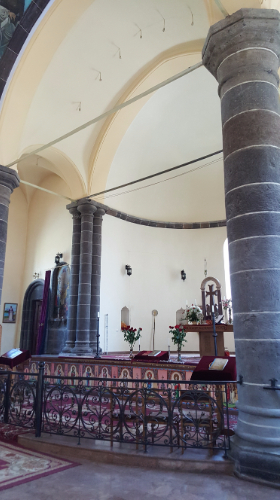
My first go-inside destination was Surp Nishan Church. I was pleasantly surprised by how pretty it was, and the door was open, so I went in for a bit and sat. There was no one else there for most of the time that I was there, so it was perfectly distraction free and a good place to do some thinking. There’s something about a church that helps the thoughts and prayers flow too. I really enjoyed it. It’s much better than just going into a church for a second and then leaving. Why not use it?

The outside of Surp Nishan
Inside Surp Nishan!

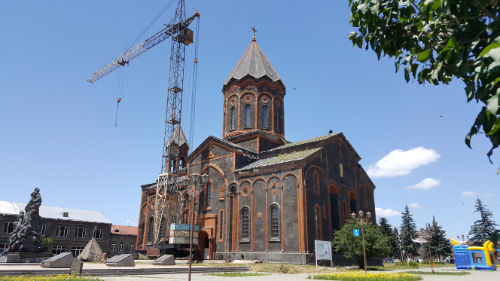
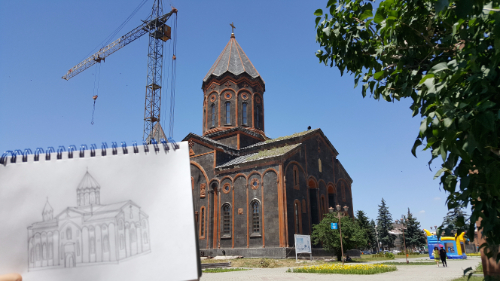
From there, I headed to the main square where the City Hall building is and sat for a couple of hours sketching one of the churches there, Holy Saviour’s Church. The church was mostly destroyed in the earthquake, and they’ve been rebuilding it (rather slowly, I think). The outside looks like it’s mostly restored, but you still can’t go inside. I sat on a bench and made friends with some random men who spoke basically no English.

If only the tower crane wasn’t there…
My sketch attempt and also a failed picture where I tried to focus my phone on the sketch and take the picture with one hand while the other held my sketchbook. If that makes any sense…
City Hall!
The outside of the Cathedral of the Holy Martyrs. Looks like every other Armenian church, right?

After I finished, I looped around the square, stopping in another church, Yot Verk (there was a wedding going on!), and walking past City Hall to one of the market streets. I bought what I think is shampoo, conditioner, and body wash, but I guess I won’t really know until I try them out. I feel confident though because “shampoo” is basically the same in Armenian, and the thing that I think is conditioner is the same as the shampoo bottle except upside down. I then put on a fabulous charades performance to convey “shower gel”, and I think the shopkeeper and I were on the same page at the end.

I also went to another store and spent a solid 15 minutes trying to identify lotion. Everything was written in Russian, so I was that goober in the toiletries aisle using my phone to take google translate pictures of the labels. A woman came over to help me, and after I told her that I don’t speak Armenian, she just nodded knowingly, gave me a pitying look, and left me to my struggles. I bought something that is hopefully lotion.

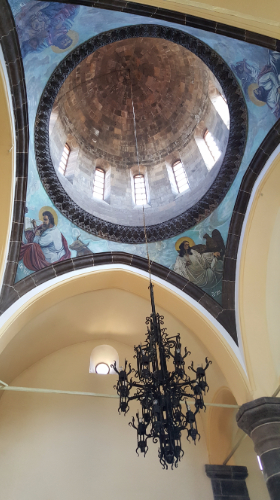
I made one last church stop in the Cathedral of the Holy Martyrs after that. It’s a little Catholic church that was completed in 2015, and the ceiling was architecturally awesome. I love how they made it fit in with the traditional style of Armenian churches, but the inside is modern at the same time.

The museum of architecture and urban life
Gyumri views
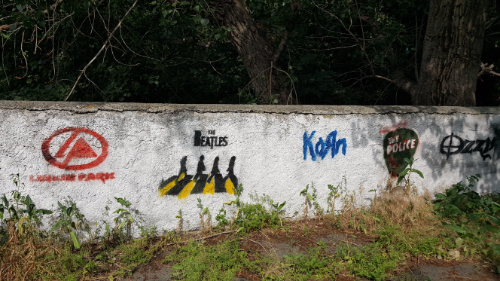
There’s a random bridge with the names/logos of a bunch of bands painted on it. Random…
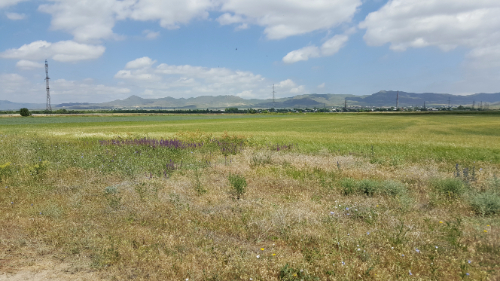
Our quest was for these mountains.

Sunday was unexpectedly awesome! I didn’t have any plans for the day until another volunteer, Lexi, texted me at around 10 and asked if I wanted to go for a walk. I figured why not? So we met at 11 and walked towards the mountains. That’s vague, I know, but she said that she wanted to get a good view of the mountains, and I had been thinking that same thing recently. We wandered through fields in search of a good view and eventually spotted a church in the distance that we decided was going to be our destination. The walk was way more of a trek than I was expecting, so I was also hoping that there would be water but didn’t want to get my hopes up.

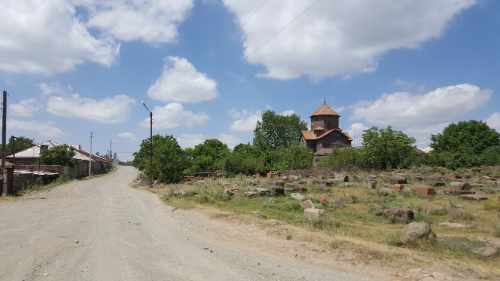
Our first glimpse of the church that wasn’t from a mile away.

Luckily, we made it and there was water! And a cherry tree. I wasn’t a huge fan of them, but Lexi ate a bunch and then grabbed a handful for the road. From there, it was an easy walk back to Gyumri. We definitely took the long way there haha.

We made it!!
Note the water fountain in the front. I almost cried happy tears when I saw it.

We wandered around town for a couple more hours, just talking and doing a little shopping. It was nice having some time to hang out with her one-on-one because so much that we do here is in a group. That can get overwhelming, and I really enjoy getting to spend time with individuals or small groups. Much better for building good friendships! I know that if I’m going to be here for 4 months like I’m planning, I’m going to need some solid friends so that I don’t lose my mind.

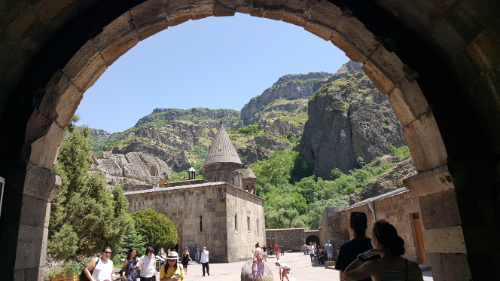
Our last day of sightseeing unintendedly ended up being somewhat rock themed. Since we obviously hadn’t seen enough monasteries yet, we had another one, Geghard, on the docket for the morning, plus the only remaining pagan temple in the country, Garni Temple.

Temple of Garni

By now you’re used to the process of getting around… we took a city bus to a marshrutka station and a marshrutka to Garni, the town where Garni Temple is. It took under an hour to get there, and the walk from the bus stop was less than 10 minutes. Easy peasy.

Back in the day (like waaay back), the Armenians were sun worshippers. It’s interesting because you can look at the Christian art and architecture that came after the country’s conversion to Christianity and see how it’s connected to the art and architecture that came before. Pagan symbols were re-explained in Christian terms, rather than getting rid of them. For example, the pomegranate is used A LOT as a symbol here. In the pagan days, it was a symbol of fertility. In the Christian days, it was changed into a symbol of unity (people are the seeds, all individuals but part of the same body of Christ).

Temple from the back

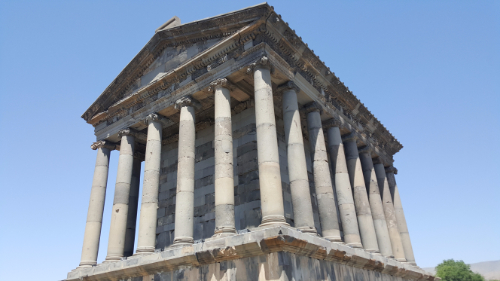
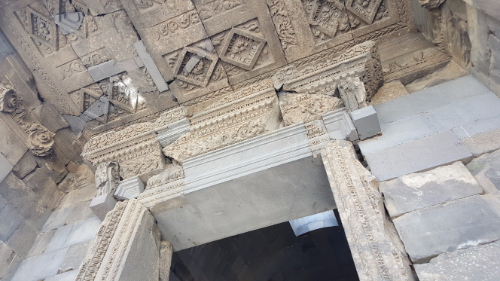
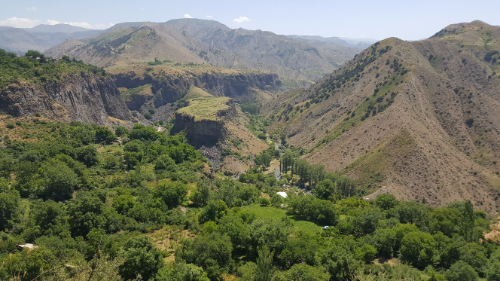
Anyway, I kind of went off on a tangent. The point is that Garni Temple was a temple built in the first century AD and dedicated to the sun god, Mihr. The reason it survived even after Armenia’s conversion was because it was turned into a royal summer house. An earthquake in 1679 caused it to collapse, and it was finally excavated and reconstructed in the 1970s. They used almost all original stones to reconstruct it, but the ones that are not original were made obvious. It’s built in the classical Greek style with a little bit of an Armenian twist. The temple is cool, and the location makes it even better. You can get a great view of the Azat River gorge which is part of a big national park, Khosrov Forest State Reserve, one of the oldest protected areas in the world. It was founded in the 330s AD! I’m getting sidetracked again, but I’m definitely putting it on my list of places to visit while I’m here.

Such cool detailing!

The gorge
Looking out into Khosrov Reserve

After Garni Temple, we headed to Geghard. That required getting a taxi which we weren’t too excited about, but it ended up being extremely easy! Walking back towards the main street, we met an older gentleman who asked if we were going to Geghard. He asked if we needed a taxi and offered to take us in his, there and back for 2000 dram (a little more than $4). It’s about 10km away, and he said he would wait for an hour which is plenty of time to see everything. We agreed because that price was definitely lower than it should have been (and we gave him some extra at the end because we kind of felt like we were cheating him), and we were off!

First glimpse of Geghard

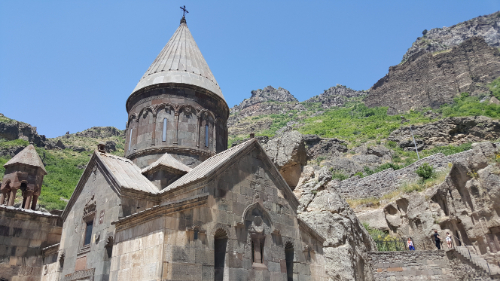
Geghard Monastery has a connection to everyone’s favorite historical figure… that’s right, St. Gregory! In its current form, it has multiple churches and tombs, but it started out just as a cave church. There’s a spring inside where you can wash your hands and face or drink some fresh, freezing cold water. There’s some great water in this country. The name “Geghard” comes from the word for “spear” because the monastery used to house the spear that was supposedly used to wound Jesus during the crucifixion and brought to Armenia by the apostle Thaddeus. That spear is now kept in the museum at Etchmiadzin.

Geghard scenery

The monastery has a few different chapels now, with most carved into and one built out from the cliff. There’s one chapel in particular that is completely carved into the cliff and has some amazing acoustics. There are khachkars (stone crosses) EVERYWHERE, with some stuck into the cliff. They’re there to commemorate donations or in memory of the deceased. The “khachkar style”, if you will, was developed because stone crosses with the stone following the shape of the cross broke too easily. With a khachkar, the stone is a rectangle, and the cross is carved into it with elaborate decorations surrounding it.

This is all carved into the cliff!
Hallway into the big chapel with khachkars lining the walls. Ignore my finger in the picture (oops)
The biggest chapel completely inside the cliff
Khachkar party!
You’ll see tons of people trying to toss pebbles into little shelves in the rocks. If you get your rock to stay, your wish comes true!
Into the depths…

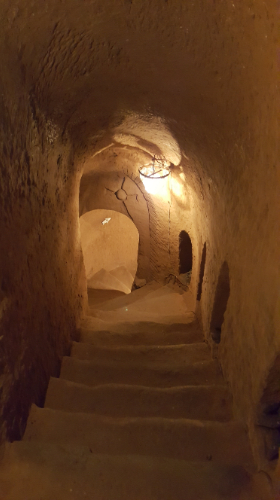
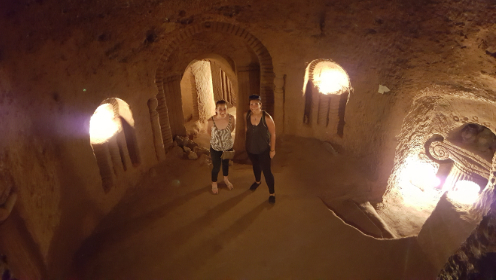
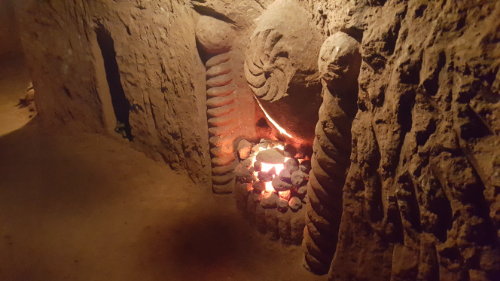
Our day ended with a trip to a slightly more offbeat attraction. Sarah and I are very into going to see things that are a little bit weird, so when we found the information about Master Levon’s Divine Underground, we knew we had to see it. The story goes (and this I know for a fact is a completely true story) that a man named Levon, a builder by trade, was asked by his wife to dig a potato cellar. He started digging, hit rock, moved over and kept digging more. And then he kept digging. And digging. And digging. And digging. He said that he had divine visions that told him to keep going, so he did. He dug for 23 years, until his death, with just a hammer, a chisel, and a bucket to carry out the rubble. The underground complex he created still isn’t complete according to his plans, but my gosh it’s amazing. My favorite quote by his wife, Tosya, is, “all I wanted was a good house and a potato cellar, and I got neither.” On the bright side though, she now has an ongoing revenue stream from visitors, so maybe Levon knew exactly what he was doing (it’s free to enter, but they accept donations).

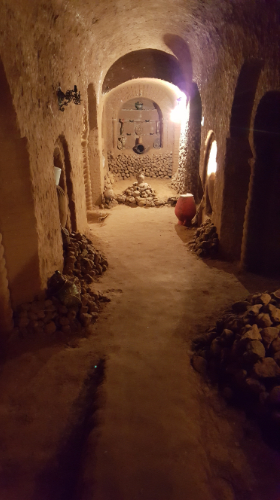
At its deepest, the complex goes down 70 feet below the house! How crazy is that?!?! There are seven rooms connected by corridors and staircases, and decorations are carved into the walls at every turn. The pictures don’t do it justice, but they can at least give you the beginnings of an idea of what it was like.

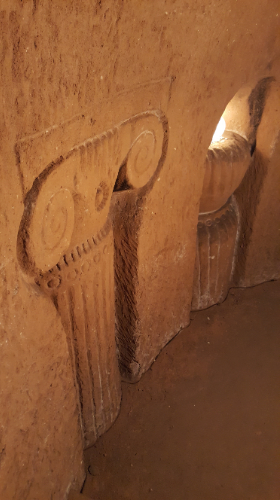
Column carvings like these were all over the place

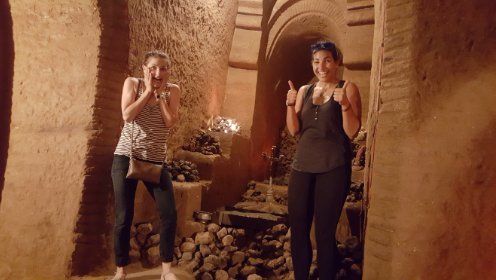
Awkward self-timer pictures
This room is huge. It was at least a two-story space with an overlook where I propped my mini-tripod and sprinted downstairs for this picture
This is crazy, right?

We were welcomed in by Tosya, and she left us to explore the caves on our own. At 50 degrees F (10 C), it’s fabulously cool down there, and thankfully, there are arrows marking out the route or we would have been hopelessly lost. When we came out, Tosya showed us to a little museum inside the house where you can see the hammers and chisels that Levon used, plus his clothes and a bunch of news articles that have been written about his creation. She spoke no English, but once again, we managed to communicate enough. After that, she led us outside into the garden where the walls were covered with stone mosaics and two paintings: one of Levon, and one of Tosya. This was one talented guy. We signed a guestbook with notes by visitors from all over the world and headed back into the city, our minds still blown by what we had just experienced. Who knew that this would turn into a cave exploration day?

One thing that there’s no shortage of in Armenia is churches. We wanted to go to Etchmiadzin (basically the Vatican of Armenia), and we decided to turn it into a full-on church day.

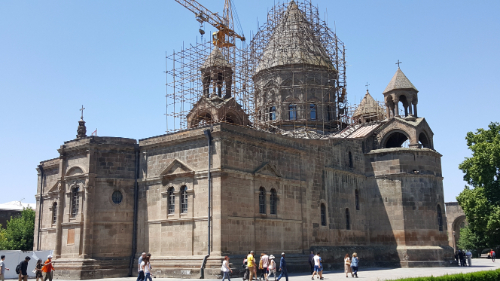
Etchmiadzin. Probably would look cooler without the scaffolding, but what can you do?

Etchmiadzin is located in Vagharshapat, a town about half an hour west of Yerevan. Even though the town isn’t that big, there are five churches there (including Etchmiadzin which is like a little church city), so we decided to visit them all. Why not, right?

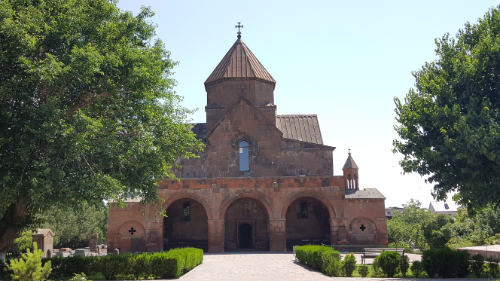
Church of Saint Gayane

We did the usual routine, taking a city bus to a marshrutka station and getting a marshrutka from there to Vagharshapat. The churches we were planning to see were kind of laid out in an L-shape, so we started at one end of the L and worked our way through. The first stop was the Church of Saint Gayane. It was built originally in 630AD and had some renovations done in 1652. Just pause for a second… That. Is. Ridiculous. I don’t know about you, but I think that St. Peter’s (the Vatican) is old, and construction on that didn’t start until the 1500s! Also, the fact that they went over 1000 years without needing renovations, and that after 1000 years they just did some work on the dome and ceilings, is crazy. Who knows, maybe it’s not as impressive as I think, but it sounds pretty good to me!

Lots of curved and perfectly fit together stones.

Anyway, do you want to hear the story of Saint Gayane? Because obviously she has a story because everything is part of a long, interconnected history here. Get ready for your head to hurt a little. Remember how I talked about St. Gregory? The guy who was imprisoned for 13 years in the pit in Khor Virap and was only freed when the king went mad? Well, the reason why the king went mad has something to do with both Saint Gayane and Saint Hripsime, the namesake of church #5 in our Vagharshapat church tour. (Note: this is another one of those stories that definitely has a certain amount of fact in it but has also certainly been embellished over the years. You can decide what you want to take and leave.)

The word is that Gayane was the head of an abbey of nuns in Rome, with Hripsime included. Hripsime was very beautiful, and Diocletian, the Roman emperor, noticed her and wanted to force her to marry him. The entire abbey of 30-some nuns fled Rome and ended up in Vagharshapat. There, Hripsime attracted the attention of yet another unwanted suitor, King Tiridates III, the same king who St. Gregory helped. When she refused his advances, she and the rest of the nuns were tortured and martyred. Some stories say that the king also fell in love with Gayane, and she also refused him. The exact facts on this are a little unclear, as are the exact methods of the martyring. Both Saint Gayane and Saint Hripsime’s churches are supposedly built on the sites where each woman was killed, and the rest of the nuns were killed at the future site of Shoghakat (church #4 on the tour). I read somewhere that Saint Hripsime was stoned, and her church supposedly has some of the actual stones that were used. Who knows if that’s true, but I can attest that there’s a little glassed-in alcove in the wall near her tomb with some rocks in it. Anyway, these women are considered the first Christian martyrs in Armenia’s history.

Sarah’s beloved doors

After killing a bunch of nuns for doing nothing wrong, the king went crazy (with some stories saying that he literally turned into a wild boar or that he had a boar’s head), and that’s when St. Gregory came in and saved the day and Armenia became the first Christian nation. So really, these women deserve the credit for turning Armenia into the country that it is today, though it would have been nice if they didn’t have to be murdered for that to happen.

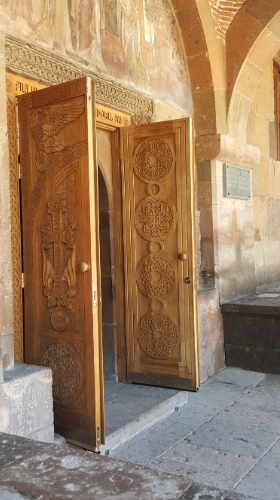
Saint Gayane’s church is beautiful. It’s the same style as so many other Armenian churches, but I still think they’re all super cool. The doors are wooden and covered with insanely intricate carvings (Sarah closely examined and marveled at a door for a solid 5 minutes: “This is WOOD??! And someone carved it like THIS? What if they messed up? How did they do this? THIS IS AMAZING. This is WOOD??”) The inside of the church is simple, but it’s still impressive when you think about the fact that it’s stone, and all of those stones had to be shaped and fit together perfectly to make all the curves and arches.

Etchmiadzin (church #2) was up next. Guess who is involved with the story of Etchmiadzin? If you said “St. Gregory”, you win! St. Gregory had a vision of Jesus Christ descending from heaven and striking the site with a golden hammer, so that’s where the cathedral was built. Etchimiadzin means “where the Only Begotten descended”. It was originally built in 301AD and is considered the oldest cathedral in the world, but it has been destroyed and rebuilt many times since the original. It is the headquarters of the Armenian Apostolic Church and is where the Catolicos (like the Armenian pope) resides.

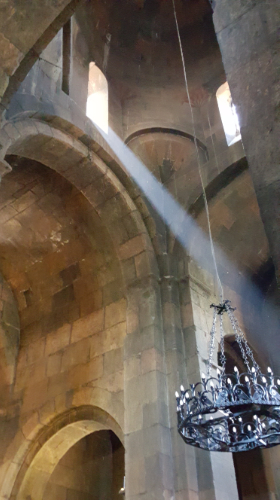
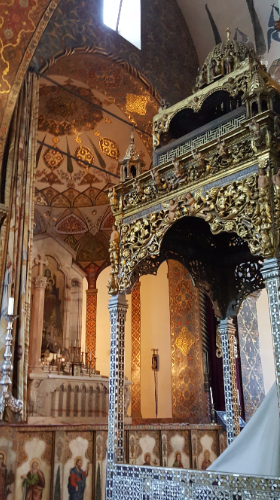
The inside of this church was anything BUT simple. Everything was beautifully painted, and Sarah and I sat on a bench inside and just stared at the walls and ceilings until we felt ready to leave. It was beautiful. Check out the pictures because words aren’t sufficient.

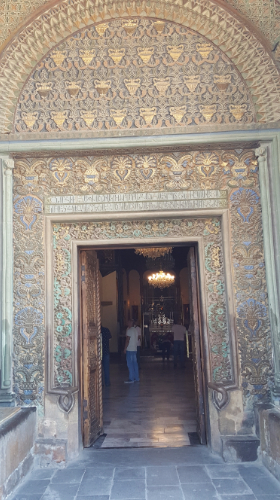
Talk about epic doorways…
Simple, right?
My new most favorite ceiling in the universe.

Church #3 was Holy Mother of God Church. No crazy story with this one. There was an actual service going on when we visited, so that was fun to see. That also means I don’t have any pictures though, so you’ll just have to go for yourself if you want to know what it’s like.

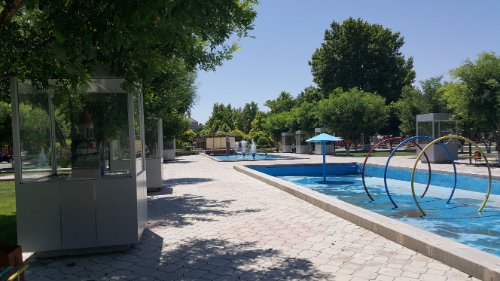
This is a park in Vagharshapat. Some kids were playing in the far fountain, and Sarah and I were about 5 seconds away from joining them to escape the heat. This park is also funny because there are all of these little church replicas around it, so we did a mini-church tour in the middle of our human-sized church tour. You can see a couple in the cases on the left side of the picture.
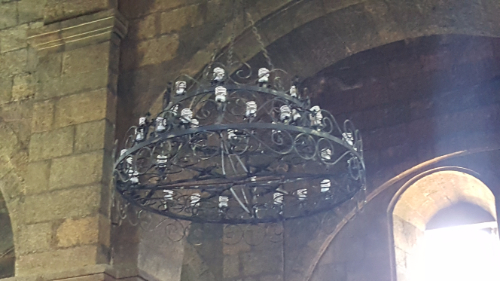
I laughed at this. There are a bunch of churches where I’ve seen similar things, and maybe you won’t think its as funny as I do… but instead of using light bulbs that look nice and match the chandelier, they have these icky spiral compact fluorescent bulbs. I mean, good for them for trying to save energy, but it is possible to do that without sacrificing aesthetics. Okay, rant over.
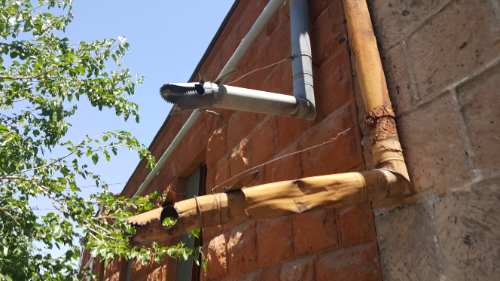
Intense dragon drainpipes

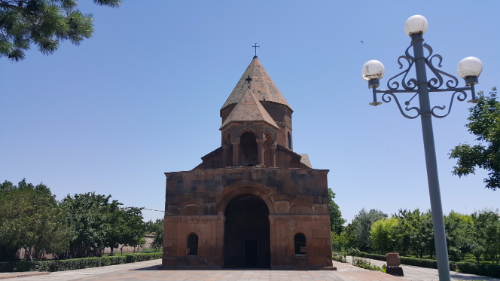
Church #4 was Shoghakat, the site where the remaining nuns were martyred. That was probably the smallest of the five churches, but it was still interesting to see and compare it to the others.

Shoghakat
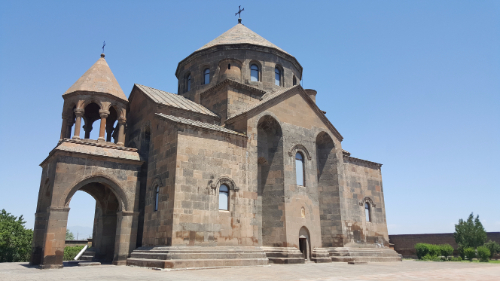
Saint Hripsime

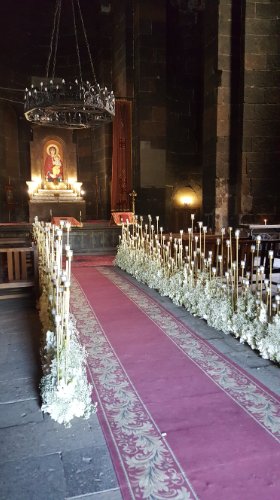
Finally, church #5 was St. Hripsime’s church. It’s definitely one of my favorites if you’re going off of exterior appearance, and the fact that it’s basically sitting on a pedestal probably helps. It makes the church seem so much more commanding because it’s raised up above the surroundings, and nothing is impeding your view of it. The inside was simple again, but very pretty. I think it was set up for a wedding or something because the aisle was lined with candles and flowers (Sarah and I approved… they looked nice). We popped our heads into the tomb to see the glass-encased stones and then high-tailed it out of there because it felt weird.

The candles are a nice touch, right?
This is from the back of the building, but you can get an idea of the mosaic work from the dome.

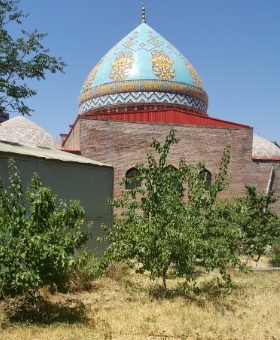
When we got back to Yerevan, we stopped by the Blue Mosque, the only active mosque in all of Armenia. It avoided the fate of other mosques because it was temporarily the History Museum of Yerevan. It seems like temporary repurposing is the only way that religious buildings make it through tumultuous times. We only snuck into the complex for a couple of seconds because it technically wasn’t visiting hours, but the mosaic work on the mosque is awesome.

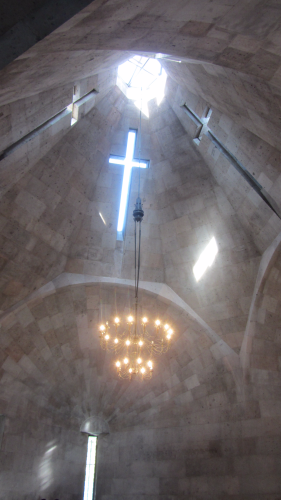
Last stop was St. Gregory the Illuminator Cathedral (yes, as in our BFF St. Gregory) which is the biggest Armenian church in the world. It was finished in 2001 for the 1700th anniversary of Christianity as the state religion of Armenia. It is massive, obviously, and very simple inside except for a crazy big chandelier that I didn’t feel comfortable taking a picture of at the time. I could probably go into more detail, but I’m exhausted just writing this, and I’m sure you’re exhausted reading it. Gosh, Armenia. You have too much history!

I don’t know that this picture conveys the scale or epic-ness of this church, but just trust me, it’s huge.

Congratulations, you’ve now virtually visited EVERY mosque in Armenia and six of the 1 bagazillion churches in Armenia. How does it feel?